Boeing Praised the Tanker Competition as Fair — Right Up Until It Lost
As Boeing prepared to protest the Air Force tanker award that promised an assembly line for Mobile, its own executives' and allies' past statements praising the competition's fairness came back into view.
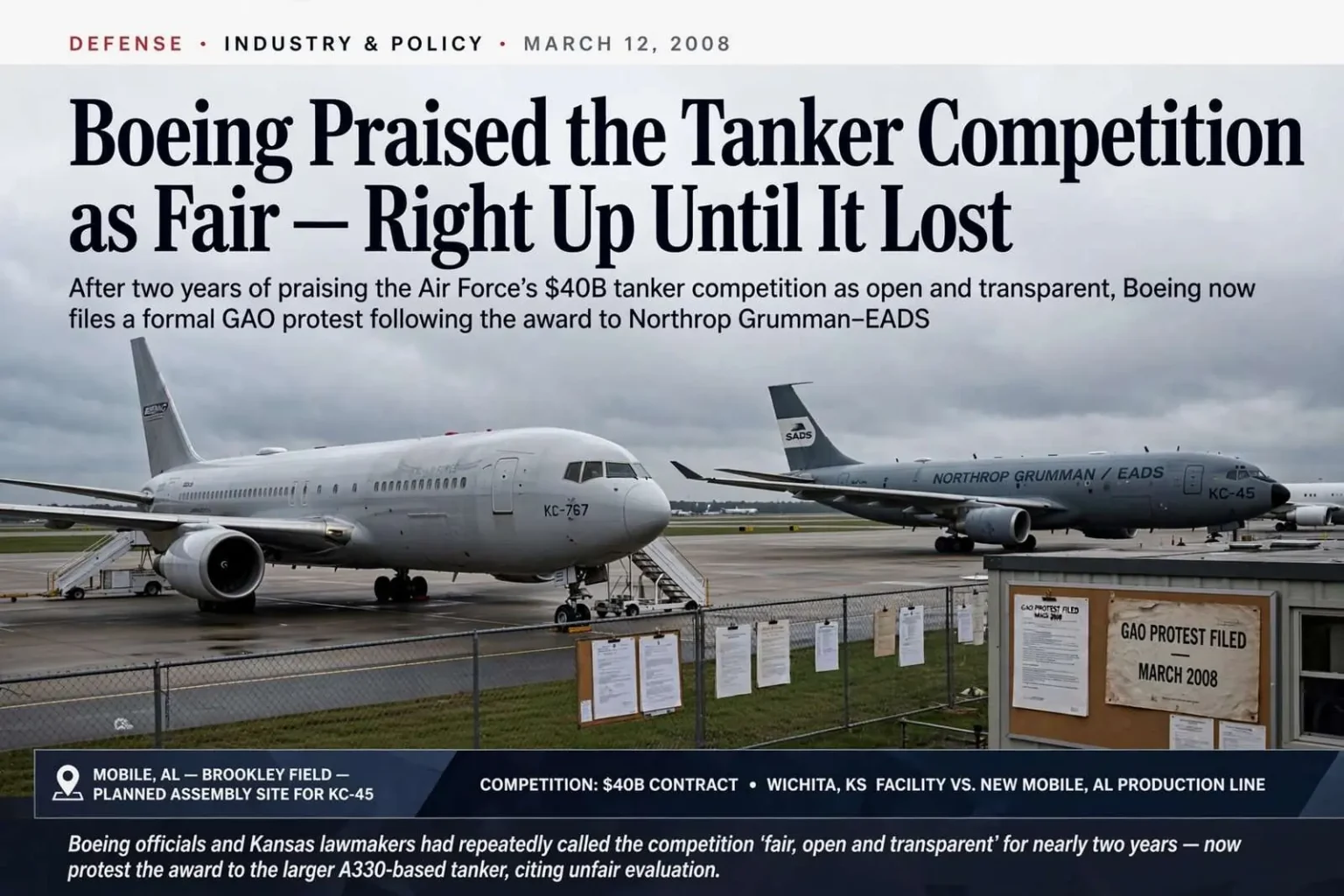
In the two weeks after the U.S. Air Force awarded its $40 billion aerial refueling tanker contract to the Northrop Grumman and EADS team — a decision that promised an aircraft assembly line at Mobile’s Brookley Field — Boeing and its congressional allies moved toward a formal protest, arguing the competition had been unfair. That argument sat awkwardly alongside a long public record. For nearly two years, the same company and the same officials had been saying, repeatedly and on the record, that the competition was open, fair and transparent.
The reversal matters less as a matter of campaign rhetoric than as a matter of substance. A protest before the Government Accountability Office turns on whether the Air Force followed its own rules — whether the evaluation was conducted as the solicitation promised — and the issuing of the solicitation, the conduct of the evaluation and the making of the award all happened while Boeing was praising the process. Any case built on the competition’s fundamental fairness has to explain away years of the protester’s own public confidence in it.
The record
Boeing’s vice president of tanker programs said in April 2007 that the company continued to have confidence the Air Force would run a fair and open competition. A day earlier he had gone further, expressing “extreme confidence” that the Air Force would continue a fair and open competition, praising the service for doing a great job, and saying he expected it to announce a winner so the program could move forward.
The same executive said Boeing had tailored its platform to the Air Force’s requirements rather than trying to tailor the requirements to its platform — a claim that would look different once the service concluded that the competing aircraft, built on a larger airframe, better met those requirements. In a protest, the question of whose proposal answered the requirements is the heart of the case, and Boeing’s own 2007 statement conceded that the requirements, not Boeing’s preferences, defined the contest.
In December 2007, a Boeing spokesman said the Air Force had clearly communicated with the company throughout the summer and fall — a statement that cuts directly against any later assertion that the company was blindsided by shifting or opaque ground rules. In January 2008, a former Air Force chief of staff working as a Boeing consultant observed that if a protest were to come, it would have to rest on something everybody already knew — “because it is so transparent.”
Congress echoed the company
Boeing’s supporters in Congress said much the same. A senator from Kansas commended the Air Force in October 2007 for conducting an open and fair competition, saying he had been nothing but impressed. Another Kansas senator said in February 2008 that it was “precisely because of the open nature of this competition” that he could confidently state Boeing had submitted a superior proposal.
The senators’ statements deserve their own reading. Saying a competitor’s proposal was superior “precisely because of the open nature of this competition” is a strange construction: it grants that the process was conducted openly while asserting confidence in a losing proposition. Both positions cannot easily survive the same argument. If the competition was open enough to reveal Boeing’s superiority to a careful observer, it is hard to claim the same openness rendered the outcome rigged when the evaluation went the other way.
Kansas’s stake in the rhetoric is no mystery. Boeing’s tanker work was historically anchored in Wichita, and generations of Kansas politicians of both parties had defended the company’s share of defense work as a matter of constituent employment. The same is true, in reverse, of politicians in Washington state, where the 767 airframe that underpinned Boeing’s bid was built. Congressional pressure on a $40 billion award was predictable the moment the contract was sized, and the protest that followed the award was being prepared in the open for months.
What is actually being protested
A GAO bid protest is a narrow instrument, whatever its reputation. The agency does not re-run the competition or substitute its judgment for the Air Force’s. It examines the evaluation record against the solicitation: whether the source selection followed the announced criteria, whether offerors were treated equally under them, and whether the stated rationale matches the documented analysis. Protesters win not by proving the outcome was wrong, but by proving the process deviated from its own rules in a way that could have affected the result.
That standard frames the awkwardness of Boeing’s position. The public record shows the company praising the clarity of the requirements, the quality of the Air Force’s communication and the transparency of the process at every stage before the award. The protest, to succeed, must find specific procedural defects in a process its own executives repeatedly endorsed — a narrower and harder path than the political argument that “the competition was unfair” suggests.
It also frames the stakes for the two bids themselves. Boeing’s offering rested on a 767-based tanker, smaller than the Northrop Grumman–EADS aircraft built on the A330 airframe. The Air Force’s solicitation emphasized capabilities that favor a larger tanker — more fuel, more cargo, more passengers carried on each mission. Boeing’s central strategic wager for two years had been that its platform could meet those requirements well enough to win on price and industrial-base arguments. When the award went the other way, the company faced a choice: accept a judgment that the rival’s larger aircraft better answered the mission, or attack the judgment itself. The protest is that second choice, made formally.
What the award meant for Mobile
The contract’s award to the Northrop Grumman and EADS team carried a promise with particular weight in Alabama: assembly of the tanker — designated the KC-45 by Northrop — at Mobile’s Brookley Field, inside converted hangars that EADS had already built out for the failed 2007 bid at the same work. A $40 billion program with a production line on Mobile Bay would rank among the largest industrial projects in the state’s history, employing thousands directly and drawing a supplier network across the Gulf Coast.
The Mobile bid’s logic had always rested on the same facts the evaluation favored. The A330 airframe on which the Northrop–EADS tanker was built is larger than the 767, with more volume for fuel and cargo, and it is in current production with a worldwide fleet and support network. The decision to assemble the aircraft in Mobile — rather than fly in completed airframes — was itself part of the political case for the win, appealing to congressional pressure for American production and creating the unusual circumstance of a European airframe built on Alabama soil.
Which is why the protest, wherever it lands, will be felt here first. A GAO decision to sustain Boeing’s protest would freeze work on the Mobile line while the Air Force re-examined its evaluation; a denial would clear the way for construction and hiring on the site that civic leaders have spent years preparing. The two-week window since the award has already seen the arguments framed in precisely those terms: jobs in Washington and Kansas versus jobs in Alabama, an old supplier versus a new one, and a competition whose fairness everyone praised until the day it ended.
The longer arc of the tanker saga
The tanker program’s history made controversy almost inevitable. The Air Force has flown its fleet of Eisenhower-era KC-135s for half a century, and every effort to replace them has stumbled: the lease-and-buy proposal that collapsed in scandal in 2004 sent executives to prison and forced the service to begin again from zero. The 2007 competition was the restart — conducted, by all accounts at the time, with elaborate care to avoid repeating the old scandals, which is why so many officials on both sides spent two years praising its integrity.
That history also explains the emotion now attached to the result. For Boeing, losing the tanker after the procurement scandal that punished its own company was more than a lost contract; it was a referendum on the argument that the work should stay with the incumbent. For the Air Force, the award was meant to prove the service could run a clean competition to its conclusion. And for Mobile, the award was the second act of a decade-long campaign to turn a closed Air Force base into an aerospace manufacturing center — a campaign that survived the loss of the tanker bid in 2004 and built toward this program’s arrival.
The next milestone is the GAO’s ruling on the protest, expected within the agency’s statutory 100-day window. Whatever it decides, the record that accompanies the decision will include the same quotations that now seem so inconvenient: two years of the losing side’s own words, praising a competition it had every reason to believe it would win, right up until it didn’t.