Will Delta’s Simplified Fares Finally Reach Mobile? The Airport’s Marketing Chief Explains
After Delta announced it would take its simplified-fare experiment nationwide in January 2005, Mobile Airport Authority marketing chief Marc Pelham explained what cheaper tickets would mean for local travelers.
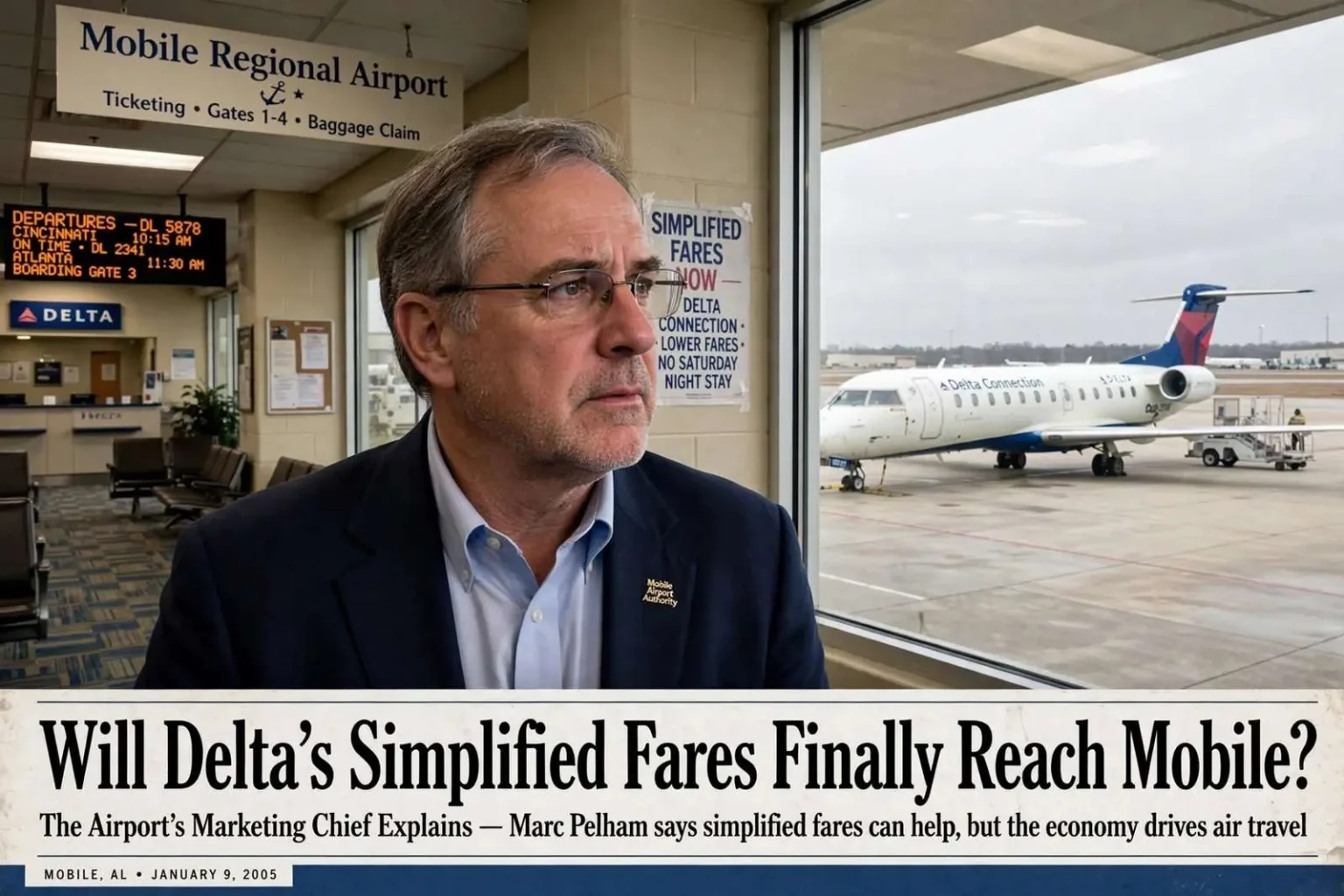
MOBILE — For years, travelers leaving Mobile faced a familiar and unwelcome piece of arithmetic: drive an hour and a half east to Pensacola, or pay a great deal more to fly out of home. In early January 2005, Delta Air Lines announced it would expand nationwide a simplified-fare experiment that had already produced cheaper tickets and rising passenger traffic at one of its major hubs. The move promised to reshape fare competition across the industry — and raised an obvious question in South Alabama. Marc Pelham, marketing chief for the Mobile Airport Authority, was asked what it meant for Mobile Regional Airport. His answers were more measured, and more interesting, than the hopeful headline suggested.
Not a Low-Fare Carrier, but Lower Fares
Pelham was careful not to oversell. “It doesn’t guarantee the same fares as Pensacola,” he said. “And it doesn’t help carriers cut costs and become profitable. But it means we have great fares from our dominant carrier with global service. It means all other carriers will have to match. And it takes fares off the table as a major issue.” That last point was the one he pressed hardest. The conventional wisdom in Mobile had long been that fares drove air travel — that if the airport could just get the price down, the passengers would come. Pelham disagreed. “Contrary to conventional wisdom, fares don’t drive air travel, the economy does,” he said. “And that turned up last summer. More passengers means more service. That’s what we need.”
What Actually Changed
Pelham argued that the most consequential parts of Delta’s restructuring were not the headline fares at all. Elimination of the Saturday-night stay requirement. For years, the cheapest fares out of Mobile were available only to travelers willing to remain at their destination over a Saturday night — a rule that effectively priced business travelers out of the discount market. Halved business fares. The reduction in unrestricted, last-minute pricing mattered more to the airport’s core demographic — corporate travelers, government contractors, and military personnel commuting between Mobile and Washington, Atlanta, or Houston — than any leisure fare. One-way pricing. The ability to book one-way tickets at half the round-trip price removed a penalty that had discouraged multi-city itineraries and open-jaw trips.
Delta’s simplified fare structure, rolled out first at its Cincinnati hub in 2004, replaced the traditional 15-20 fare buckets with a streamlined four-tier system: unrestricted first class, unrestricted coach, restricted coach with 21-day advance purchase, and restricted coach with 7-day advance purchase. It eliminated the complex yield management rules that had made fare shopping a guessing game.
The Cincinnati experiment had increased passenger traffic by 20 percent while maintaining revenue per passenger mile, suggesting that transparency and simplicity could grow the pie rather than just redistribute it.
The Competitive Landscape
Mobile Regional Airport in 2005 was served by Delta (via its Delta Connection carriers to Atlanta and Cincinnati), Continental Express to Houston, Northwest Airlink to Memphis, and US Airways Express to Charlotte. Delta was the dominant carrier by frequency and destination reach, with Atlanta — the world’s busiest hub — providing global connectivity. Pelham’s point about “all other carriers will have to match” reflected the reality that fare leadership at a spoke airport typically comes from the dominant carrier, and competitors follow or lose share. The airport’s challenge was that its market was bifurcated: business travelers who valued schedule and connectivity over price, and leisure travelers who drove to Pensacola for price.
The Pensacola comparison was unavoidable. Pensacola’s airport, owned by the City of Pensacola, had aggressively courted low-cost carriers — AirTran, Southwest (which acquired AirTran in 2011), and later Frontier and Spirit. Mobile Regional, owned by the Mobile Airport Authority, had focused on retaining and expanding legacy carrier service. The two strategies reflected different assessments of the market: Pensacola bet on stimulation through low fares; Mobile bet on retention through network access. Delta’s simplified fares blurred the line, offering legacy-carrier network access at prices that approached low-cost carrier levels on selected routes.
The Mobile Airport Authority’s Strategy
The Mobile Airport Authority, created by the Alabama Legislature in 1980, operates both Mobile Regional Airport and the Brookley Aeroplex — the former Brookley Air Force Base, converted to an industrial and aviation complex. The authority’s dual mandate — commercial air service at Mobile Regional and economic development at Brookley — gave it a unique revenue base. Brookley’s tenants, including Airbus’s A320 final assembly line (announced in 2012, operational by 2015), ST Aerospace, and numerous defense contractors, generated lease revenue that subsidized airport operations and marketing. This structure allowed the authority to take a longer view on air service development than airports dependent solely on passenger facility charges and concession revenue.
Pelham’s marketing role focused on the demand side — convincing travelers that Mobile Regional was a viable option and convincing carriers that Mobile was a market worth serving. The authority’s air service development efforts had secured the Delta Connection service to Cincinnati (later discontinued when Delta closed the Cincinnati hub) and worked to maintain the Atlanta frequency that was the airport’s lifeline. The simplified fare rollout was, in Pelham’s view, a demand-side win that required no capital investment from the airport — just the market power of the dominant carrier doing what the airport had been asking for years.
Economic Context and the 2005 Outlook
The interview with Pelham took place against a backdrop of economic transition in Mobile. The region’s traditional economic pillars — shipbuilding (Austal USA, BAE Systems), paper (International Paper, Georgia-Pacific), chemicals (Olin, BASF), and the military (Naval Air Station Meridian, Coast Guard Aviation Training Center) — were stable but not growing rapidly. The Airbus announcement was still seven years away. The mobile economy of 2005 was driven by government spending, healthcare, and the port. The “economy drives air travel” thesis that Pelham advanced meant that air service would follow the region’s economic trajectory, not lead it. Lower fares could capture existing demand but couldn’t create new demand where the underlying economy didn’t support it.
This was a contrarian view in an industry where airports routinely promised that a new low-cost carrier would transform their market. Pelham had seen the pattern: a carrier enters with low fares, stimulates traffic for 12-18 months, then either raises fares or exits when the market proves insufficient. Mobile Regional had seen carriers come and go — Pan Am, Eastern, Continental mainline, American Eagle. The authority’s strategy was to build a stable base of legacy carrier service that could weather industry cycles, supplemented by targeted incentives for new entrants where the business case existed.
The Long View: From 2005 to the Present
In retrospect, Delta’s simplified fare rollout was a transitional moment in an industry that was about to undergo consolidation on a massive scale. Delta merged with Northwest in 2008. Continental merged with United in 2010. US Airways merged with American in 2013. The four-carrier landscape at Mobile Regional in 2005 — Delta, Continental, Northwest, US Airways — collapsed into three legacy giants plus Southwest (which entered Pensacola via AirTran but has never served Mobile Regional). The simplified fare structure itself was eventually subsumed into the dynamic pricing algorithms that now govern airline revenue management, where fares change by the minute based on demand signals, competitor pricing, and machine learning models.
Mobile Regional Airport today is served by Delta (to Atlanta), American (to Charlotte and Dallas-Fort Worth), and United (to Houston and Denver). The Cincinnati service is gone. The Memphis service is gone. The Atlanta frequency remains the anchor. The Pensacola comparison persists — Pensacola has Southwest, Frontier, Spirit, and Breeze alongside the legacy carriers, and its fares are still often lower. But Mobile Regional has held its ground, with passenger enplanements hovering around 300,000-350,000 annually pre-pandemic, and the Airbus facility at Brookley has become the economic engine the authority bet on.
Pelham’s Legacy and the Current Challenge
Marc Pelham retired from the Mobile Airport Authority in 2018 after a 25-year career. His “economy drives air travel” philosophy continues to inform the authority’s approach under current leadership. The current challenge is different from 2005: the pandemic reshaped business travel, remote work reduced the Monday-Thursday corporate shuttle traffic that sustained high-yield fares, and leisure travel has rebounded faster than business travel. The authority is now pursuing low-cost carrier service more aggressively — talks with Breeze, Avelo, and Allegiant have occurred — while maintaining the Delta and American relationships that provide the network connectivity Pelham valued.
The fundamental arithmetic Pelham described in 2005 — drive to Pensacola or pay more to fly from Mobile — still confronts South Alabama travelers. But the gap has narrowed. Delta’s simplified fares, the subsequent industry consolidation, and the rise of ultra-low-cost carriers at Pensacola have created a more complex competitive landscape. The airport authority’s job, as Pelham saw it, was not to win a fare war but to ensure that Mobile had the air service its economy warranted — no more, no less, and at a price the market would bear.