Proposal Would Raise Mobile’s Minimum Wage to $10.10 an Hour
State Rep. Napoleon Bracy's proposal would push Mobile's minimum wage up to $10.10 an hour, well above the current federal floor of $7.25 an hour.
A Local Wage Floor Above the Federal Line
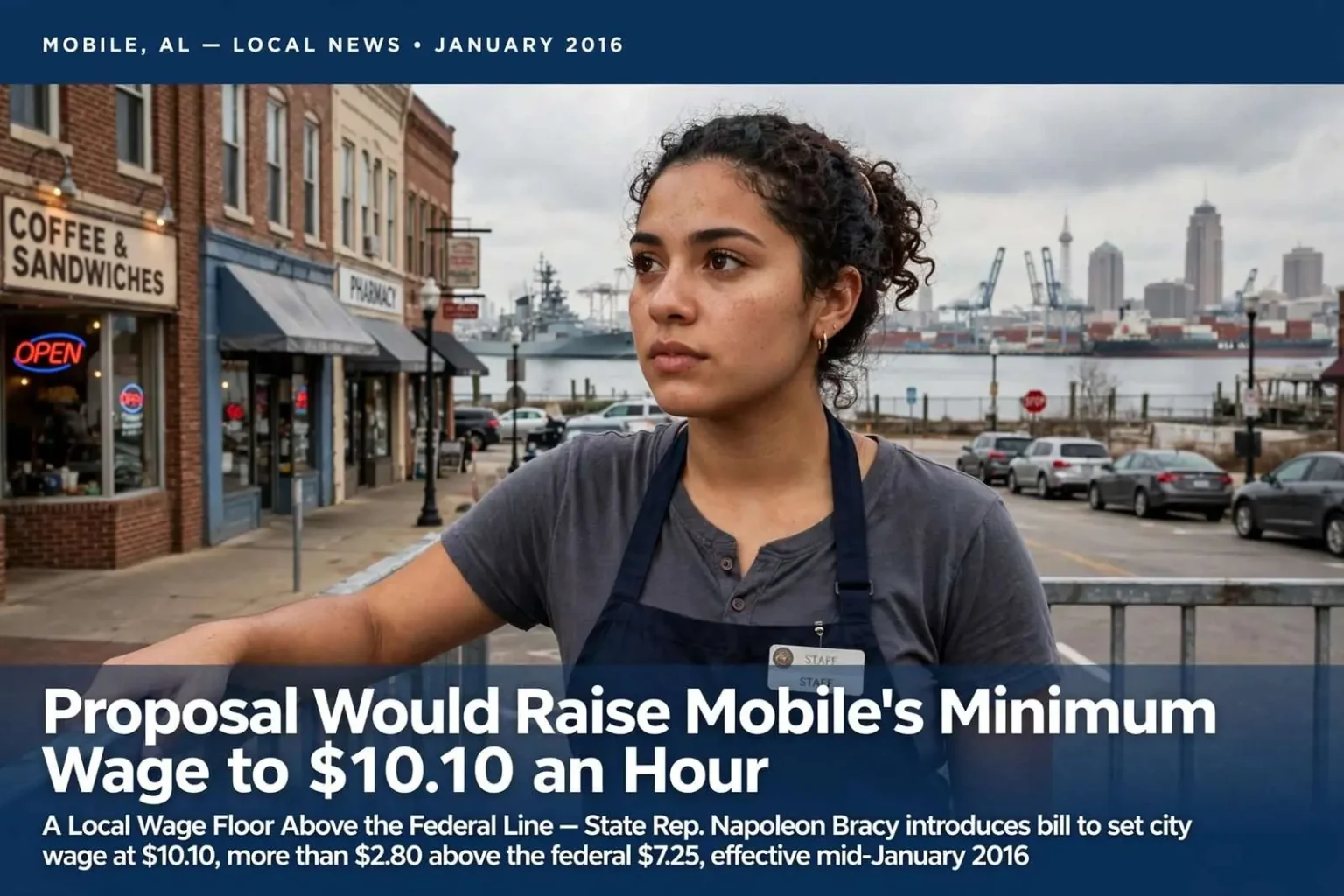
State Rep. Napoleon Bracy has introduced legislation that would raise the minimum wage within the city of Mobile to $10.10 an hour, more than $2.80 above the current federal floor of $7.25. If passed, the increase would take effect in mid-January 2016 — a timeline that would put Mobile ahead of both the state and the nation, since Alabama sets no minimum wage of its own and defaults to the federal rate.
The $10.10 figure was no accident. It matched the number congressional Democrats and the White House had pushed to set as the new federal minimum — a proposal that had stalled in Washington — which meant the Mobile bill would effectively import the national debate’s central number into a single city’s borders.
The gap between the two wage levels is significant in real terms. A worker earning the federal minimum for 40 hours a week brings home about $15,080 a year before taxes, compared to roughly $21,008 a year under the proposed local rate, a difference of nearly $6,000 annually — a sum that approaches a couple of months’ rent for many Mobile households.
With one-bedroom apartments in the Mobile area commonly renting for $600 to $900 a month, housing alone can consume close to half of a minimum-wage worker’s annual income even at the lower end of that range, leaving relatively little for food, transportation, utilities and other basic expenses. At the proposed $10.10 rate, the same rent would consume a meaningfully smaller share, though still a substantial one.
The federal minimum has stood at $7.25 since 2009, which means every year of intervening inflation has quietly cut its purchasing power. For workers at the bottom of the pay scale, the erosion shows up in the same arithmetic every month: the paycheck stays flat while rent, groceries and utilities climb, and the distance between earnings and expenses widens without anyone voting to make it so.
Who Earns the Minimum
Nationally, according to data from the Pew Research Center, workers earning at or below minimum wage skew young, with about half between the ages of 16 and 24. Roughly 3.3 million people nationwide earn at or below the federal minimum, and about 77 percent of them are white, with white women making up roughly half of that group.
Most minimum-wage earners work part time, and food service and preparation jobs account for a large share of the total. The profile matters for any policy discussion: a wage floor touches a workforce made up largely of young workers, part-timers and restaurant employees, which shapes both who benefits from an increase and which businesses feel it first.
Alabama’s share of workers earning minimum wage, at 6.3 percent, runs higher than the national norm. In a state with no wage floor of its own and a cost of living lower than the national average, the federal minimum does more of the work of an actual minimum wage — and its limitations show up more directly in household budgets.
Mobile’s economy adds its own texture to the debate. The city’s employment base runs through the port, manufacturing, healthcare, retail and the tourism drawn to the Gulf Coast, and the jobs most likely to pay at or near the minimum — restaurants, hotels, retail counters — cluster exactly where tourists and downtown workers spend their money. A higher local wage would flow through those registers on both sides: as a cost to employers and as additional spending power for workers who spend nearly everything they earn locally.
Questions a City-Level Raise Raises
Bracy’s proposal would apply specifically within Mobile city limits rather than statewide, raising questions among local business owners and employees alike about what a local wage floor would mean for hiring, prices and competitiveness with surrounding jurisdictions that would remain under the lower federal rate. A business sitting just outside the city line could pay $7.25 where its competitor across the boundary paid $10.10 — an asymmetry that both supporters and opponents of the bill acknowledged would shape real decisions.
It also raises the question of whether businesses would feel pressure to raise pay for workers already earning above minimum wage in order to preserve pay differentials. A shift supervisor earning $10 an hour gains little from a wage floor set just above that line, and employers who want to keep the distance between crew and management will have to fund it — a ripple effect that pushes the true cost of a minimum-wage increase well beyond the workers it directly covers.
Supporters of city-level action argued the alternative was waiting on a state or federal fix that had not arrived. Alabama’s Legislature had shown little appetite for raising the state’s wage floor, and Congress had not raised the federal rate in years, leaving cities weighing what they could do within their own borders. Whether Mobile could legally set a wage floor at all — and how a local ordinance would survive court challenge — was among the questions the bill would have to answer on its way through the Statehouse.
The bill’s prospects in the Alabama Legislature remain uncertain, and no committee vote had been scheduled at the time the measure was filed. That procedural limbo is where most member-introduced bills in the Statehouse spend their lives, and a local wage mandate — a concept with few friends in a Legislature skeptical of both regulation and local autonomy — faced an uphill path even before the policy debate began in earnest.
The debate over who should set wage policy was already familiar terrain nationally. Cities including Seattle, San Francisco and Chicago had moved to establish local minimums above their states’ rates, and courts and legislatures elsewhere were sorting out where municipal authority ended. For Alabama’s cities, the question was whether a state that preempts aggressively would allow a local wage experiment to stand, or whether the first city to try would trigger a statewide response.
For Mobile workers, the math was the most concrete part of the debate. An extra $6,000 a year is the difference between a car that runs and one that doesn’t, between renting alone and doubling up, between a dental problem handled and one deferred. Opponents saw the same arithmetic from the employer’s side — the same $6,000 per full-time worker, multiplied across every minimum-wage position on a payroll, at margins that in food service often run thin.
Economists lined up on both sides of the broader question of employment effects, as they have for decades. Research on past minimum-wage increases has found everything from modest job losses to no detectable effect, depending on the market studied and the size of the increase, and the honest summary is that outcomes depend on local conditions — how tight the labor market is, how much pricing power businesses have, and how workers and employers adjust on both sides of the ledger.
What was not in dispute was the direction of the underlying trend. The federal minimum had not moved since 2009; bills to raise it nationally had stalled; and state legislatures across the South had declined to fill the gap. That left the field to cities willing to test their authority — and left Mobile’s minimum-wage workers waiting on a bill in Montgomery that, as of its filing, had not yet found a committee willing to give it a hearing.
Bracy, whose district includes communities in Mobile County just north and west of the city, framed the issue in the terms that define most local wage debates: workers who live in his district but work in low-wage jobs across the area, and families whose incomes fall short of the rent those same communities charge. A wage floor inside Mobile’s city limits would not reach every worker in the county, but it would reach a large share of the region’s lowest-paid jobs.
The practical mechanics of enforcement would have mattered as much as the number itself. A city-level wage floor requires some mechanism for checking compliance — complaints, records, penalties — since workers earning below a local minimum are unlikely to report it if enforcement depends entirely on their initiative. Any Mobile ordinance would have needed an enforcement design, and a budget for it, before the first paycheck reflected the new rate.
The tipped workforce added a further wrinkle. Restaurant servers and bartenders occupy their own corner of wage law, with a lower base cash wage permitted when tips bring earnings up to the minimum, and any local increase would have to decide how tips fit into the calculation. Mobile’s tourist-season restaurants, busy from spring through Mardi Gras, employ a substantial share of the workers a wage floor would touch.
For younger workers — half of the minimum-wage workforce nationally is between 16 and 24 — the debate lands differently than it does for heads of household. Some are students and first-job earners for whom $7.25 is an entry point; others are adults supporting families on part-time service wages, and the same floor that one group treats as a starting rung the other experiences as a ceiling. Any single number has to serve both.
The bill’s fate would ultimately rest in Montgomery, where a proposal to lift wages inside one city’s borders sat uneasily with a Legislature that guards statewide uniformity closely. Until a committee granted it a hearing, the $10.10 proposal remained what most member bills are: a statement of priorities, a marker of a debate the city’s workers were already living, and a number that gave Mobile’s minimum-wage workers something specific to measure any future proposal against.