Mobile Radio Station’s St. Jude Radiothon Aims to Help Local Families
A Mobile radio station's two-day St. Jude radiothon aims to support roughly 55 Mobile and Baldwin county children receiving hospital treatment.
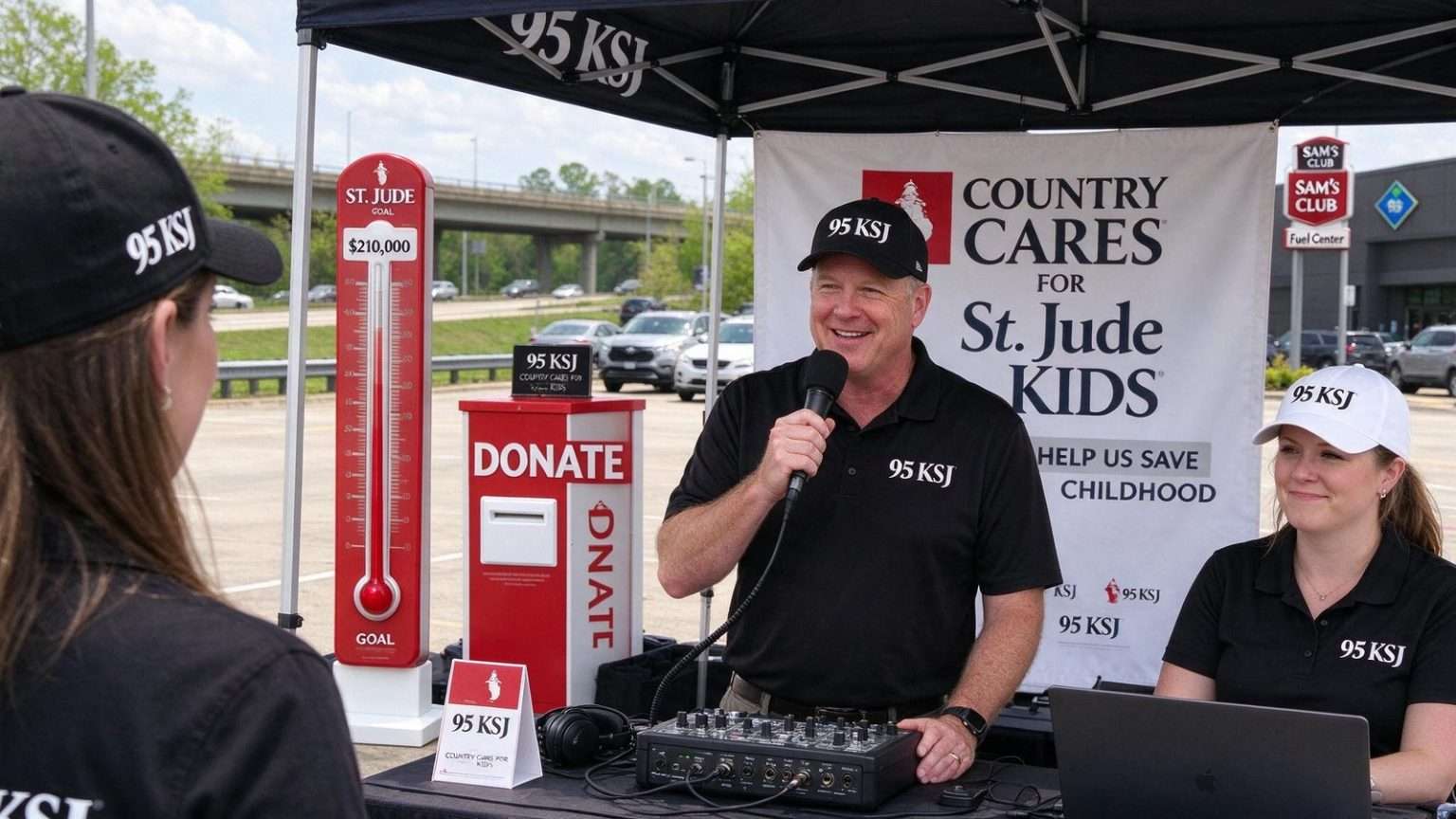
A local radio tradition returned to Mobile this week as station 95 KSJ kicked off its annual Country Cares for St. Jude Kids radiothon, a two-day fundraising push that has become a springtime fixture for South Alabama listeners.
The radiothon, which airs live from a remote broadcast tent set up outside the Sam’s Club on the eastern service road of Interstate 65, asks listeners to call in pledges directly to support St. Jude Children’s Research Hospital in Memphis.
Station personality Bill Black, who has anchored the event in past years, said the campaign exists almost entirely because of small-dollar donors.
“The real goal is raising money for the hospital,” Black said, noting that more than three-quarters of St. Jude’s funding comes from private donations rather than government support or patient billing.
That funding model is what makes radiothons like the one KSJ stages each year more than a gesture. St. Jude operates on a scale few medical institutions can match — research and treatment running side by side — and it does so while declining to bill the families it serves. Families whose children are treated at St. Jude are never charged for medical care, travel, housing or food, a policy the hospital has maintained since it opened in the 1960s. Every dollar of that guarantee has to come from somewhere, and contributors along the Gulf Coast are part of the answer.
For South Alabama, the stakes are personal. Black said roughly 55 children from Mobile and Baldwin counties are currently receiving treatment through St. Jude’s network, a number that underscores why local radio stations continue to devote air time to the cause year after year. Many of those families travel back and forth to Memphis for treatment, and radiothon organizers say local pledges help offset the broader costs of keeping that pipeline of care free for every family who needs it.
How the pledge model works
Listeners are encouraged to donate by phone or online, with the option to become a “Partner in Hope” — a recurring pledge of $20 a month for at least a year. Organizers say the recurring-donation model gives the hospital predictable funding it can plan around, rather than relying solely on one-time gifts during the broadcast window.
“We feel like a lot of people can afford to make that pledge,” Black said. “It won’t put a personal strain on their budget, and it will go a long way toward helping the hospital survive.”
The math behind the Partner in Hope pitch is straightforward. Twenty dollars a month adds up to $240 over a year — an amount most households can absorb without strain, but which multiplied across thousands of listeners becomes a meaningful, continuing revenue stream for the hospital. Recurring gifts also smooth out the fundraising calendar: a hospital that can count on pledged monthly income can budget for research programs and treatment capacity with more confidence than one living on unpredictable windfalls.
Phone pledges during a radiothon also serve a purpose beyond the money. Each call read on the air becomes part of the broadcast itself, turning individual generosity into a public narrative that encourages the next caller. Radio fundraisers have always run on that dynamic, and a country music station’s audience — built on community, family and loyalty — is a natural fit for it.
The timing of a springtime event matters as well. By holding the radiothon in this window, the station reaches listeners before summer and the vacation season pulls attention in other directions, and it spaces the appeal a sensible distance from the year-end campaigns that dominate charitable giving. A spring tradition also gives the hospital community in South Alabama a rhythm — schools, civic clubs and businesses that support the cause know when the call will come and can plan their participation around it, whether that means matching employee pledges, organizing collection drives or simply marking the calendar to call in.
A two-day broadcast with a local track record
Last year’s radiothon brought in $210,000 for the hospital, according to station organizers, a total they hope to match or exceed with this year’s two-day push.
A half-million-dollar window over consecutive years would rank KSJ among the region’s most productive community fundraisers, and the figure illustrates why hospitals and broadcasters alike continue to invest in the radiothon format. For the station, the event has become a signature of its identity in the market — a station that does more than play country music, and that its listeners associate with a cause bigger than the playlist. For St. Jude, coast-to-coast events like the Country Cares program aggregate thousands of local efforts into the private funding base the hospital depends on.
The broadcast coincides with continued fundraising tied to the St. Jude Memphis-to-Mobile relay run, an annual event that channels runners and cyclists along a multi-day route benefiting childhood cancer research.
The relay gives the radiothon a visible thread connecting Mobile to the Memphis hospital itself. Runners and cyclists carry the cause down the route in stages, and by the time they reach the Gulf Coast, the story has accumulated the momentum of every community along the way. For listeners hearing the relay covered on air while the radiothon takes pledges outside a Sam’s Club, the distance between South Alabama and the pediatric hospital in Memphis is made to feel short.
Community fundraising efforts like the radiothon have long been part of the fabric connecting Mobile and Baldwin county families to the Memphis hospital, giving neighbors a direct, tangible way to support children undergoing cancer treatment and other serious illnesses without ever leaving home. With roughly 55 local children in treatment through the St. Jude network at any given time, many listeners are donating with neighbors in mind, not strangers.
The families themselves become part of the story the station tells on air. Parents who have made the drive to Memphis understand better than anyone what the no-charge policy means in practice — no bill for the treatment, none for the apartment, none for the meals that keep a family together during the hardest stretch of its life. When those stories surface during a radiothon, the $20-a-month ask stops being an abstraction, and the phones at the broadcast tent ring accordingly.
The scene on the service road
Organizers say the response from Sam’s Club shoppers and passersby during the broadcast window is typically strong, with cars lining up along the service road to drop off pledges in person.
The remote location is a deliberate choice. Interstate 65 carries traffic from Mobile to the state line and beyond, and a Sam’s Club parking lot offers a steady cross-section of the station’s audience — families running errands, small business owners picking up supplies, commuters passing through. Setting up the broadcast tent in front of that traffic puts the fundraiser where the community actually is, and lets donors see the station’s personalities working the event in person rather than hearing an abstract appeal from the studio.
Live remote broadcasts of this kind are among the oldest tools in radio, and they still work because they are communal in a way a website never is. Shoppers stop by between errands. Volunteers staff the phones. The pledge totals climb on a board where passersby can read them. Children who came through St. Jude’s program are often part of such events, giving donors a face to attach to the cause. The two-day format builds its own momentum, with each hour’s total becoming the target the next hour tries to beat.
Why the hospital needs the help
St. Jude’s no-charge policy dates to founder Danny Thomas’ vision for the hospital, and it has defined the institution for more than half a century. Families facing a child’s cancer diagnosis arrive in Memphis without the additional weight of insurance battles, travel costs or housing expenses, and the hospital’s supporters nationwide are the reason that promise holds. More than three-quarters of the operating budget — the figure Black cited on air — comes from the kinds of contributions a Mobile radiothon generates, which places South Alabama donors squarely inside the hospital’s survival model.
The research mission adds to the cost. St. Jude’s work extends beyond treating the children who walk through its doors to sharing its findings with hospitals around the world, so that breakthroughs made in Memphis improve survival rates everywhere. That broad ambition is precisely what requires the steady, predictable funding that recurring pledges and annual radiothons provide — and why organizers describe the goal in terms of the hospital’s long-term survival rather than a single year’s total.
The station plans to continue similar remote broadcasts in future years, tying the on-air appeal to a specific, visible location so residents can see where their donations are being collected in real time. For the families in Mobile and Baldwin counties whose children depend on the Memphis hospital, the two-day broadcast is more than a radio tradition — it is the community’s annual proof that the pipeline of care between the Gulf Coast and Tennessee is something local donors themselves keep open.