Mobile City Council to Weigh Push for New National Historic Districts
Mobile's City Council will consider paying a preservation consultant to seek national historic status for three city neighborhoods and corridors.
Mobile’s City Council is set to consider a resolution that would fund an effort to add two new historic districts to the National Register of Historic Places and expand a third, a move city leaders say could bolster ongoing redevelopment efforts downtown and in nearby neighborhoods. The proposal arrives at a moment when Mobile’s administration has been pushing a broader agenda of reinvestment in the city’s historic core, where blocks of 19th-century buildings stand as the city’s most distinctive asset and, city officials hope, a foundation for its economic future.
The resolution would pay preservation consultant Shaun Wilson $30,000 to prepare the applications needed to seek the federal designation. National Register nominations are meticulous documents, requiring architectural surveys, boundary maps, photographs and written arguments establishing a district’s historical significance, and the work of preparing them is typically done by consultants who specialize in the process. Wilson’s contract covers applications for the new districts as well as an expansion of an existing one.
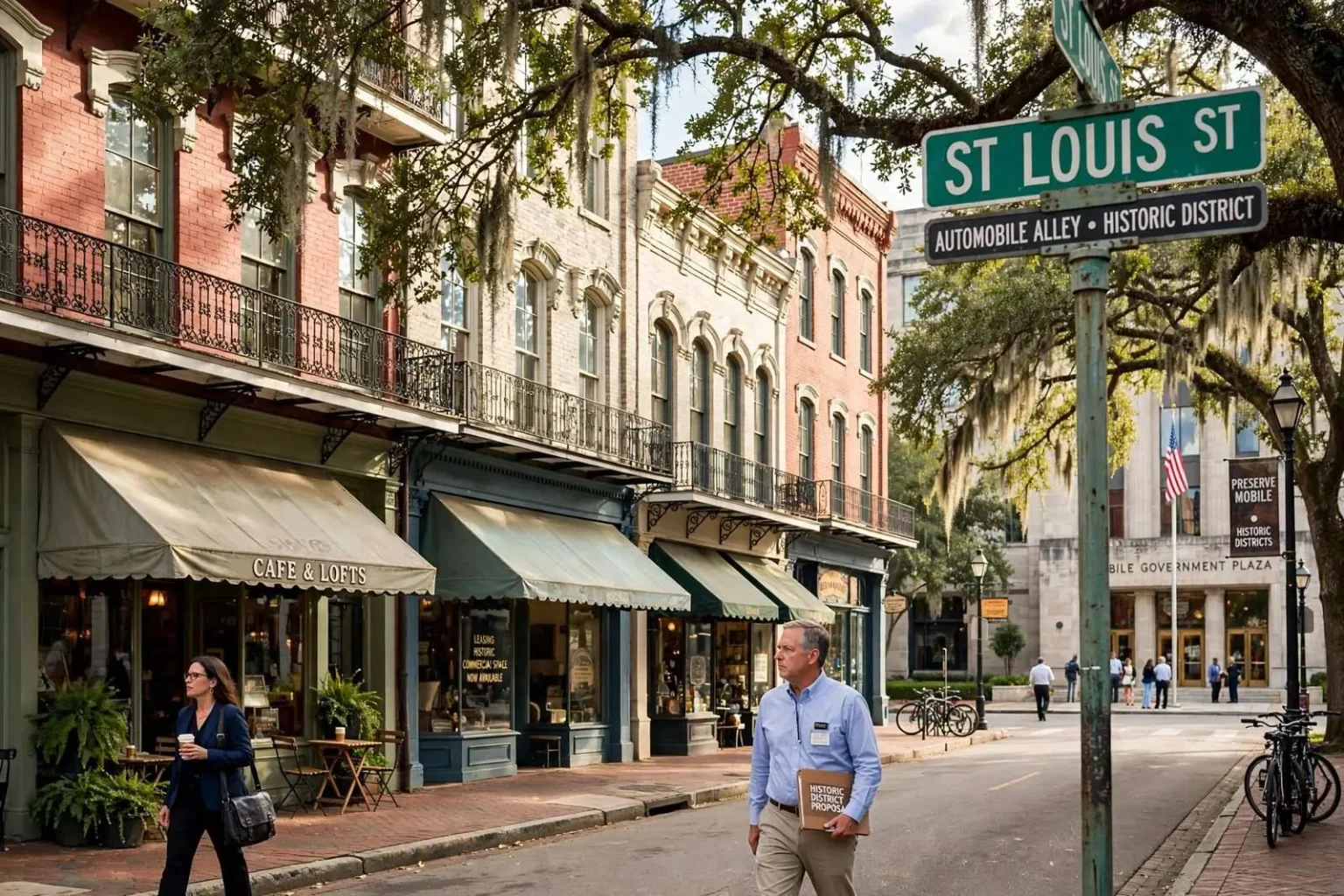
If both the council and federal reviewers sign off, the recognition would extend to the stretch of St. Louis Street downtown once known as “Automobile Alley,” the Texas Hills neighborhood south of the Oakleigh Garden Historic District, and an expanded version of the Church Street East Historic District. Each of the three areas tells a different chapter of Mobile’s story, from the commercial strip that sold cars to a generation of Mobilians to a historically Black neighborhood whose housing stock is among the most historically significant in the city.
The agreement would also direct Wilson to survey the Lewis Quarter area and add the Lafayette Heights Historic District to the city’s existing list of recognized historic neighborhoods, according to details of the proposal. Those steps represent the early groundwork of future nominations, mapping the boundaries and documenting the resources that would support a National Register case in a later round. Building a district inventory in stages is standard practice for cities that have more eligible neighborhoods than they can document at once.
Preservation consultants like Wilson occupy a specialized niche in the planning world, combining architectural history, documentation standards and the practical politics of persuading neighborhoods and property owners that designation serves them. A $30,000 contract covering multiple nominations and a survey represents a concentrated burst of that work, and cities that maintain a steady pipeline of nominations tend to accumulate federal designations the way Mobile’s neighbors in New Orleans and Pensacola have over the decades.
A City Already Rich in Districts
Mobile already recognizes ten historic districts locally, including Leinkauf, Midtown, Lower Dauphin Street, Old Dauphin Way, DeTonti Square, the Campground, Oakleigh and Church Street East, but not all of those carry the federal designation that comes with placement on the National Register. The gap between local recognition and federal listing matters in practical terms, and the resolution is designed in part to close it, bringing the city’s official map of historic places into alignment with the areas that qualify for federal benefits.
The distinction between the two systems is worth understanding. Local historic districts, established through the city’s own preservation rules, give the city’s architectural review boards authority over exterior changes to contributing buildings, a regulatory power that can protect character but also imposes obligations on property owners. National Register listing, by contrast, is honorific at the federal level, and city preservation officials note that National Register status does not restrict private property owners the way local historic district rules can.
What the federal designation does provide is access. Placement on the National Register makes buildings within the boundaries eligible for federal historic rehabilitation tax credits, a detail that has made the designation attractive to property owners considering renovation projects in older commercial corridors. Supporters say national recognition for the districts could open the door to additional preservation grants and tax incentives tied to historic rehabilitation, tools that have helped fund restoration work in other Mobile neighborhoods in recent years.
For developers and owners weighing a renovation against a demolition, those incentives can be decisive. Historic tax credits are calculated on qualifying rehabilitation expenses, and in commercial corridors like downtown Mobile they have repeatedly converted marginal buildings into profitable projects that might otherwise have stood empty or come down for parking. Every building saved through that arithmetic strengthens the case the city has been making for its historic fabric.
The Neighborhoods in Question
The resolution is sponsored by Mayor Sandy Stimpson and Councilman Levon Manzie, and ties into a broader push by the administration to reinvest in older sections of the city. The pairing of a mayor and a councilman whose districts include some of the areas affected signals that the effort has support both at City Hall and in the neighborhoods themselves, which has historically been essential for preservation initiatives that require resident buy-in to succeed.
A new historic marker for the St. Louis Street corridor and the Texas Hills community would complement other redevelopment work already underway in those areas. Historic markers cost little but do quiet work, anchoring a neighborhood’s story in public view and giving newcomers and visitors a reason to look twice at streets they might otherwise pass through. In redevelopment planning, the signage is often paired with streetscape improvements and housing programs aimed at stabilizing the surrounding blocks.
City officials have separately discussed converting “Auto Alley,” named for the strip of car dealerships that once lined the corridor, into a technology hub and business park. The idea of turning a strip of aging commercial buildings into a home for technology companies follows a pattern that has worked in other mid-sized cities, where incubator space in historic buildings has attracted startup activity at rents the downtown market struggles to match. The National Register nomination would give the corridor’s buildings access to rehabilitation credits that could underwrite such conversions.
The St. Louis Street corridor’s history as Automobile Alley reflects a specific moment in the city’s commercial past, when the automobile arrived in Mobile and dealerships lined the downtown street closest to the government street gate. The buildings they left behind, with wide openings and deep showrooms, have proven adaptable to the kind of loft office and commercial conversions that technology tenants favor, which is part of why planners see the tech hub concept as more than wishful thinking.
Community response has historically been the variable that determines whether these designations succeed. Property owners sometimes fear that historic recognition is a first step toward local regulation, and preservation staff have made a point of explaining that National Register listing carries no design restrictions of its own. In neighborhoods like Texas Hills, where revitalization planning is already underway, the conversation about what residents want the future to look like is happening alongside the technical work of documentation.
The Lower Dauphin Street corridor offers the local proof of concept. Since its historic designation, the downtown corridor has seen building after building restored for restaurants, offices and residences, to the point where it anchors Mobile’s nightlife and has become one of the city’s most photographed streetscapes. City officials point to that record when they talk about what designation and the incentives that follow it can do for a block, and the new applications aim to reproduce that dynamic in corridors that have yet to see similar investment.
Earlier this year, the council approved a roughly $50,000 contract with an Atlanta-based urban planning firm to develop a neighborhood revitalization plan specifically for Texas Hills, a historically Black neighborhood that has drawn increasing attention from city planners. The neighborhood sits south of the Oakleigh Garden Historic District, within walking distance of downtown, and its collection of historic homes has made it a candidate for both preservation investment and, advocates worry, redevelopment pressure that could displace long-time residents if not managed carefully.
The historic district nomination for Texas Hills fits directly into that planning work. National Register recognition does not stop redevelopment, but it documents what is significant in the neighborhood, gives residents a formal argument for preserving it, and makes the tax credit financing that funds respectful rehabilitation available to the area’s property owners. Preservation planners have long argued that designation is one of the few tools that protects character while actively directing money into existing housing stock.
What Happens Next
The council is scheduled to take up the historic-district contract during its Tuesday pre-conference session, followed by consideration at the regular council meeting later that morning. The pre-conference is where council members typically question the details of contracts before the formal vote, and the Wilson agreement is expected to draw questions about timelines and scope, particularly for the survey work in the Lewis Quarter that extends beyond the immediate nominations.
If approved, the consultant’s work would proceed through the state historic preservation office before reaching the National Park Service, which administers the National Register and makes the final listing decisions. That review process typically takes months from submission to listing, and nomination documents sometimes return with requests for additional documentation before approval. Cities that have been through the process describe it as slow but predictable.
For Mobile, the effort represents a continuation of a preservation tradition that stretches back decades, to the campaigns that saved the Oakleigh house, the Church Street East neighborhood and the downtown commercial core from earlier eras of demolition. The resolution before the council extends that tradition to neighborhoods the city has historically overlooked, and its backers say the timing fits the administration’s larger argument that Mobile’s future prosperity and its historic buildings are the same project, not competing ones.