Mayor Stimpson Renews Push to Redirect Soccer Complex Funds to Mobile Parks
Mayor Sandy Stimpson again asked Mobile City Council to redirect $1.5 million from a county soccer complex toward repairing city parks instead.
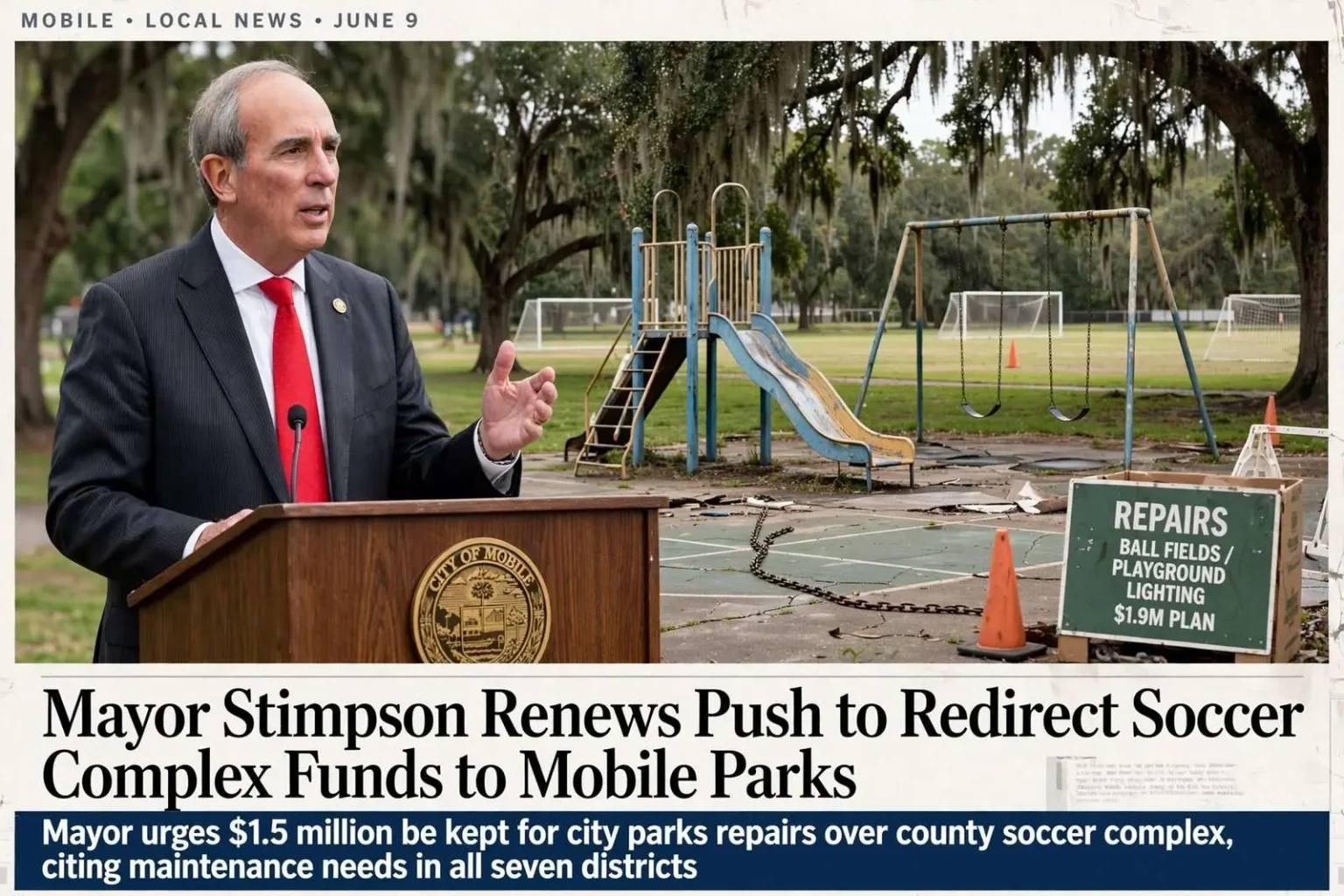
Mobile Mayor Sandy Stimpson has renewed his effort to keep $1.5 million earmarked for a county soccer complex inside the city limits, asking the Mobile City Council once again to consider spending the money on repairs to existing city parks instead. The request, made in a letter dated June 9 and addressed to Council President Gina Gregory, marks the latest round in a months-long dispute between City Hall and Government Plaza over how a single pool of recreation dollars should be spent. Gregory sponsored a resolution, along with two other council members, to transfer the funds to Mobile County for a proposed soccer complex, and the council was scheduled to take the matter up even as the mayor pressed his alternative.
In the letter, Stimpson restated a series of concerns he first raised the previous fall. Those questions centered on the long-term maintenance costs a new complex would create, the suitability of the proposed site, the sources of funding that would keep the facility running in future years, and the economic projections supporters had used to make their case. None of those questions, he wrote, had been answered to his satisfaction in the months since he first posed them.
“During the public discourse in August and September 2014, I publicly stated my preference was for the city to fix what is broken and in disrepair within our parks rather than build a new park,” the mayor wrote. The language deliberately echoed the arguments Stimpson made during the initial debate over the transfer, when the council first moved to route the money to the county, and framed his renewed objection as a matter of consistency rather than a newly minted position.
A Sharp Rebuttal From the County
The letter drew a quick and pointed response from County Commissioner Connie Hudson, the leading advocate for the soccer complex on the Mobile County Commission. In an email distributed to council members, Hudson pushed back on the mayor’s renewed objections, characterizing them as “very oddly curious.” The exchange laid bare the fractured relationship between the mayor’s office and the county over a project that supporters view as a regional asset and critics view as an expensive gamble.
At the center of Hudson’s defense was an economic impact study the county commissioned from a Florida-based sports facilities consulting firm at a cost of roughly $50,000. She said the firm’s analysts intentionally build conservative estimates into their projections rather than overstate the potential benefits of a new facility, an answer aimed directly at Stimpson’s skepticism about the economic numbers behind the complex. The study has been a fixture of the debate since it was completed, with supporters citing it as proof that tournament traffic would translate into hotel nights, restaurant sales and sales tax revenue across the county.
The dispute set up an unusual legislative standoff, with dueling votes scheduled on the same day. The Mobile City Council was set to consider the funding transfer, while the Mobile County Commission planned to vote separately on whether to accept the money from the city. The sequencing meant that both governing bodies would go on record on the same question within hours of each other, leaving little room for a quiet compromise before the money changed hands.
A Parks Plan for Every District
Ahead of the council vote, Stimpson stepped up his lobbying for an alternative use of the funds. He unveiled a parks improvement plan touching every council district at a projected cost of roughly $1.9 million, and items tied to that plan were placed on the same council agenda as the soccer complex transfer. The move gave council members a concrete choice: approve the transfer to the county, or keep the money in Mobile and spread it across ball fields, playgrounds and grounds in their own districts.
Mobile’s parks system serves every corner of the city, from neighborhood playgrounds near Spring Hill and Midtown to large athletic complexes along Airport Boulevard and in West Mobile. Maintaining that inventory has been a persistent challenge for the city, which like most Alabama municipalities must balance parks upkeep against paving, drainage, public safety and other core services. Deferred maintenance on aging ball fields, lighting systems and playground equipment has been a recurring complaint at council district meetings, and the mayor’s office has argued that repairing what already exists delivers benefits faster than building something new.
“I am a huge supporter and have personally committed to improving their playing fields and committed to creating more soccer fields,” Stimpson said, adding that he also wants to support the wider athletic and fitness community by improving the facilities already in use. The mayor has sought to draw a distinction between opposing soccer outright, which he says he does not, and questioning whether a brand-new county complex is the right vehicle for the city’s recreation dollars.
The $1.9 million plan was structured so that each of the council’s seven districts would see visible work, a political calculation designed to counter the argument that rejecting the soccer transfer would leave the city with nothing to show for the money. City officials pointed to field renovations, restroom and concession work, and general repairs across the system as the kind of projects residents ask for most often.
The roots of the dispute reach back to the fall of 2014, when the transfer proposal first moved through City Hall and prompted a round of public hearings and council debate. At that time, parks advocates and neighborhood associations filled council chambers to argue that the city’s own facilities were going begging while a new regional project was being courted. The letter Stimpson sent in June made clear that the administration had not changed its view in the intervening months, even as the council majority behind the transfer held firm.
From the county’s side, the argument has been that a complex would serve the entire region, not just unincorporated Mobile County. Commissioners have pointed to the growth of youth soccer across the Gulf Coast and to the communities that already host weekend tournaments, from Foley and Gulf Shores across the bay to venues in the Florida Panhandle, as evidence that families will travel for quality fields. A Mobile County facility, in that view, would keep hotel stays, restaurant meals and sales tax dollars inside the county instead of exporting them to competing destinations.
Soccer’s Growing Footprint in the Mobile Area
Local sports organizers have long pointed to a shortage of quality soccer facilities in the Mobile area, and previous efforts to build tournament-caliber fields in the county have stalled over funding and site questions. Youth soccer participation has grown steadily across the Gulf Coast, and travel teams from Mobile and Baldwin County routinely travel to venues in Foley, Pensacola and the Florida Panhandle for weekend tournaments that other communities capture instead. Supporters of the county complex argue that keeping that spending at home justifies the upfront investment.
Stimpson said he supports that broader goal but believes the city should prioritize fixing existing athletic facilities before funding new ones. In his view, fields that are already in daily use by city leagues and school teams offer a more immediate return than a facility that would take years to plan, permit and construct. The debate over sequencing, rather than the merits of soccer itself, has defined the mayor’s public position throughout the dispute.
What It Means for Mobile Residents
The back-and-forth between the mayor’s office and county officials reflects a broader tension over how limited public recreation dollars should be prioritized between new regional facilities and maintenance of existing neighborhood parks across Mobile. That tension is familiar to cities across Alabama, where municipal and county governments share a tax base but answer to different constituencies, and where a signature project in one jurisdiction can be seen as a zero-sum loss in another.
For residents, the practical stakes are straightforward. The $1.5 million at issue is enough to fund meaningful repairs across a parks system that serves hundreds of thousands of visits a year, but it is also, by the county’s argument, a seed investment in a facility that could draw visitors and their spending for decades. The competing votes scheduled for the same day forced both the council and the commission to put those philosophies on the record.
Whichever way the votes fell, the dispute has already shaped the conversation about recreation spending in Mobile. The mayor’s parks plan put maintenance front and center on the council agenda, while the county’s study and advocacy kept the case for regional tournament facilities alive at Government Plaza. How the two bodies reconcile those priorities will determine whether the region’s next major sports venue rises on county land or whether the money stays in the city, spread across the fields and playgrounds Mobile families already use.