Bay Minette Had No Mardi Gras Parade in 2018
Bay Minette residents were told in February 2018 that the city would not hold a Mardi Gras parade that year, according to WKRG.
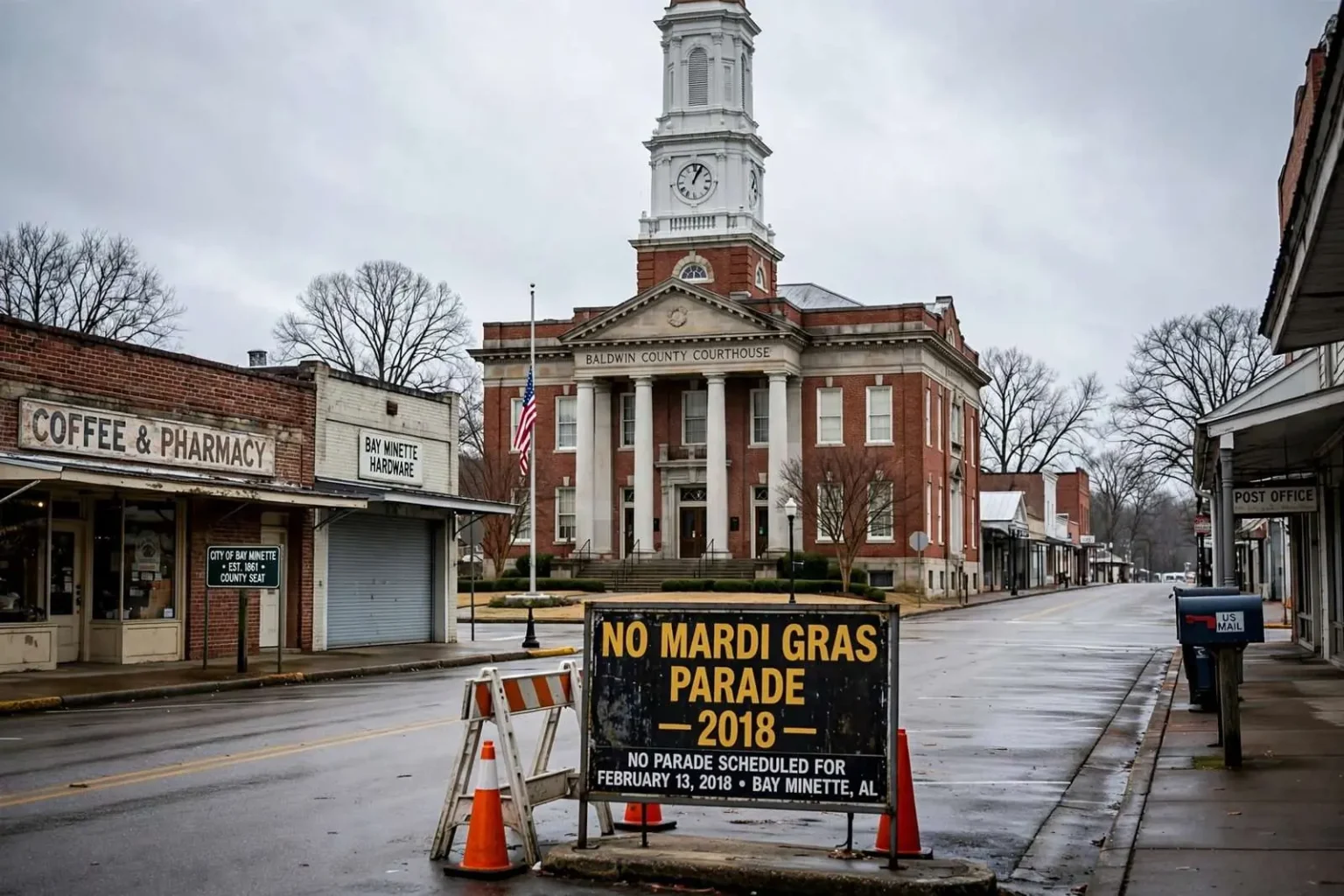
BAY MINETTE, Ala. — Originally reported February 10, 2018. Bay Minette residents were told in February 2018 that the city would not hold a Mardi Gras parade that year, according to a local news report. A post on the city’s Facebook page stated that there would be no celebration, while Bay Minette’s police chief told the station that a parade had not been planned in the first place — a clarification that resolved confusion among residents who had expected the city’s customary splash of Carnival season.
The announcement settled a question that had circulated locally as Mardi Gras season reached its peak across the rest of coastal Alabama. While Mobile’s Carnival celebrations were in full swing downtown and parades rolled in communities across Baldwin County, Bay Minette’s 2018 calendar contained no procession — and city officials moved to make that clear before residents made plans around a parade that was not coming.
The Clarification and the Confusion Behind It
According to the report, the city communicated the decision through its official Facebook page, the modern front door of small-town government. The police chief’s added detail — that a parade had not actually been planned for 2018 — suggested that expectations of a procession had grown from the city’s history of celebrating rather than from any actual scheduling. In communities where an event has taken place in some years and not others, the assumption that it will happen each year is persistent, and small cities routinely use social media to correct it.
For a city of Bay Minette’s size, a parade is a significant municipal undertaking: street closures along the route, police staffing, cleanup crews, coordination with marching units and float builders, and the liability and logistics questions that come with closing roads for an afternoon. When no organizer steps forward to carry those costs in a given year, the event simply does not appear on the calendar — and the city’s job becomes managing public expectations rather than managing a parade.
Bay Minette’s Place in Baldwin County
Bay Minette sits in the northern reaches of Baldwin County, serving as the county seat — a distinction that often surprises coastal visitors who associate Baldwin County with its beach towns. The county’s administrative offices, courthouse, and jail are located in Bay Minette, and the city of roughly 8,000 residents functions as the government and service hub for a county that stretches from the Florida line to Mobile Bay.
Geographically, Bay Minette lies north of the interstates that funnel tourists to Gulf Shores and Orange Beach, along U.S. 31 and near the routes that connect the county’s interior to Mobile across the causeway. Its position in the county’s interior places it at the northern edge of Alabama’s Carnival country. Mardi Gras as a public celebration is strongest along the coast — Mobile, the American birthplace of the tradition, and the Baldwin County communities along the Eastern Shore and the beach corridor — and thins as one moves inland and northward.
Mardi Gras in Baldwin County’s Communities
Baldwin County’s parade map in a typical year includes events in Daphne, Fairhope, Foley, Gulf Shores, Orange Beach, Spanish Fort, Loxley, Robertsdale, and Elberta, each with its own mystic societies and civic clubs. The parades range from large evening processions drawing tens of thousands of spectators to small-town daytime rolls organized by volunteer fire departments and school booster clubs.
Against that backdrop, the absence of a Bay Minette parade in 2018 was a local scheduling fact, not a countywide pattern. But it illustrated how unevenly Carnival season is distributed across Baldwin County’s geography, and how much a community’s Mardi Gras identity depends on the civic organizations willing to organize a procession year after year.
Mobile’s Claim as the Home of American Mardi Gras
Any story about a missing Baldwin County parade in 2018 is best understood against the tradition centered 30 miles southwest, in Mobile, where Carnival has been celebrated since the early 18th century. Mobile’s mystic societies — secret organizations with masked balls, parade themes, and centuries-deep customs — predate New Orleans’ Carnival by years, and the city marks the season with family-friendly parades, MoonPie throws, and the fireworks that close the season on Fat Tuesday.
Baldwin County’s parades are, in a real sense, satellites of that Mobile tradition. Eastern Shore communities developed their own procession culture in the 20th century, and Baldwin’s small-town parades draw families who want the experience without the downtown crowds. When one of those towns does not roll in a given year, residents simply redirect — driving to Fairhope or Foley, or across Mobile Bay — which is part of why a single community’s absence rarely makes waves beyond its own city limits.
How Small Cities Decide to Parade
The mechanics behind a small-town Mardi Gras parade are worth understanding, because they explain years with parades and years without them. A procession requires an organizer — typically a civic club, a nonprofit, a mystic society, or the city itself — that files for permits and street closures, arranges for law enforcement coverage, secures insurance, recruits floats and marching units, and raises the money to cover costs. In Baldwin County’s smaller communities, that organizer is often a handful of volunteers.
When that group’s energy or funding lapses, the parade lapses with it, and the city may or may not step in to revive the tradition in a later year. Cities that own their parades — where the municipality organizes rather than merely permits — have more continuity, but they also carry the full cost and the political weight of canceling. Bay Minette’s 2018 position, as reported, was that no parade had been planned by anyone; there was no organized event to cancel, only an expectation to correct.
The Police Chief’s Role in the Story
It was notable that the clarification came in part from the police chief, whose department would have been the operational backbone of any parade that did happen. Police chiefs in Baldwin County’s small cities are deeply involved in Carnival season every year: planning traffic control, staffing intersections, coordinating with county and state agencies, and managing the crowds that parades attract. A chief’s office knows before almost anyone whether a parade is on the calendar, because the department’s staffing plan for parade day is one of the first documents produced when an event is real.
That made the chief’s statement — that no parade had been planned in the first place — authoritative in a way few other sources could be. It cut through the speculation that had built in the community and gave residents a clear answer before Mardi Gras weekend arrived.
Social Media and Small-Town Announcements
The vehicle for the announcement — a city Facebook page — reflected how municipal communication had changed by 2018. Cities across Baldwin County had adopted social media as their primary channel for time-sensitive announcements: road closures, weather alerts, event schedules, and corrections of circulating misinformation. For older residents without social media accounts, word still traveled through the newspaper, the courthouse, and the church, but the Facebook post was where an official answer lived and could be shared.
The Season of 2018 Along the Gulf Coast
Mardi Gras fell on Feb. 13 in 2018, making the second weekend of February prime parade season along the central Gulf Coast. Mobile’s downtown rolls were underway, Baldwin County’s communities were launching their own processions, and the weather that year brought the typical Gulf Coast February mix — cool air, occasional rain, and crowds in sweatshirts catching throws. Against that active backdrop, Bay Minette sat out the season, its usual revelers presumably finding their floats in Fairhope, Foley, or across the bay.
What the Absence Meant Locally
A year without a parade leaves small marks on a community: school clubs lose a fundraising stage, downtown merchants lose an afternoon surge of customers, and children who measure the winter by the parade route lose a tradition for a year. None of these is permanent, and communities that skip a year commonly resume when organizers regroup. The 2018 season in Bay Minette was such an intermission — a gap in the calendar rather than a repudiation of the tradition.
For the record, what the city communicated in February 2018 was narrow and precise: there would be no celebration that year, and no parade had been planned to begin with. The city’s statement, coupled with the police chief’s clarification, stands as the complete official account of the matter as reported by the local station at the time.
A Historical Note on This Article
Because this article records the local event update as reported in 2018, it is not a current Mardi Gras schedule and does not describe whether Bay Minette has held parades in subsequent years. Mardi Gras schedules along the Alabama Gulf Coast change annually, and readers seeking current information should consult the cities and organizations that actually stage each year’s processions — the mystic societies of Mobile, the civic groups of Baldwin County’s communities, and the municipal pages where each season’s calendar is published in the weeks before Fat Tuesday.
What the 2018 episode documented, and what remains true in any year, is the relationship between small Alabama cities and the region’s Carnival tradition: parades happen where organizers commit to them, expectations outrun calendars when traditions are unevenly held, and the fastest way to correct a community’s assumption is an official post that says, plainly, that the parade is not coming this year. In February 2018, that was Bay Minette’s message — a county seat without a procession, while the parades rolled everywhere the coast’s organizers were ready to roll them.