Jill Biden to Speak at Christening of Austal-Built USS Gabrielle Giffords in Mobile
Second Lady Jill Biden will speak at the June 13 christening of the Navy's newest Austal-built ship, named for former Rep. Gabrielle Giffords.
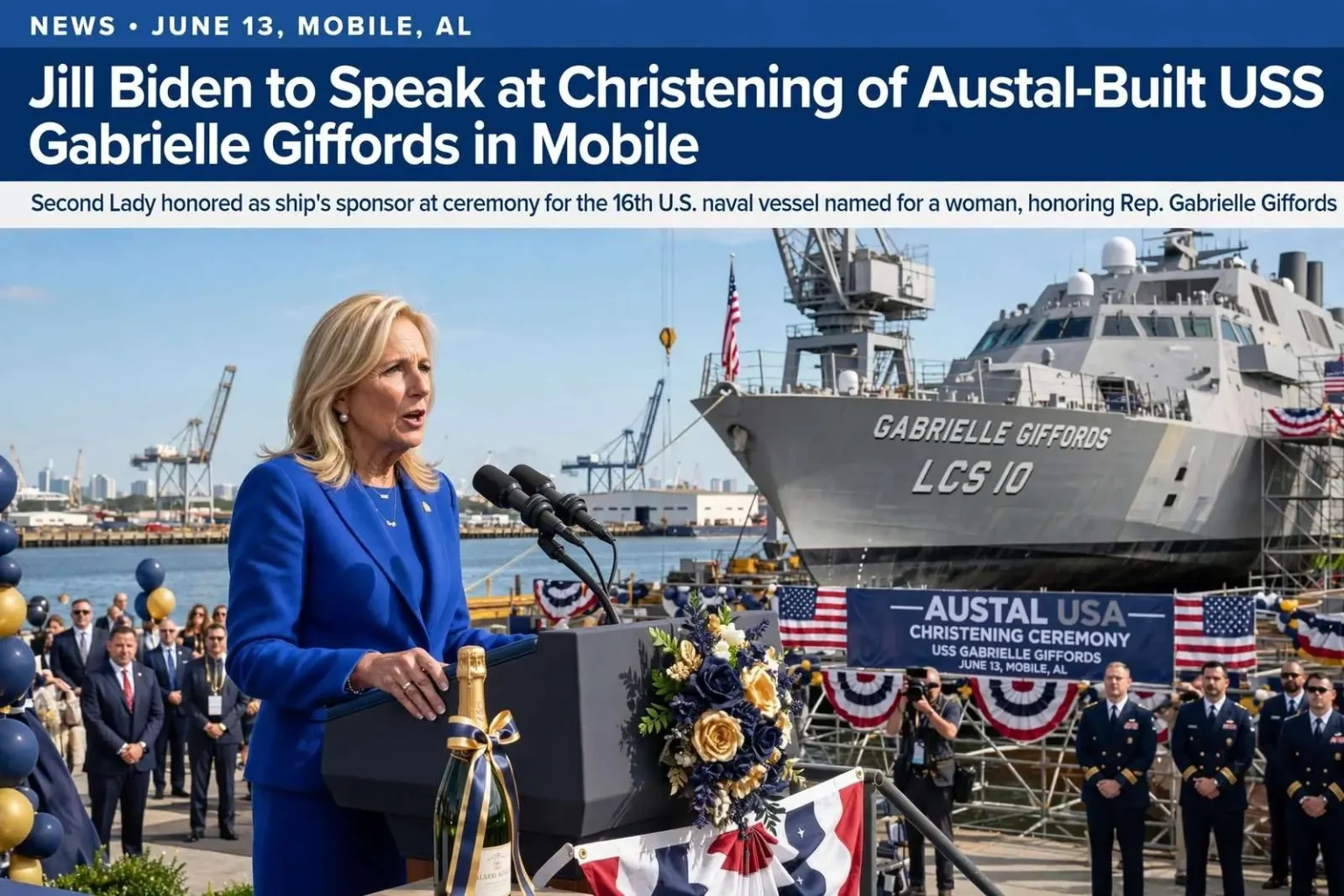
Second Lady Jill Biden is scheduled to speak in Mobile on June 13 as the ship’s sponsor at the christening of the future USS Gabrielle Giffords, the newest littoral combat ship built by Austal USA along the Mobile River. The ceremony, a closed event set for midday, will mark a milestone both for the Navy and for the Gulf Coast shipbuilding industry that has transformed the Mobile waterfront over the past two decades.
The christening carries unusual historical weight. The future USS Gabrielle Giffords will be the 16th U.S. naval vessel named for a woman, and only the 13th ship since 1850 to be named for a living person. The Navy’s practice of honoring living Americans is a rare one, reserved by tradition for individuals whose service and character are considered emblematic of the values the fleet represents.
Ships named for living Americans occupy a narrow and deliberate corner of naval history. For most of the Navy’s existence, warships were named only after the departed, on the theory that history should render its verdict before a name is affixed to a hull. The handful of living namesakes honored since 1850 reflect a modern willingness to recognize service while it can still be witnessed, a category the Navy has reserved for figures whose stories it considers worth telling while they are alive to hear the tribute.
As the ship’s sponsor, Biden will hold a role steeped in naval custom. A sponsor is traditionally a woman of distinction selected to represent the ship’s namesake, and it falls to the sponsor to break a bottle of champagne across the bow at launch and to maintain a lifelong relationship with the vessel and its crew. Sponsors are invited back for commissionings, deployments and homecomings, making the designation one of the most personal honors the Navy bestows.
Biden, an educator who has spent decades in the classroom and advocating on behalf of military families, has made support for service members and their loved ones a signature issue of her public life. Her presence in Mobile underscores the ceremony’s dual character: a recognition of one woman’s resilience and a salute to the sailors, shipbuilders and families who stand behind every hull that takes shape on the Mobile River.
Former U.S. Rep. Gabrielle Giffords is expected to attend alongside her husband, retired Navy Capt. Mark Kelly, a former NASA astronaut. As of the days leading up to the event, Vice President Joe Biden was not among the scheduled participants, though the second lady’s role as sponsor places the honor at the center of the program.
Giffords served southern Arizona in the U.S. House of Representatives before an assassination attempt in 2011 left her gravely wounded at a constituent event in Tucson. The attack shocked the nation and prompted an outpouring of support for the congresswoman. In the years since, her painstaking recovery has made her one of the most widely recognized figures in American public life, admired across party lines for her determination to resume a life of service.
‘Synonymous with courage’
U.S. Secretary of the Navy Ray Mabus has described Giffords as “synonymous with courage” for the resilience she has shown since the shooting. Mabus, a Mississippi Gulf Coast native who has led the Navy Department through a period of aggressive shipbuilding expansion, has repeatedly pointed to the region’s shipyards as the engine behind the Navy’s growing fleet, making Mobile a frequent stop in his official travel.
Other scheduled speakers include Austal USA President Craig Perciavalle; Dennis McGinn, assistant secretary of the Navy for energy, installations and environment; and Vice Adm. Philip Cullom, deputy chief of naval operations for fleet readiness and logistics. The lineup reflects the range of interests converging on the program: the Navy’s operational leadership, the civilian branch of the department that oversees installations and energy policy, and the shipbuilder whose yard delivered the hull.
The ship itself is a product of one of the most distinctive vessel designs in the modern fleet. Littoral combat ships are 416-foot aluminum trimarans designed for a range of missions, including mine countermeasures, submarine hunting, drug interdiction and humanitarian relief. The class takes its name from its intended operating environment — the littorals, the shallow coastal waters close to shore where larger warships are difficult to maneuver and where many of the Navy’s most pressing missions now unfold.
The aluminum trimaran hull, derived from high-speed ferry designs, allows the ships to reach speeds well beyond those of conventional warships while carrying swappable mission packages that can be changed as needs evolve. A single hull can be configured for surface warfare on one deployment and mine clearance on the next, an approach the Navy has billed as a flexible answer to the unpredictable demands of coastal operations.
The ships also operate with relatively small crews compared with larger warships, a design choice intended to hold down operating costs and concentrate sailors on the mission packages each deployment requires. Aviation facilities on the flight deck support helicopter and unmanned aircraft operations, extending each ship’s reach in the surveillance, interdiction and search-and-rescue missions that dominate modern coastal operations.
The future USS Gabrielle Giffords is the fifth vessel built under Austal’s $3.5 billion, ten-ship contract with the Navy for Independence-class LCS vessels, and only the third of those ten to reach the christening stage. The contract has anchored the Mobile yard’s naval workload and made the Port City the exclusive construction site for the Independence variant of the class, a responsibility that funnels hundreds of millions of dollars in naval investment through the Mobile River shipyard.
At the time of the announcement, seven littoral combat ships were under construction at Austal’s Mobile shipyard in various stages of completion. Two Independence-class ships, the USS Independence and USS Coronado, had already entered Navy service, while the future USS Jackson and USS Montgomery were preparing for acceptance trials, the final battery of tests a ship must pass before the Navy formally takes delivery.
Farther back in the production line, the future USS Omaha and USS Manchester were being assembled in the yard’s Bay 4 and Bay 5, and modules for two more ships, the future USS Tulsa and USS Charleston, were also under construction. The staggered assembly line, with some hulls in final outfitting, others in structural erection and others still existing only as modules, is the hallmark of the modular construction method Austal brought to American naval shipbuilding.
A shipyard that reshaped Mobile
The christening also arrives as the Navy continues to deepen its ties to the Gulf Coast shipbuilding corridor, which now produces a substantial share of the service’s auxiliary and combatant tonnage. Every christening along the Mobile River draws visiting officials, sailors’ families and industry representatives to the city, reinforcing the connection between the fleet and the communities that build it.
Austal’s Mobile operation has grown from a modest ferry-building venture into one of the region’s largest industrial employers since the Australian shipbuilder opened its U.S. yard on the Mobile River. The company’s aluminum shipbuilding expertise, honed on fast ferries delivered to customers around the world, positioned it to compete for Navy work when the service sought a new class of fast, agile coastal warships in the early 2000s.
The resulting Independence-class program has made Mobile the sole production site for one of the Navy’s two littoral combat ship variants, the other being built on the Great Lakes in Wisconsin. The distinction gives the city a permanent foothold in a fleet program expected to run for years, with hull after hull moving through the same riverfront bays where the future Gabrielle Giffords took shape.
The yard’s growth has rippled across the local economy, drawing suppliers, tradespeople and skilled welders to the Gulf Coast and anchoring a shipbuilding corridor that stretches along the Mobile River. Each new hull sustains work across hundreds of subcontractors, from aluminum fabricators to electronics installers, tying the region’s industrial identity to the health of the Navy’s shipbuilding budget.
For the Navy, the June 13 christening is the midpoint of a ship’s journey from contract to combatant. After christening and launch, the vessel will undergo fitting out and sea trials before its formal commissioning, when it enters active service and joins the fleet. For Mobile, it is another visible reminder that the ships protecting American interests around the world are being built on the central Gulf Coast, in a yard visible from the city’s downtown skyline.
The choice of namesake and sponsor gives the ceremony a human dimension that shipyard milestones rarely carry. A congresswoman whose recovery became a national symbol of perseverance will watch a warship bearing her name take to the water, sponsored by the wife of the vice president, in a shipyard that has become one of the most productive naval facilities in the United States.
When the champagne bottle breaks across the bow of the future USS Gabrielle Giffords, it will mark not only the launch of a warship but the latest chapter in Mobile’s rise as a cornerstone of American naval shipbuilding. For the sailors who will one day crew the ship, the civilians who built her and the Gulf Coast community that watched her grow from modules to a completed hull, June 13 represents the moment a name on a contract became a ship on the water.