Austal Christens Future USS Gabrielle Giffords in Mobile
Austal USA christened the future USS Gabrielle Giffords in Mobile, with Second Lady Jill Biden serving as the littoral combat ship's sponsor.
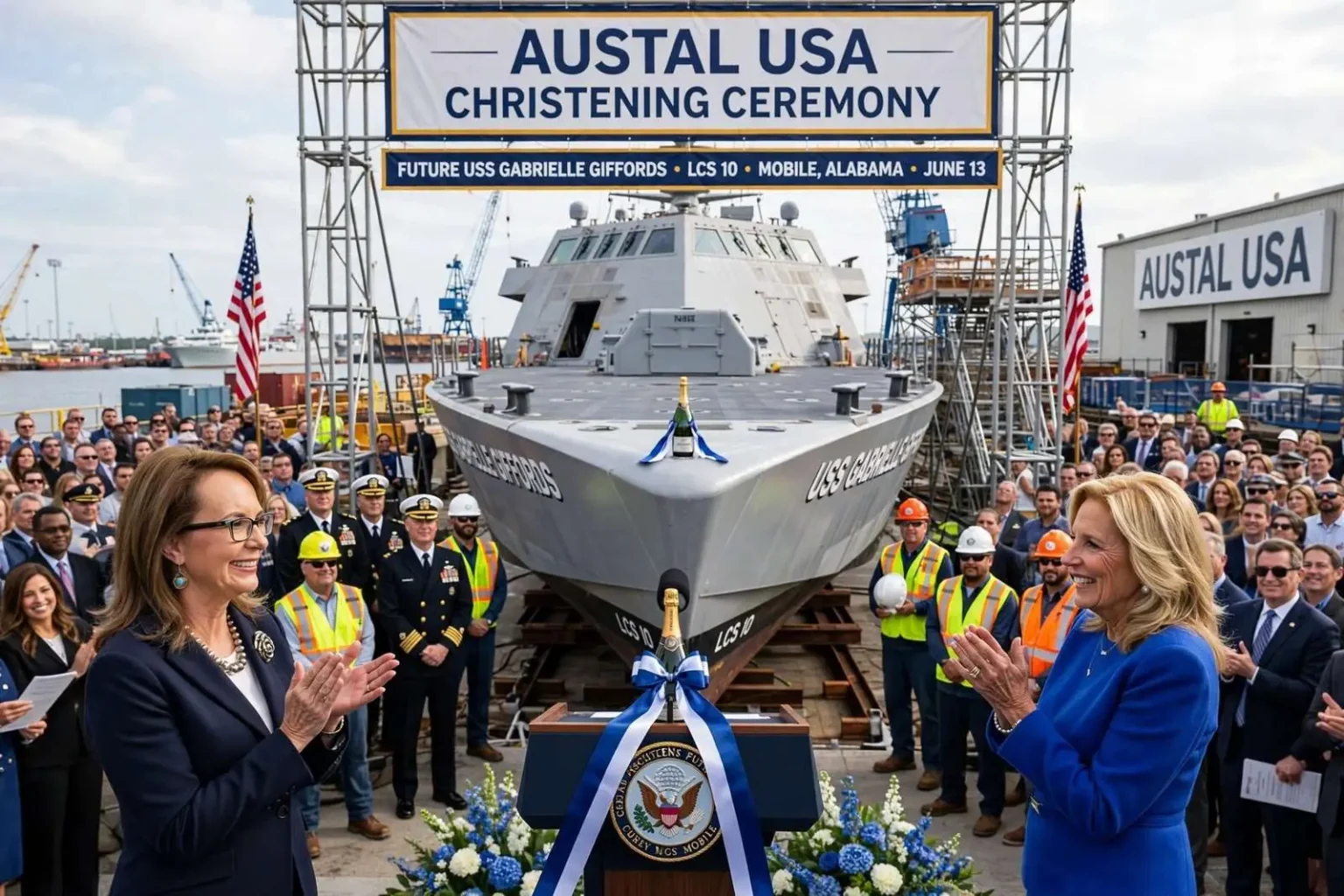
More than 500 people gathered at Austal USA’s Mobile shipyard on June 13 to christen the future USS Gabrielle Giffords, the Navy’s newest littoral combat ship and the fifth vessel Austal has delivered under a $3.5 billion, 10-ship contract. The 416-foot trimaran, designed to hunt submarines, sweep mines, intercept drug traffickers and deliver humanitarian aid, bears the name of former U.S. Rep. Gabrielle Giffords, who was severely wounded in a 2011 shooting in Tucson, Ariz., that killed six people and injured 13 others. The ceremony brought together Navy leadership, shipyard workers, elected officials and the ship’s namesake herself for a morning that blended shipbuilding milestone with a story of personal resilience that has become part of the vessel’s identity.
A christening is the moment a hull becomes a ship with a name and a sponsor’s blessing, breaking a bottle across the bow in a tradition older than the republic. For the crew and the yard, it also begins the final stretch toward commissioning — the ceremony, still ahead, at which the ship enters active service. The Gabrielle Giffords was being built in a class and at a yard that had transformed both the Navy’s surface fleet and Mobile’s economy, and the speakers on the podium returned to that double significance again and again.
A Ship Named for Courage
“Like you, Gabby, she will be strong all the time, kind when reaching out to our allies and tough when she needs to be,” Austal USA President Craig Perciavalle told the crowd. The line captured why the Navy had chosen the name. Giffords, who represented southern Arizona in Congress, was shot in the head while meeting constituents outside a Tucson supermarket in January 2011; six people died and thirteen were wounded in the attack. Her recovery — relearning to walk and to speak, returning to public life, and continuing to advocate on issues she cared about — made her name a byword for resilience in public life, and Navy officials made no secret that the ship was meant to carry that standard.
Giffords, whose remarks were brief but heartfelt, thanked the shipyard workers who built the vessel. “She’s stealthy. She will defend freedom around the world. Go Navy,” she said. For the builders, those few sentences carried weight that no ribbon-cutting speech could: the people who welded, wired and painted the ship heard directly from the woman whose name it would carry for the next three decades or more. Warship names are read aloud in ports around the world, and from commissioning day every sailor aboard would speak that name.
Second Lady Jill Biden served as the ship’s sponsor, calling the future USS Gabrielle Giffords “an amazing feat of engineering excellence” and noting she would serve as an honorary crew member for life. The sponsor’s role is a lifelong relationship with the ship and crew — visiting, corresponding, and representing the vessel at milestones — and Biden’s presence linked the Mobile-built ship to the White House at a moment when the littoral combat program needed visible support.
The Navy’s View From the Podium
Vice Admiral Philip Cullom, deputy chief of naval operations for fleet readiness and logistics, said Giffords “has truly modeled courage and resilience,” qualities he said would define the ship’s character. Coming from the Pentagon’s fleet-readiness shop, the framing was more than ceremonial. The littoral combat ship concept — fast, modular, designed to operate close to shore — had drawn criticism and scrutiny in Washington, and Navy leaders used christenings like this one to make the case for what the ships could do: swap mission modules for mine-clearing, surface warfare or anti-submarine work as needs change, and operate in the shallow littorals where larger warships cannot easily go.
Dennis McGinn, assistant secretary of the Navy for energy, installations and environment, called the Independence-class littoral combat ships built in Mobile “one of the Navy’s greatest achievements” because of their flexible, modular design, which allows the fleet to adapt quickly to different missions. The Independence class — the aluminum trimaran variant, unmistakable at sea with its knife-like bow and wide flight deck — was designed from the keel up for that adaptability, and McGinn’s remarks placed the Mobile-built hulls at the center of the Navy’s argument for the class.
A Shipyard’s Transformation
The christening marked another milestone for Austal’s Mobile operation, which Perciavalle said has grown from a single shed and two trailers in 1999 into a major shipbuilding campus, with more than $380 million invested along the Mobile waterfront in the past five years alone. He credited the state’s congressional delegation and Mobile Mayor Sandy Stimpson with helping create conditions for that growth. The trajectory is one of the more remarkable industrial stories on the Gulf Coast: an Australian shipbuilder that came to Mobile to build ferries ended up winning Navy contracts that made its riverfront campus one of the largest producers of surface warships in the United States.
The $3.5 billion, 10-ship contract under which the Gabrielle Giffords was built anchored that growth. Multi-year block contracts are what allow a yard to invest in facilities, hire and train a workforce, and build a supplier network — and the Independence-class work gave Austal’s Mobile operation a production rhythm that few new-construction programs anywhere achieve. Each hull refined the process for the next; the Gabrielle Giffords, as the fifth delivery under the contract, embodied lessons the yard had absorbed across four predecessors.
The investment numbers tell their own story. More than $380 million along the waterfront in five years means fabrication sheds, outfitting piers, and the infrastructure of a yard that must move aluminum plate, pipe, cable and equipment through a precise sequence to launch a 416-foot trimaran on schedule. Around that physical plant sits a workforce drawn from across the Gulf Coast — welders, electricians, pipefitters, engineers — many trained on the job through the yard’s own programs and the region’s community colleges and technical schools.
Shipbuilding and Mobile’s Economy
The christening reinforced Mobile’s growing role in national shipbuilding, an industry that has become one of the region’s largest employers and a source of steady economic investment along the waterfront. Mobile has built ships for as long as it has been a port — the city’s history runs through shipyards, from World War II-era production to the present — but the modern era added a distinctive layer: a major Navy new-construction yard on the river, alongside the existing ship repair and offshore industries that share the waterfront.
The economic logic reaches well past the yard gates. A warship program spreads dollars through hundreds of suppliers, many of them Alabama companies, and each shipyard job supports additional work in the region — the standard multiplier that makes shipbuilding the kind of industry mayors court. Programs that run a decade, like the 10-ship contract, offer the steadiness that families and technical schools can plan around, which is why the ceremonial days matter economically as well as symbolically: they are the moments when the community sees the program’s continuity confirmed in public.
What the Ship Will Do
The mission list read at the christening — hunting submarines, sweeping mines, intercepting drug traffickers, delivering humanitarian aid — is a fair summary of what littoral combat ships are asked to do. The trimaran’s wide deck carries helicopters and unmanned systems; its speed lets it reposition quickly; and its modularity means one deployment might focus on countering smuggling in the Caribbean while the next sees it clearing mines in the Persian Gulf. The Gabrielle Giffords would join a fleet built for exactly that flexibility, with a core crew smaller than that of earlier warship generations and mission packages that arrive with their own specialists. For the crew that would eventually bring her to life, the christening was the day the future ship acquired its identity — a vessel named for a wounded congresswoman who rebuilt her life in public view sets a tone for the sailors who will serve aboard her: resilience as doctrine, courage as routine. That was the theme every speaker returned to on the podium by the river, and it was the thing the more than 500 people gathered on the Mobile waterfront came to witness — a city, a yard and a Navy setting a named warship on her way.
The Meaning of a Sponsor
The sponsor tradition deserves its own note, because Jill Biden’s role was more than ceremonial decoration. In Navy custom, the sponsor — traditionally a woman of significance to the ship or its namesake — breaks the bottle of champagne across the bow at christening and remains connected to the ship for its service life. Sponsors attend commissionings, visit the ship in port, check on crews after deployments, and serve as a kind of civilian guardian of the vessel’s story. For a ship named for Gabrielle Giffords, the pairing of sponsor and namesake gave the crew two public figures with personal stakes in the ship’s welfare, and it signaled the Navy’s intent that the connection to the namesake’s story stay alive for decades.
Biden’s description of the ship as “an amazing feat of engineering excellence” reflected the perspective of someone who had visited the yard and seen the work firsthand. Warships are assembled by thousands of individual acts of skill — a weld ground smooth, a cable run precisely, a system tested and retested — and guests who have walked the floor speak about those details. Her pledge of lifelong honorary crew membership formalized the relationship the Navy hopes every sponsor maintains.
Austal, Alabama and the Trimaran Advantage
The Independence class’s trimaran hull is not a styling choice; it is a capability. The three-hull configuration provides a wide, stable deck at high speed, generous internal volume for mission modules, and a flight deck that handles heavy helicopters and their fuel loads with room to spare. Aluminum construction keeps weight down for the speed the class was designed to sustain. Those attributes — born from a design lineage that traces back to high-speed commercial ferries, which is precisely the business that first brought the builder to Mobile — give the class its distinctive silhouette and much of its operational argument.
The vessel’s 416 feet of length carries a crew small by Navy standards, an intentional feature of the littoral combat concept: automation and modular design reduce the sailors needed to fight the ship, with specialized detachments embarking for specific missions. That crew model has operational and cost implications the Navy has debated at length, but aboard the Gabrielle Giffords it translated into a tight-knit ship’s company whose sailors would each carry broad responsibility — a reality that begins with the builders, who outfit the ship knowing fewer hands will operate what they install.
A Waterfront Changed
Stand on the Mobile River waterfront today and the scale of the change since 1999 is visible from any angle. The single shed and two trailers that Perciavalle recalled have become a campus of fabrication halls, assembly bays and outfitting piers; the river hosts hulls under construction alongside completed ships waiting to sail; and the yard’s employment draws from every county around the bay. The $380 million invested in the previous five years exceeds what most industries invest in a region in a generation.
The growth also changed Mobile’s self-image. The city has always been a port, but a modern warship program gave it a place in national defense planning that few mid-sized Southern cities hold — the regular host of commissionings, christenings and the crowds of sailors’ families they bring downtown. Events like the June 13 ceremony are the visible surface of that position: a community watching a warship it built take on the name of a public figure the nation knows, in a ceremony broadcast to an audience far beyond the bay.
When the bottle broke across the bow and the crowd rose, the Gabrielle Giffords joined the Navy’s register as a named ship — still months from commissioning, but no longer an anonymous hull. The shipyard workers returned to their shifts, the ship’s future sailors continued their training, and Mobile’s waterfront resumed the production rhythm that had delivered four ships before this one. The christening was a single June morning, but everything it celebrated — the contract, the yard, the workforce, the name — was built to last for decades.