Fairhope’s Old Bay Steamer Closes for Good, Owners Blame Oil Spill Fallout
After 18 years in Fairhope, Old Bay Steamer is closing for good. Owners Robin and Ray Lambert say a BP claims shortfall and spill fears sealed its fate.
A Fairhope Institution Closes Its Doors
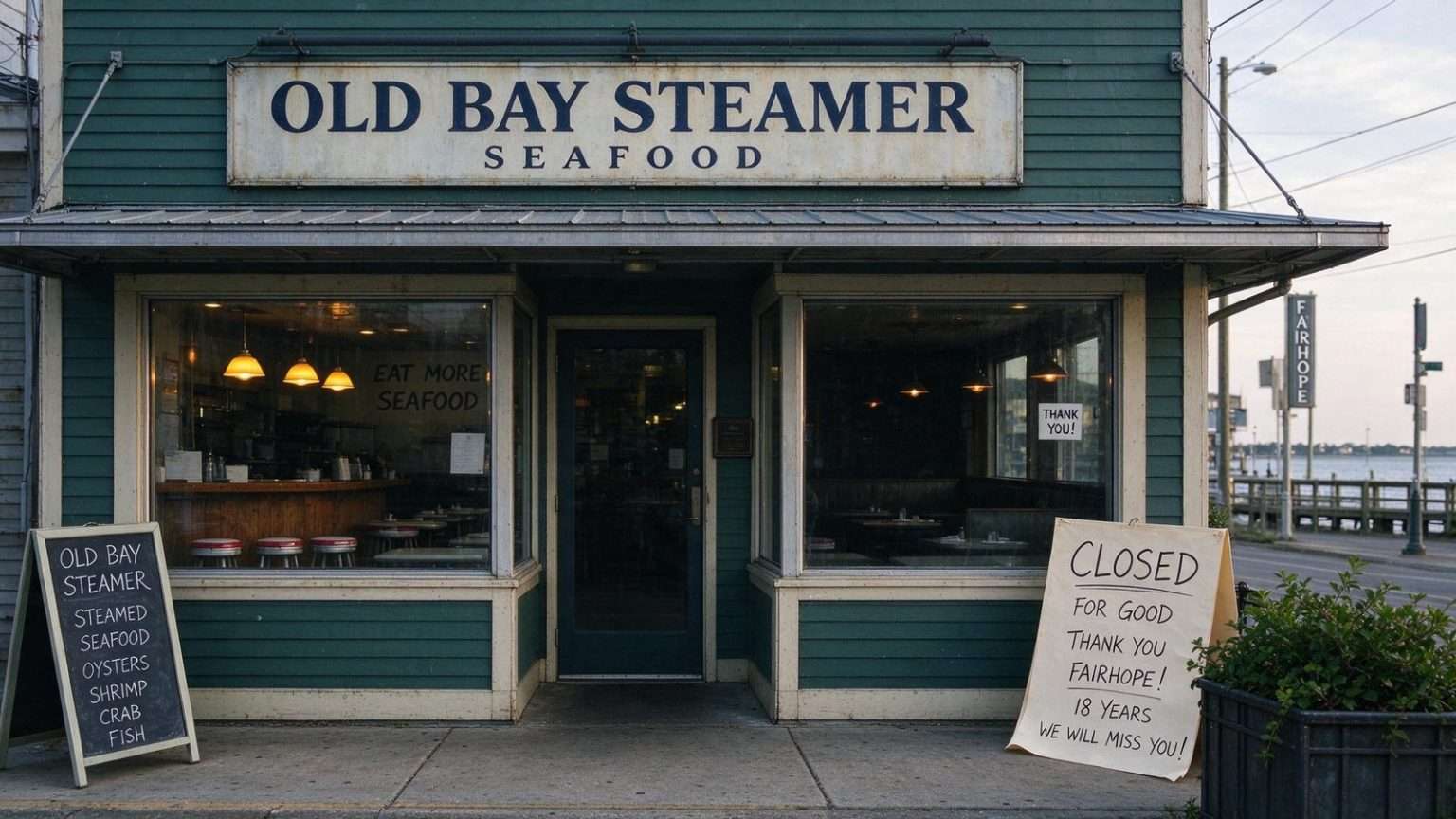
The Original Old Bay Steamer, a seafood restaurant that has served the Fairhope area for nearly two decades, closed for good this weekend, becoming the latest Baldwin County business owners say could not recover from the economic fallout of the 2010 Deepwater Horizon oil spill. Owners Robin and Ray Lambert say the restaurant survived the national recession, but couldn’t overcome the lingering perception among diners that Gulf seafood was unsafe to eat after BP’s Macondo well blew out in the Gulf of Mexico earlier in the year. The closure ends an 18-year run for a restaurant whose steamed seafood platters had become a fixture of the Eastern Shore dining scene. It also adds a Baldwin County name to the list of businesses that blame their failure not on their own balance sheets but on a disaster that never touched their doorstep.
Even though the well was capped and Gulf waters reopened to fishing, many customers stayed away. The reopening of state and federal waters, verified through rounds of government testing, was supposed to be the signal that restored consumer confidence, and in much of the region it eventually did. In Fairhope and along Mobile Bay’s eastern shore, the Lamberts said, the customers simply did not come back at the volume the business needed. A restaurant that had filled its dining room through one of the worst economies in a generation found itself with empty tables in a recovery.
“I think the local people are somewhat concerned, and they’re taking a ‘better safe than sorry’ approach to it, and saying, ‘You know what? I’m sure it’s fine, but I’m just not going to eat it at this time,'” Robin Lambert said. The sentiment she described was widespread on the Gulf Coast in the months after the spill, and it proved stubborn even after testing showed Gulf seafood was safe to eat. Public health officials and tourism agencies ran campaigns to reassure diners, but perception moved more slowly than data. For a restaurant built on local catch, that gap between reassurance and belief was fatal.
The Lamberts said they filed a claim with BP’s compensation fund seeking to recoup lost business, but came away frustrated by how little of their actual losses the company was willing to cover. “Our actual six-month losses are $159,000, and we got a check for $16,000. That’s really what made us decide immediately that we just can’t take it any further. That’s not adequate. We’ve got to close it up,” Robin Lambert said. The claims process, administered under the fund BP set up after the spill, became one of the defining experiences of the disaster for small businesses across the coast, and the Lamberts’ numbers show the gap that drove so many of them to give up.
Profits Versus Revenue: A Claims-Process Trap
Ray Lambert added that the claims process compensated the restaurant for lost profits, but not for lost revenue, a distinction that left the family well short of what they said they needed to keep the doors open. The difference is enormous for a restaurant operating on thin margins. Lost revenue measures all the money that would have come through the register during the months customers stayed away; lost profits subtract the costs the restaurant also avoided, such as food purchases and some labor. A claimant compensated only for lost profits receives a fraction of the hole in their cash flow, which is precisely the money a business needs to make rent, loan payments and payroll while rebuilding its customer base.
The Lamberts’ $159,000 in documented losses against $16,000 in compensation illustrates the problem in stark terms. Businesses across the Gulf Coast told similar stories as the compensation process wore on, and the gap between what claimants documented and what they were paid became a lasting grievance of the spill’s aftermath. For a restaurant already weakened by months of slow business, a payout covering one-tenth of the loss does not bridge the gap; it merely documents it. The family said the check they received made the decision to close immediate rather than eventual.
The legal architecture of the compensation fund shaped those outcomes. BP created the fund under pressure from the White House early in the disaster, and it operated under rules governing how different categories of losses were calculated and proven. Restaurants could claim losses tied to tourism declines, but proving the oil spill caused each empty table required documentation many small operators did not systematically keep. The Lamberts kept their numbers, and the numbers still left them with a fraction of what they needed, a result that says as much about the process as it does about their business.
A Send-Off After 18 Years
Old Bay Steamer planned to stay open for normal hours through its final Sunday, then close out the night with a celebration for regulars and staff. “We’ll be open normal hours until 7, when we’re going to get everything out of the freezer, and cook it up and give away some food and do cash bar and, hopefully, somebody will show up and play some music,” Robin Lambert said. The plan turned a closing announcement into a farewell party, with the restaurant’s last inventory served to the customers who had stuck with the business through its hardest year. Staff members who had worked the dining room for years faced the end of the run alongside the family that owned it.
Ray Lambert reflected on the restaurant’s run in Fairhope. “Eighteen years here, and it’s going to be emotional, but it’s going to be the end, and we’ll have to move forward,” he said. Eighteen years is long enough for a restaurant to become part of a town’s routine, and Old Bay Steamer held that place in Fairhope, where dining rooms on the Eastern Shore compete for a loyal local base rather than a passing tourist trade. The couple built their reputation on steamed seafood and a family-run atmosphere, the kind of business that anchors a downtown and knows its customers by name.
The couple said they haven’t ruled out opening another restaurant down the road, but have made no firm plans. Restaurant operators rarely leave the industry entirely, and the Lamberts’ skills, recipes and supplier relationships remain theirs even as the Fairhope location closes. Whether they reopen will depend on finances, opportunities and how the region’s dining economy recovers from the season that broke their first restaurant. For the moment, their energy went into closing out the business they had, paying its remaining obligations and saying goodbye to the staff and regulars.
One More Name on a Growing List
The closure adds Old Bay Steamer to a growing list of Baldwin County restaurants and tourism-dependent businesses that struggled through the summer of 2010, as the spill’s economic ripple effects reached well beyond the beaches directly affected by oil, touching Eastern Shore establishments many miles from where crude actually came ashore. Fairhope sits across Mobile Bay from the Gulf itself, and no oil reached its waterfront in any significant way. The damage was done by images: pictures of oiled marshes and tarred beaches on the news, and the word “Gulf” attached to every report, made diners hundreds of miles inland hesitate to order what local waters were still producing. Baldwin County’s tourism economy depends on Gulf-facing beaches on its southern end, but its restaurant economy is spread across communities like Fairhope, Daphne, Foley and Gulf Shores, and all of them felt the season’s weakness.
The broader pattern that summer was consistent: charter fishing boats tied up, condo bookings thinned, seafood processors cut shifts, and restaurants that had survived recessions and hurricanes closed their doors. Some failed because customers stopped coming; others failed because the compensation process underpaid them at the moment they needed cash most. The Old Bay Steamer’s story contained both elements, which is why the Lamberts’ account resonated so strongly with other Gulf Coast business owners hearing it. Theirs was not a tale of a badly run restaurant, but of a well-run one that the recession could not kill and a spill’s aftermath could.
For Fairhope, the loss was about more than a balance sheet. The town’s downtown, perched on the bluff above Mobile Bay, has long cultivated a mix of shops, galleries and restaurants that draw visitors from across the county, and a nearly two-decade-old seafood house was part of that draw. Municipal leaders in the Eastern Shore communities spent the months after the spill pressing state officials and BP for recognition that their economies were damaged too, even without oil on their beaches. The Old Bay Steamer’s closure gave that argument a concrete example: a business 20 miles from the nearest oiled shoreline, gone for good because its customers believed the Gulf was contaminated.
The restaurant industry is unforgiving of even one bad year, and the summer of 2010 delivered a bad year with perfect timing, arriving just as the region was climbing out of the deepest recession in generations. Restaurants that might have recovered from one blow could not recover from both. The Lamberts said their place survived the recession, but the combination of empty tables and an inadequate claims payment in the same season was more than the business could absorb. Their departure from Fairhope’s dining scene stands as a reminder of how far the economic damage of the Deepwater Horizon spill reached, and of how the businesses it pushed under were, in many cases, the ones that had endured everything else.