Orange Beach Increased Water Testing After 2010 Corexit Report
A 2010 WKRG report said Orange Beach officials planned additional testing after a resident's samples were reported to contain Corexit.
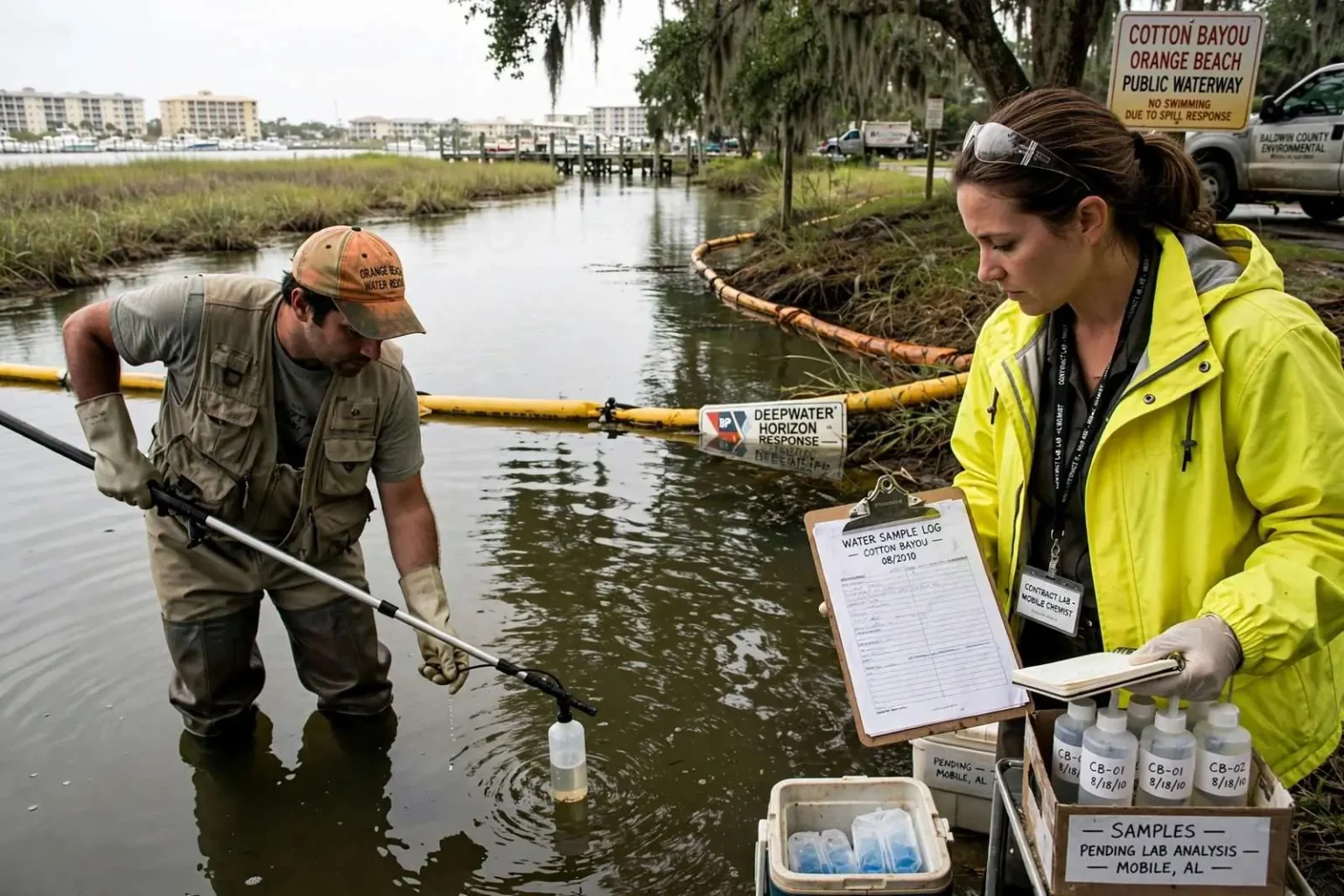
In August 2010, the station reported that Orange Beach officials planned more extensive water testing after a resident submitted samples from Cotton Bayou to a Mobile chemist. According to the report, the chemist’s results indicated the samples contained the dispersant Corexit. City officials said they would conduct additional testing in Cotton Bayou and other locations to determine whether the substance was present. The report reflected a developing local environmental concern during the Deepwater Horizon oil spill response. The resident’s sample result was not presented as the final determination for the bayou. This is a historical account of a 2010 report and its attributed test result. It is not current environmental or health guidance.
The report landed at a moment of acute anxiety along the Alabama Gulf Coast. The Deepwater Horizon drilling rig had exploded on April 20, 2010, killing eleven workers and triggering the largest marine oil spill in United States history. For months, oil and mousse tar washed onto the beaches of Baldwin County, and communities whose economies rest almost entirely on clean sand and water watched the summer season collapse around them. Orange Beach, with its bayous, back bays and beachfront condominiums, was among the hardest-hit stretches of the Alabama coastline.
Cotton Bayou itself is a small waterway in the heart of Orange Beach, running through the Perdido Pass area where the bayou system meets the Gulf. In ordinary years the city’s waterways support swimming, boating and fishing, and their condition is monitored as a matter of both public health and economic survival. When oil began arriving offshore in June 2010, those waterways became the focus of containment boom lines, skimming operations and constant visual monitoring by local crews and spill-response contractors.
Corexit and the Response Debate
Corexit is a line of chemical dispersants used to break oil into small droplets that disperse into the water column rather than collecting at the surface. During the Deepwater Horizon response, millions of gallons of dispersant were applied at the wellhead a mile below the surface and sprayed from aircraft onto surface oil, making it the largest use of dispersants in the history of the response to an offshore spill. The practice was controversial from the start: dispersants reduced the amount of oil reaching shore in visible form, but the chemical’s toxicity and its behavior in warm Gulf waters were the subject of disagreement among scientists, federal agencies and coastal residents throughout the summer of 2010.
Against that backdrop, a resident’s decision to collect samples from Cotton Bayou and pay a Mobile chemist for independent analysis reflected a wider collapse of public confidence in official assurances. Coastal residents had spent months hearing that water testing showed no contamination while simultaneously watching cleanup crews work the sand in front of them. Independent sampling became a common response along the Gulf Coast that summer, with residents, fishermen and business owners commissioning private lab work and publishing the results as a challenge to official narratives.
The chemist’s attributed finding — that the submitted samples contained Corexit — was reported by the station as a single result from a single set of samples. City officials’ response, planning more extensive testing in Cotton Bayou and other locations, followed the prudent sequence for an unverified result: rather than either accepting or dismissing it, the city moved to gather enough data to determine whether the substance was actually present in the waterway. The report made clear that the resident’s sample was not the final determination for the bayou.
What Water Testing Involved
Environmental testing for petroleum compounds and dispersants is specialized work. Samples must be collected in specific containers, preserved and transported under controlled conditions, and analyzed using methods capable of detecting the target compounds at low concentrations. A single sample documents conditions at one place at one moment; water quality can shift with tides, rainfall and the movement of any contaminant through a bayou system. That is why environmental agencies generally require multiple samples across locations and time before drawing conclusions — and why Orange Beach officials’ plan for additional testing in Cotton Bayou and other locations was the standard, rather than exceptional, response.
During the spill response, water and sediment samples along the Alabama coast were collected by multiple parties: BP’s contractors, federal and state agencies, universities, and independent labs commissioned by local governments and residents. Results sometimes conflicted, detection limits and target analytes varied between labs, and the overall picture took months to settle. Local governments in Baldwin County, caught between the need to protect public health and the need to reassure visitors, frequently complained that they were receiving test results too slowly to make operational decisions about beach openings.
The Summer of 2010 in Orange Beach
The economic stakes behind that frustration were enormous. Orange Beach and Gulf Shores depend on summer tourism for a large share of annual revenue, and by the height of the 2010 season, media images of oiled beaches had emptied condominiums and cancelled fishing charters across the coast. The city lost tourism tax revenue at the exact moment response costs mounted, and local officials spent much of the summer pressing BP and federal agencies for faster claims payment, more containment resources, and clearer information about water safety.
The spill’s arrival also reshaped local environmental monitoring permanently. In the years after 2010, coastal municipalities and state agencies expanded routine water quality programs, and the experience of the spill informed how subsequent events — from algal blooms to hurricane-related discharges — have been communicated to the public. The episode in Cotton Bayou became part of that longer story: a community that learned during the summer of 2010 that timely, credible testing information is itself a public resource.
Placing the Report in Its Timeline
August 2010 sat near the end of the active crisis phase. The well had been capped in mid-July, and by early September a permanent cement plug was in place, but oil and tar continued to appear on Alabama beaches into the fall, and cleanup operations continued for years afterward under the Natural Resource Damage Assessment process. Monitoring for dispersant-related compounds was part of the broader scientific record compiled during and after the response, alongside studies of oil chemistry in Gulf waters, marsh sediments and marine life.
That broader record is the reason a single 2010 sample result should be read as historical. Scientific assessments of the spill — including federal water sampling programs that ran through the response — produced large datasets, and the question of where dispersant compounds appeared, in what concentrations, and with what effects was addressed across those datasets rather than by any individual test. Residents reviewing the 2010 report today should treat it as documentation of what was said and done at the time, not as a statement about current conditions in Cotton Bayou.
Current water quality for Orange Beach swimming areas is the domain of ongoing state monitoring programs, which post advisories through the Alabama Department of Public Health and its coastal partners, and conditions in any given bayou or swimming area today bear no necessary relationship to a sample collected in August 2010. Anyone with present-day questions about water quality in Cotton Bayou or other Orange Beach waterways should consult the agencies that currently test those waters rather than this historical account.
What the 2010 report preserved was a moment in the record of the spill along Alabama’s coast: a resident who took sampling into their own hands, a Mobile chemist’s attributed finding involving Corexit, and a city government that responded by ordering more tests of its own. It was one thread in the larger fabric of the Deepwater Horizon response — the uncertainty, the independent verification, and the long shadow the summer of 2010 cast over every subsequent conversation about water quality on the Alabama Gulf Coast.
How the Community Responded
Along the Alabama coast in 2010, information moved through channels that had little precedent. Public meetings in Orange Beach and Gulf Shores filled with residents asking about health effects, compensation and cleanup timelines. Fishing crews signed on with the vessel-of-opportunity program, trading their commercial gear for containment and skimming work. Parents weighed whether to let children swim off beaches they had grown up on. Into that atmosphere came private lab results, conflicting statements, and a running argument over whose numbers to trust — which is precisely the environment in which the Cotton Bayou report emerged.
Local government’s role in that period was largely reactive by necessity. Cities like Orange Beach did not control the wellhead, the response budget, or the federal testing program, but they bore the daily consequences of every decision made above their heads. Ordering independent or expanded testing of municipal waterways was one of the few levers a city had, and using it served double duty: it produced data and it signaled to residents that local officials were not simply deferring to others on a question that mattered to every household and business in town.
The episode also illustrates how spill information travels over time. A station report in August 2010, a resident’s samples, a chemist’s finding, a city’s pledge of additional testing — each element passed into the local record, and years later the account survives as the way residents remember the summer. Historians of the spill have noted that Gulf Coast communities built their own documentation in exactly this fashion, through local reporting and grassroots sampling that filled gaps in the official record.
For the record’s sake, the boundaries of the 2010 report are worth repeating: the chemist’s attributed result concerned samples a resident submitted from Cotton Bayou; city officials said they would conduct additional testing in Cotton Bayou and other locations to determine whether Corexit was present; the resident’s result was not the final determination for the bayou; and nothing in the report constituted environmental or health guidance. Within those boundaries, the account stands as a documented piece of the Deepwater Horizon story on the Alabama coast — a summer when the question of what was in the water was asked everywhere, answered unevenly, and settled only through the slow accumulation of evidence that followed.