Daphne gymnast Brie Clark lands the ‘Biles I’ in competition
Daphne gymnast Brie Clark is sticking the 'Biles I,' a skill named for Simone Biles, and is described as just the fourth gymnast to land it in competition.
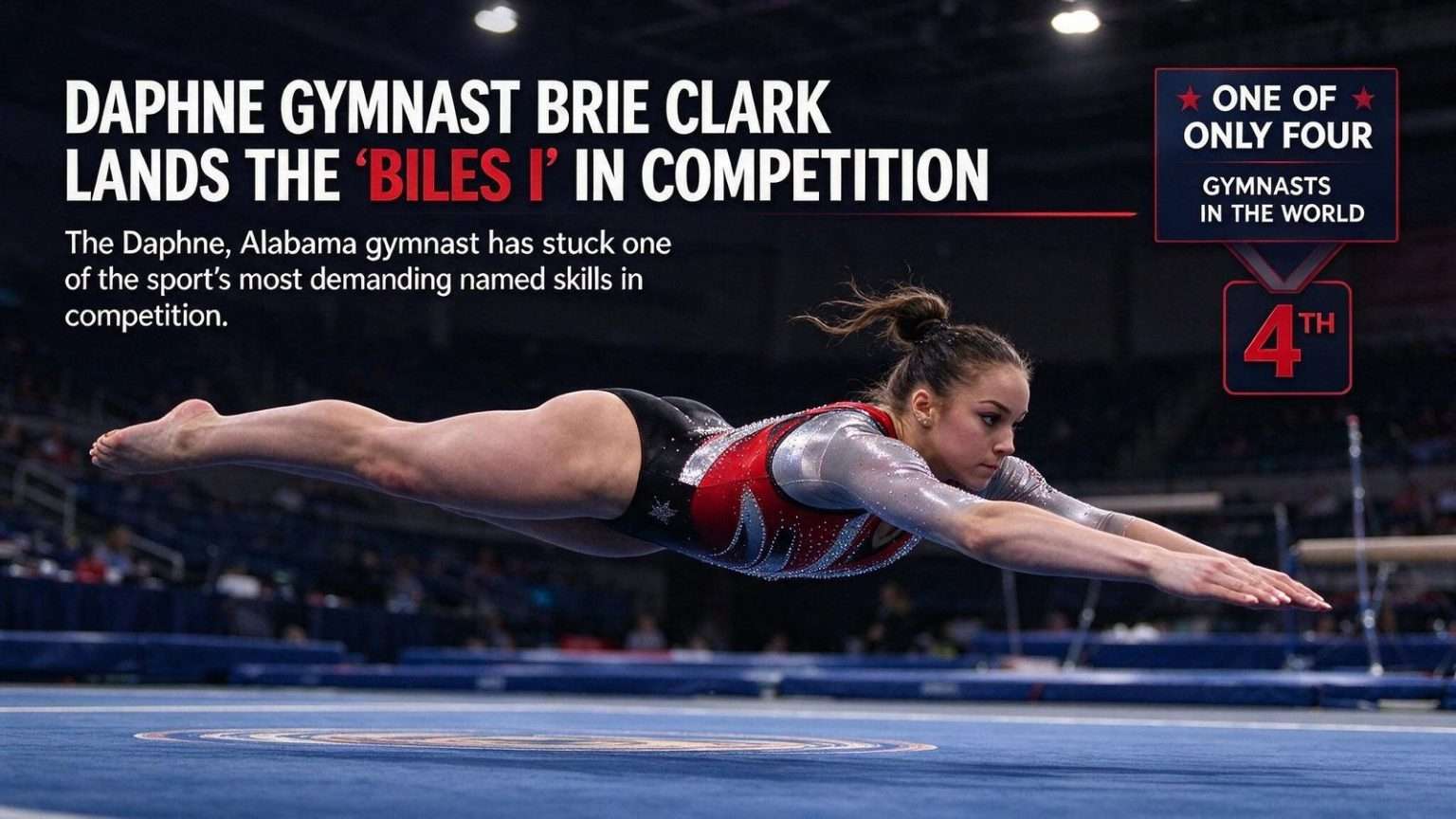
Simone Biles has rewritten the record books in gymnastics, and the skills she pioneered have proven so demanding that only a handful of athletes anywhere in the world have ever landed them in sanctioned competition. One of the athletes who now appears on that short list trains on the Gulf Coast. Brie Clark of Daphne, Alabama has stuck the “Biles I,” the tumbling pass named for the sport’s most decorated champion, and the report described the Daphne athlete as just the fourth gymnast to perform the element in competition, a distinction that places a local name alongside one of the most difficult moves ever attempted in the sport.
The Biles I, named when Biles first successfully competed it, is a tumbling skill of extraordinary difficulty, combining a height and rotation load that most gymnasts cannot generate at all. In the international gymnastics code of points, elements that no other athlete has performed in competition can be named for the first athlete to land them, and Biles has accumulated an entire portfolio of such eponymous skills across vault, balance beam and floor exercise. Landing one of them is a statement: it means an athlete has absorbed a skill from the very edge of what the sport considers possible and made it repeatable under judging conditions.
What landing a Biles skill requires
The difficulty of the Biles I stems from its demands on power, spatial awareness and nerve. Tumbling elements at this level require gymnasts to generate enormous amplitude off the floor, control multiple rotations and twists in the air, and land cleanly enough to avoid heavy deductions or dangerous falls. Gymnasts spend years building the strength and technique base to attempt such skills, and even then the pass carries real physical risk, which is why so few in the sport’s global ranks ever put one into a competitive routine. Each new athlete who lands one joins a roster that is measured in single digits, not dozens.
For Clark, the accomplishment is also a product of the Gulf Coast’s growing footprint in elite gymnastics. The region has produced strong club programs over the past two decades, drawing on the same athletic culture that fuels the area’s football and track success, and Daphne, sitting along the Eastern Shore of Mobile Bay, is part of a Baldwin County community that has invested heavily in youth sports facilities. Elite-level training typically requires families to commit to hours of daily practice, travel to specialized gyms and competition circuits across the Southeast, and years of patience as skills progress from drills in foam pits to attempts on the competition floor.
Why the “fourth gymnast” distinction matters
Being counted as the fourth gymnast to perform a named Biles skill in competition carries weight beyond the moment. The code of points evolves as athletes push boundaries, and each competitor who lands a frontier skill makes it slightly more ordinary for the next generation, who grow up watching it done. Biles herself has described her skills as attempts to move the sport forward and to advocate for gymnasts’ safety and agency while doing it. Every young athlete who follows, Clark included, benefits from the path that pioneering work opened, and each successful landing validates the skill as achievable rather than the property of a single champion.
Local sports fans in coastal Alabama have watched this dynamic play out across other sports, where a single breakout athlete can reshape what a community believes is possible. Gymnastics rarely gets the spotlight in a region devoted to football, but a Daphne athlete landing a skill that carries Simone Biles’ name is the kind of achievement that cuts through: it is verifiable on the world stage, it is measured against the best ever to compete, and it cannot be dismissed as a small-market story. Clark’s name now sits in the same code of points record that includes the sport’s all-time greats.
The report of Clark’s feat also arrives at a moment when gymnastics participation is climbing across the Gulf Coast, with new facilities opening and waitlists forming at clubs from Mobile to Baldwin County. Parents weighing the sport’s demands, the hours, the travel, the physical commitment, now have a local example of where that investment can lead. Sticking a Biles I in competition does not happen by accident; it is the visible end of a training pipeline, and Daphne can now claim a milestone on that pipeline that only three other gymnasts in the world had reached before her.
The broader story of named skills in gymnastics helps explain why Clark’s achievement resonates. For decades the code of points reserved eponymous elements for a small circle of innovators, and the wave of skills Biles introduced in recent years, on vault, beam and floor, expanded that circle faster than at any time in the sport’s modern history. Each named skill represents a barrier broken under competition pressure, with judges watching and scores on the line, not a training-gym feat. That distinction is what separates the athletes who attempt such elements from the handful, now including Clark, who actually land them where it counts.
Elite gymnastics careers are also shaped by timing, and the window for attempting a skill as demanding as the Biles I is narrow. Athletes build toward such elements when their power peaks, and the decision to put one in a routine reflects confidence built over thousands of repetitions. A successful competitive landing requires everything to align on the day: the run, the punch, the rotations and a controlled landing that satisfies judges trained to deduct even small stumbles. The report that Clark stuck the skill, rather than merely survived it, suggests a level of consistency that bodes well for what she attempts next.
Alabama’s place in the sport
Alabama’s gymnastics culture runs deeper than casual observers might expect. The state’s college program at Auburn and the nearby Southeastern Conference powerhouses have made elite gymnastics a television staple in Southern households, and the visibility of NCAA gymnastics has fed growth in club programs across the state. Baldwin County and Mobile families can watch national-caliber college gymnastics within driving distance, and the sport’s stars, Biles chief among them, are household names even in towns far from any elite training center. That pipeline from living-room fandom to local gym membership to, in rare cases, elite competition is exactly the path Clark’s success illuminates.
The physical demands behind the moment deserve emphasis as well. Gymnasts who reach the level where a Biles I is attemptable have typically trained since early childhood, logged twenty or more hours a week through their teenage years, and navigated the sport’s physical toll with careful coaching and conditioning. Modern coaching has shifted toward strength-based progressions and safety-first readiness, reflecting lessons the sport learned from earlier eras. An athlete sticking a skill at this difficulty is also evidence of a support system: coaches who know when to push, medical staff who keep the body intact, and a family that sustains the commitment year after year.
For now, the record shows what the report described: Brie Clark of Daphne, performing the Biles I in competition, the fourth gymnast ever credited with the element named for Simone Biles. Whatever comes next in her career, the milestone already stands. On the Gulf Coast, where athletic milestones usually arrive on a gridiron or a diamond, it is worth pausing on the unfamiliar geometry of this one, a tumbling pass of such difficulty that its inventor is the most decorated gymnast in history, and its fourth-ever competitor grew up just across Mobile Bay.
Competitive gymnastics at this level is scored through a system that rewards difficulty as heavily as execution, which is why frontier skills carry such strategic value. Under the current code of points, a routine’s score combines difficulty value, execution and bonus elements, and an athlete who can integrate a skill as difficult as the Biles I gains a foundation that competitors without such an element simply cannot match. The risk, of course, cuts both ways: a fall on a high-difficulty pass erases the advantage and then some. Choosing to compete such a skill reflects a calculation about readiness, and landing it cleanly in competition proves the calculation was sound.
Clark’s achievement also belongs to a specific moment in the sport’s history, when the skills Biles introduced have moved from novelty to benchmark. Young gymnasts now build training plans around elements that did not exist for previous generations, and the international field has responded, with athletes from several countries incorporating Biles-named skills into elite routines. The spread of these elements through the competitive ranks is how the sport advances, and each new athlete credited with one becomes part of that story. For a Daphne gymnast to appear in that progression says something about how widely the sport’s frontier now reaches.
The local impact of a world-class milestone
Back home in Baldwin County, the practical effect of news like this shows up in gym registration lines and in the ambitions of the athletes who train alongside Clark. Young gymnasts measure themselves against what they can see done by someone from their own gym, their own school district, their own town, and a Biles I landed by a Daphne athlete makes the international level feel like a reachable rung rather than a distant abstraction. Coaches across the region now have a concrete example to point to when explaining why the long years of conditioning, drills and repeated tumbling passes matter.
The milestone also lands in a community that has grown rapidly and invested accordingly in youth athletics. Daphne and neighboring Eastern Shore communities have expanded sports complexes and club facilities as their populations have grown, and families in the area can access high-level coaching without the relocations that elite gymnastics once demanded. The sport’s geographic spread, once concentrated in a handful of traditional hotbeds, now includes Gulf Coast programs producing nationally competitive athletes, and Clark’s success is evidence of that shift from the inside.
The account of the achievement, as reported, is straightforward: Brie Clark, a gymnast from Daphne, Alabama, performed the Biles I in competition, becoming just the fourth gymnast to do so, on a skill pioneered by Simone Biles, the most decorated gymnast in history. Stripped of hype, that is the fact, and it needs little decoration. In a sport where the margin between attempting and landing a skill is measured in inches of rotation and centimeters of landing, four athletes in the world have made it through. One of them learned her sport on the Gulf Coast, and the record now shows it.