Oil Washed Ashore Again in Gulf Shores in August 2010
A 2010 WKRG report said oil and tar washed ashore near Gulf State Park after Gulf conditions stirred up material.
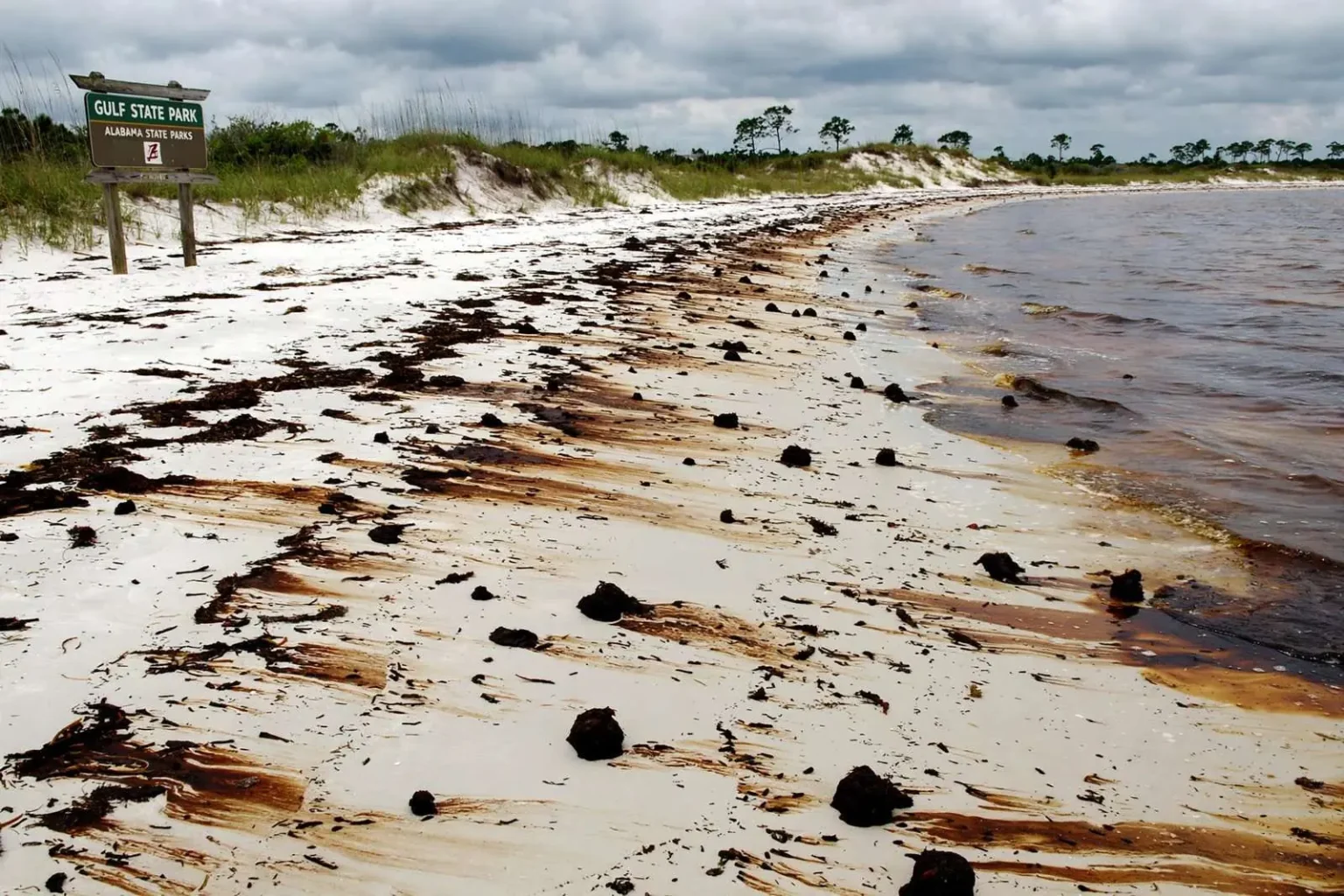
GULF SHORES, Ala. — Oil and tar washed ashore near Gulf State Park in Gulf Shores in August 2010, according to a local news report, in a striking reminder that the Deepwater Horizon disaster’s reach extended well past the initial weeks of the spill. The report described the material turning parts of the beach brown, an unsettling sight for a coastline that had spent weeks declaring itself clean and open for business.
The report said a tropical disturbance in the Gulf stirred up the oil that had been lurking offshore and pushed it onto Alabama’s beaches. That pattern was repeated throughout the summer of 2010: whenever storms or strong southerly winds churned the Gulf’s waters, weathered oil and tar balls that had drifted in offshore currents were driven back onto the sand, undoing the progress cleanup crews had made along the shoreline.
At the time of the report, the station said it found no BP cleanup crews or equipment at the state park. The absence was notable because Gulf State Park is one of Alabama’s most visited public beach areas, and visitors had raised questions about who was responsible for monitoring the sand. BP had reduced its shoreline cleanup force after a period without local beach impacts, the report said — a scaling-back that left the area without an immediate response when the material returned.
The episode illustrated a frustration coastal residents voiced repeatedly during the spill’s aftermath: the ocean does not observe cleanup schedules. Even after visible oil disappeared from the beaches and tourism campaigns declared the coast open, buried and offshore oil remained capable of resurfacing with the next dose of rough weather, and tar balls continued to appear sporadically along the Alabama shore for years afterward.
Background on the Deepwater Horizon spill
The Deepwater Horizon drilling rig exploded on April 20, 2010, killing 11 workers and initiating the largest marine oil spill in United States history. For 87 days, crude oil flowed from the damaged Macondo well nearly a mile beneath the surface of the Gulf of Mexico, with estimates eventually placing the total discharge in the millions of barrels before the well was capped in mid-July 2010. Oil reached the shorelines of Louisiana, Mississippi, Alabama and Florida, and the disaster became a defining environmental and economic event for the Gulf Coast.
Alabama’s beaches, including Gulf Shores, Orange Beach and Dauphin Island, saw waves of oiling throughout the summer of 2010, with the heaviest impacts in June. The state’s tourism economy — built almost entirely on clean beaches and Gulf access — faced a summer of cancellations even where oil never came ashore, and response operations dominated the coast’s landscape: boom lines, staging areas, cleanup workers in matching uniforms, and a fleet of vessels working offshore.
By late July, after the well was capped, conditions along much of the Alabama coast had improved enough that cleanup forces were drawn down and attention turned to reopening beaches and restoring tourism. The August reappearance of oil near Gulf State Park undercut that sense of closure and prompted renewed questions about how long monitoring and response capacity should be maintained after the visible threat appeared to pass.
Gulf State Park and the shoreline response
Gulf State Park stretches along more than two miles of white-sand beach east of the Gulf Shores public beaches, and its campground, lodge and trails make it one of Alabama’s most popular state parks. During the 2010 spill response, the park’s beaches were among the areas where material came ashore in Alabama, and its status as public land made it a focal point for questions about cleanup accountability and visitor access.
Response strategy during the spill evolved over the summer. Early in the response, BP deployed thousands of workers along the northern Gulf shorelines, and heavy equipment was used to remove oiled sand in bulk. As time passed without new oiling on a given stretch of beach, forces were typically reduced and moved elsewhere — a reasonable allocation of resources on any given day, but one that assumed the offshore threat had passed. The August events showed how quickly that assumption could fail when tropical weather reorganized subsurface oil and drove it back to the same beaches that had just been declared clean.
Tropical systems also complicated the response in other ways throughout the summer. Storms forced the temporary evacuation of response vessels, and storm surge pushed oil further inland into marshes and dunes in some areas. Researchers would later study the ways that storms accelerated the natural weathering and dispersal of the oil, but in the moment of August 2010, the immediate effect was simply that oiled material appeared where residents and visitors had hoped they had seen the last of it.
What happened afterward
In the years following the spill, environmental monitoring confirmed that residual oil from the Deepwater Horizon spill continued to surface along Gulf beaches for years, sometimes in the form of tar mats buried in the sand or tar balls stirred up by storms. Response teams, funded through BP’s obligations, continued to respond to reports of reoiling long after the major cleanup operation formally wound down, and that pattern informed how future spill responses were planned.
The spill’s financial legacy in Alabama was transformative. Settlement and restoration funding ultimately directed hundreds of millions of dollars to the state, with projects ranging from coastal restoration and habitat protection to major tourism infrastructure along the beaches that the spill had damaged. Gulf State Park itself benefited from restoration-era investment, rebuilding and expanding facilities with an emphasis on sustainable design after its lodge and other amenities were redeveloped in the years that followed.
For local residents, the summer of 2010 remains a defining memory: the sight of crews raking the sand each morning, the smell of weathered crude on the breeze during the worst days, the empty condominiums in what should have been peak season, and then the slow return of the tourists as the beaches recovered. The August reappearance of oil near Gulf State Park was a small chapter in that story, but a telling one — a demonstration that recovery from a spill of that magnitude would be measured in years, not weeks.
This is a historical summary of 2010 oil-spill reporting. It is not a current beach-condition report. Anyone seeking present-day information about beach conditions in Gulf Shores or elsewhere along the Alabama coast should consult current local sources and official beach monitoring reports, since conditions described here reflect only what was reported in August 2010. Readers interested in the full record of the Deepwater Horizon spill and its aftermath can find extensive documentation from state and federal restoration programs, which continue to publish reports on the recovery of Alabama’s coastal environment and economy.
The August 2010 incident also raised questions that would echo through later spill debates: how much oil remained offshore, how long it would continue to come ashore, and who was responsible for responding when it did. Coastal scientists from Alabama’s universities and the Dauphin Island Sea Lab were among those conducting research along the beaches and nearshore waters during and after the spill, documenting where oil traveled and how ecosystems were affected. That research base became a foundation for the Gulf of Mexico Research Initiative, a major scientific program funded with spill-related money that studied the spill’s impacts for a decade.
Tourism officials in Gulf Shores and Orange Beach responded to the spill year with an aggressive recovery campaign, using early settlement funds to rebuild the coast’s image through national advertising that acknowledged the disruption while showcasing the beaches’ recovery. The campaign is widely studied in tourism circles as a case study in crisis marketing, and it helped drive the record visitation levels the coast achieved in the years that followed. By the mid-2010s, Alabama’s beach towns were setting tourism records, a recovery that seemed improbable during the dark weeks of the summer of 2010.
The episode is also a reminder of how the spill changed the coast in less visible ways. Emergency planning along the shoreline was overhauled, with local governments, utilities, schools and tourism agencies building spill-response awareness into their planning. Volunteer networks that formed during the response continued to engage in coastal conservation work, and public attention to the health of the Gulf — from water quality monitoring to seafood testing — increased permanently.
For residents who lived through August 2010, the brown streaks on the sand near Gulf State Park were more than a curiosity; they were evidence that the disaster was not a single event but a rolling process whose end point nobody could predict with confidence. The report’s observation that no cleanup crews or equipment were on hand at the park became part of the broader record of how the response managed, and sometimes misjudged, the long tail of the spill.