

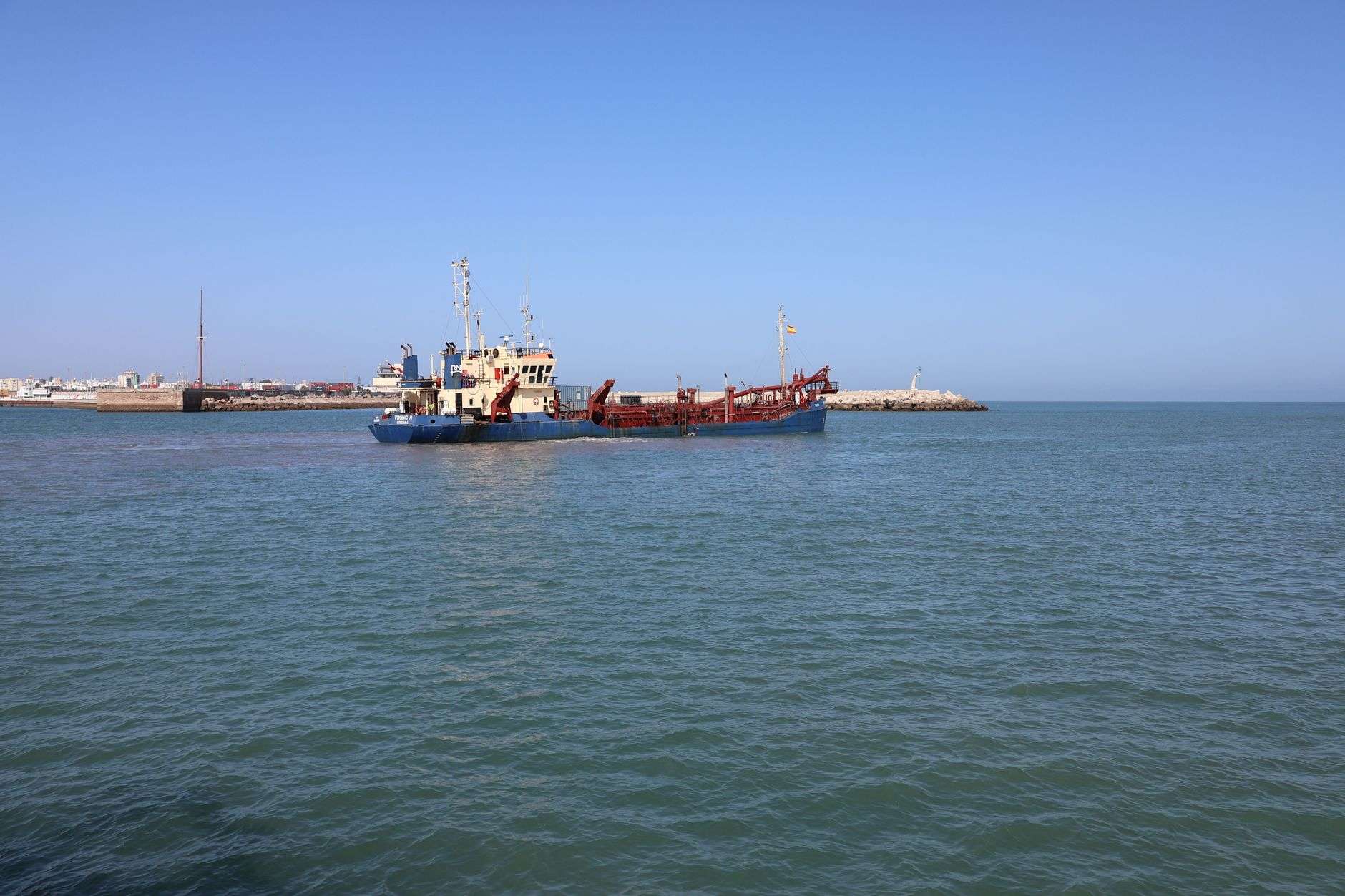
The U.S. Army Corps of Engineers is once again dredging the shipping channel that runs through Mobile Bay, a yearly undertaking the agency calls essential to keeping the Port of Mobile open to deep-draft cargo ships. The project, which began roughly two weeks ago and is expected to continue for about seven months, has reignited a long-running conversation between the Corps and local environmental advocates over how the dredged sediment is ultimately handled. A bucket dredge is currently working the channel, systematically lifting sediment that naturally accumulates on the bay floor. Colonel Kelcey R. Shaw, commander and district engineer for the Army Corps of Engineers Mobile District, said the scale of the annual effort is difficult to picture without a comparison. He described the volume removed each year as roughly 600,000,000 cubic yards, an amount he likened to stacking material four football fields long and 750 feet tall, or filling the equivalent of four RSA Trustmark Building towers in downtown Mobile.
Why the Corps Says the Work Is Necessary
According to Colonel Shaw, the dredging is not optional if the region wants to keep hosting large commercial vessels. Sediment naturally settles into the shipping channel over time, and without regular maintenance, the channel would gradually become too shallow for the deep-draft ships that call on the Port of Mobile. Shaw said the economic stakes are significant, warning that halting the work would cost Alabama its ability to handle larger vessels and the commercial activity that comes with them. The Port of Mobile is a major economic engine for the region, supporting shipping, manufacturing, and logistics jobs throughout Southwest Alabama, so keeping the channel navigable is treated as a priority by state and federal officials alike.
The Mobile Ship Channel extends approximately 36 miles from the Gulf of Mexico to the turning basin at the Port of Mobile’s McDuffie Terminal. The authorized depth is 45 feet, with a width of 400 to 500 feet in most reaches. The channel handles roughly 3,500 vessel calls annually, carrying everything from containerized cargo and bulk commodities like coal and grain to forest products and steel. The Alabama State Port Authority has invested heavily in expanding container capacity at the APM Terminals facility, betting on growth in Gulf Coast trade lanes that require reliable channel depth for the largest vessels in the global fleet.
Baykeeper Raises Questions About Sediment Placement
Not everyone is focused solely on the channel itself. Cade Kistler, representing the nonprofit environmental group Mobile Baykeeper, has questioned whether the Corps is doing enough to put the dredged material to beneficial use rather than simply disposing of it in open-water sites in the bay. Baykeeper has advocated for using dredged sediment to restore marsh habitat, nourish eroding shorelines, and build resilience against sea-level rise — approaches the Corps has employed in other districts but which Mobile Baykeeper argues have been underutilized here. The organization points to the loss of thousands of acres of coastal marsh in Mobile Bay over the past century, driven by subsidence, erosion, and sediment starvation from upstream dams.
Kistler said the Corps’ current plan places most of the material in designated open-water disposal areas within the bay, a practice that Baykeeper contends buries benthic habitat and can contribute to water quality degradation. The group has pushed for a larger share of the sediment to be directed to thin-layer placement on marsh platforms, shoreline stabilization projects, and the creation of bird nesting islands — techniques that have shown promise in Louisiana’s coastal restoration program and the Corps’ own projects in Galveston Bay and the Mississippi Sound.
Corps Response and Regulatory Framework
The Corps maintains that its disposal practices comply with all federal and state regulations, including the Clean Water Act Section 404 permitting process and the Marine Protection, Research, and Sanctuaries Act. Colonel Shaw said the Mobile District evaluates beneficial use options for every dredging cycle but that site suitability, cost, and logistics often limit the volume that can be diverted from open-water disposal. The Corps’ standard practice involves placing material in historically used disposal areas that have been modeled for dispersion and environmental impact. These areas are typically in deeper parts of the bay where the sediment settles with minimal effect on navigation or water quality.
Beneficial use projects, while environmentally desirable, often require additional handling — pumping sediment through pipelines to marsh sites, constructing containment dikes, and monitoring placement elevations — that can multiply costs several times over open-water disposal. The Corps’ budget for operations and maintenance is appropriated by Congress, and the agency must balance environmental benefits against the mandate to keep the channel open at the lowest reasonable cost. Shaw noted that the Mobile District has successfully completed beneficial use projects in recent years, including marsh creation at the former Blakely Island disposal site and shoreline nourishment at Dauphin Island, but that the volume suitable for such projects represents a fraction of the total annual dredging yield.
Economic Context and Port Competitiveness
The Port of Mobile’s competitive position in the Gulf Coast marketplace depends on channel reliability. Competing ports in Houston, New Orleans, and Savannah have all invested in channel deepening projects to accommodate post-Panamax vessels — ships too large for the original Panama Canal locks that now dominate global trade routes. Mobile’s 45-foot channel depth is sufficient for most current vessel calls but leaves no margin for the largest container ships, which can draw 48 feet or more when fully loaded. The Alabama State Port Authority has sought authorization for a 50-foot channel, a project that would require a new General Reevaluation Report and congressional authorization.
In the meantime, maintenance dredging is the only tool that preserves existing capacity. The Port of Mobile handled 27.6 million tons of cargo in fiscal year 2023, ranking 12th nationally by tonnage. Its top commodities by volume include coal, crude petroleum, iron and steel, forest products, and agricultural products. The port’s economic impact extends well beyond the waterfront — a 2022 study by the University of South Alabama’s Center for Real Estate and Economic Development estimated the port supports 311,000 jobs statewide and contributes $85.4 billion in economic value. Those figures underscore why state leaders from both parties have consistently supported the Corps’ maintenance dredging program.
Environmental Perspectives and Scientific Debate
Mobile Baykeeper’s concerns reflect a broader debate within the coastal science community about sediment management in estuarine systems. Mobile Bay is a drowned river valley estuary fed by the Mobile-Tensaw River system, which drains approximately 44,000 square miles across Alabama, Mississippi, Georgia, and Tennessee. The bay’s historical sediment budget has been altered by upstream dams that trap sediment, channelization that accelerates flow, and sea-level rise that drowns marshes faster than they can accrete naturally. The Corps’ annual dredging removes sediment that would otherwise slowly disperse through the bay system — sediment that some scientists argue could be harnessed to rebuild the very marshes that protect shorelines and support fisheries.
Research from the Dauphin Island Sea Lab and the University of South Alabama’s Stokes School of Marine and Environmental Sciences has documented the decline of submerged aquatic vegetation and intertidal marsh in Mobile Bay over the past 50 years. These habitats serve as nursery grounds for shrimp, crab, and finfish species that support both commercial and recreational fisheries — a billion-dollar industry in coastal Alabama. Thin-layer sediment placement, where dredged material is spread in thin layers over existing marsh platforms to increase elevation without smothering vegetation, has emerged as a promising technique. Pilot projects in the Mississippi Sound and at the Grand Bay National Estuarine Research Reserve have shown measurable gains in marsh elevation and vegetation density within two growing seasons.
Funding Mechanisms and Policy Pathways
The Water Resources Development Act (WRDA), reauthorized periodically by Congress, provides the primary legislative vehicle for authorizing Corps projects and modifying disposal policies. Recent WRDA cycles have included provisions encouraging beneficial use of dredged material, setting national goals for the percentage of dredged sediment put to productive use, and authorizing cost-share adjustments that make beneficial use projects more financially attractive to non-federal sponsors. The 2020 WRDA included a “Beneficial Use of Dredged Material” pilot program that selected 10 projects nationwide for favorable cost-sharing — Mobile Bay was not among them, a point Baykeeper has raised in advocating for the region’s inclusion in future rounds.
At the state level, the Alabama Department of Conservation and Natural Resources (ADCNR) manages the Alabama Coastal Area Management Program, which reviews federal consistency for activities affecting coastal resources. ADCNR has expressed support for beneficial use in principle but notes that project-specific agreements between the Corps, the port authority, and state agencies are required to move individual projects forward. The Mobile Bay National Estuary Program, one of 28 estuaries of national significance designated by the EPA, has convened stakeholder working groups on sediment management that include the Corps, Baykeeper, the port authority, and academic researchers.
Looking Ahead
The current dredging cycle will continue through the summer and into the fall, with the bucket dredge methodically advancing up the channel. Meanwhile, the conversation about sediment placement continues in permit reviews, public meetings, and congressional testimony. The Corps has committed to evaluating beneficial use options for each future dredging cycle, and Baykeeper has pledged to keep pressing for a larger share of the material to stay in the bay’s ecological system rather than being consigned to deep-water disposal sites.
For the communities around Mobile Bay, the stakes are both economic and environmental. The port’s vitality funds schools, infrastructure, and jobs across the region. The bay’s health sustains fisheries, protects property from storms, and defines the quality of life that makes coastal Alabama distinctive. The dredge at work in the channel this spring sits at the intersection of those imperatives — removing the sediment that threatens one while holding the material that could help the other. Whether the two imperatives can be reconciled more fully than they have been to date will shape the bay’s trajectory for decades to come.