

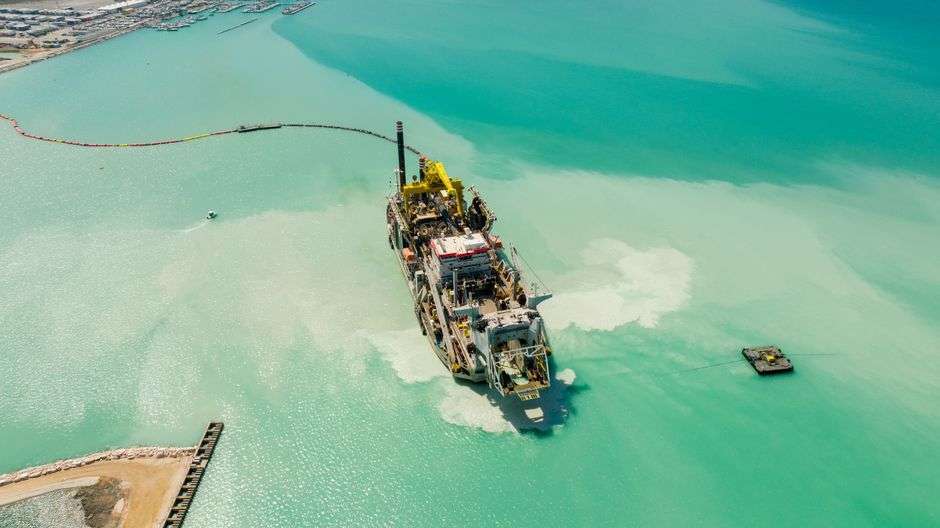
The disposal of Mobile Bay dredging spoils has long pitted local environmental advocates against economic development interests. Now it is dividing Alabama’s congressional delegation in Washington, too.
At the center of the dispute is a practice locals have come to call “mud dumping”: the process of taking sediment excavated from the Mobile Harbor shipping channel and spraying it in separate areas of the bay — a technique the U.S. Army Corps of Engineers formally refers to as thin-layer placement.
For environmental advocates, the practice threatens the bay’s ecology. For port interests, the channel deepening that made Mobile one of the Gulf’s premier harbors depends on an affordable way to manage the material that regular maintenance dredging unearths. The two positions have collided in statehouses and courtrooms — and now they are splitting Alabama’s representatives in Congress.
The Save Our Bay Act
This past year, the watchdog group Mobile Baykeeper joined State Sen. Chris Elliot, R-Josephine, and Rep. Rhett Marques, R-Enterprise, in successfully pushing environmental protection legislation through Alabama’s Republican-dominated legislature over initial financial objections by the Alabama Port Authority.
That law — the “Save Our Bay” Act, which takes effect Oct. 1 — places state-level requirements on the corps to use no less than 70 percent of dredged material for “beneficial use” projects such as shoreline and marsh restoration. Such projects can quickly compound disposal costs, which is why the port initially resisted.
The port later became more favorable to the legislation after language was added that only requires the mandate when federal funding is available for the more expensive option. The corps’ most recent communications, though, have indicated it plans to continue using thin-layer placement in the bay and considers it a form of beneficial use itself — a reading that would neatly sidestep the mandate.
“The Corps is not removing any legally available and environmentally reviewed option from future use,” an Aug. 10 press statement from the agency stated. “In Mobile Harbor, thin-layer placement has been evaluated and identified as beneficial use of dredged material. It is not the opposite of beneficial use. It is one of the tools used to manage suitable sediment in a controlled way.”
Baykeeper’s State-Level Play
Baykeeper believes the Alabama Department of Conservation and Natural Resources and the Alabama Department of Environmental Management could mandate the state’s new 70 percent threshold through the corps’ permit application process, since the Corps’ coastal permits require state water quality and coastal management concurrence. The group argues those agencies still have a meaningful role in determining whether the corps’ dredged material plans comply with water quality rules.
During an Environmental Management Commission meeting last month, ADEM Director Edward Poolos appeared to signal the agency intends to enforce the new law in its upcoming coastal permitting. “This permit is required to do any dredging within the ship channel regardless of where the material will be placed — so this is just within their normal process,” Poolos said. “After the Corps responds to public comments and finalizes their proposal, they will request two letters of concurrence from the Department. Inside those letters will be where we intend to place those requirements from the [Save Our Bay Act].”
The Fight Moves to Washington
Baykeeper’s policy push has extended to Congress, where two Alabama lawmakers have prominently championed the group’s cause — and where the delegation has split.
U.S. Sen. Katie Britt, R-Enterprise, pressed corps leadership on the issue during a June 2025 Senate subcommittee hearing, questioning Lieutenant General William H. “Butch” Graham Jr. and touting her efforts to include new regulations in the Water Resources Development Act of 2024 requiring the corps to increase beneficial use of dredged spoils.
“I included a provision in there that said no less than 70 percent of suitable dredge material would be used for beneficial use,” she said. “This is critically important. We can do two things. We can make sure that we have the economic engine that is the Port of Mobile and we responsibly preserve our natural resources. It is imperative that this dredge material could be used for habitat restoration, for beach nourishment, for wetland creation, and I am not going to move off of that.”
On the House side, Rep. Shomari Figures, D-Mobile, has sponsored efforts through the Water Resources Development Act of 2026 to prohibit mud dumping in Mobile Bay altogether and to federally fund the corps to use alternative, more costly practices.
Tuberville’s Silence
Absent from those public stands has been U.S. Sen. Tommy Tuberville, R-Auburn — Alabama’s other senator and now the Republican nominee for governor — who has not released any definitive position on the issue. Requests for comment from his gubernatorial campaign have gone unacknowledged.
A review of press releases and public statements from Tuberville’s Senate office found no mention of the controversy other than celebrating additional federal funding for Mobile Harbor channel dredging and noting funding for sediment management studies in a recent appropriations bill.
One of the few reported accounts of Tuberville’s private posture surfaced at a Baykeeper town hall in Theodore, where charter fishing captain Richard Rutland said he traveled to Washington in January 2025 and met with Alabama’s federal delegation. He said the message was “well received,” specifically citing a meeting with Tuberville, who he said “truly listened” to their concerns.
“He was very receptive,” Rutland said. “He said he had been hearing concerns from his friends on the bay. We stood up to take a picture and he told us he was behind us 100 percent.”
That account appears at odds with Tuberville’s more recent public posture. In a speech to the Mobile Chamber in January, he described Mobile as central to Alabama’s future, praised port growth, and acknowledged the dredging controversy — without taking a side.
“We dredged it,” Tuberville said of the recently completed deepening and widening of the channel. “Now we’ve had a lot of controversy with the dredging, and I’ve been involved in a little bit of that. But you know, you got to do things. You got to make things work. Sometimes you got to step on people’s toes to make things better.”
He then turned to regulation, criticizing federal rules that “have just suppressed this country” and praising new federal leadership, including EPA Administrator Lee Zeldin and Adam Telle, the president’s pick to lead the corps.
“[Telle] understands less regulations, less rules to make things happen, and we have to have that, especially here in Mobile,” Tuberville said. “Because things have got to happen faster.”
What Comes Next
With the Save Our Bay Act taking effect Oct. 1, the state agencies’ concurrence letters will become the next battleground. Environmental advocates believe they can force the 70 percent beneficial-use threshold through the permit process; the corps believes its own environmental reviews already justify its practices.
Between them sits a delegation that cannot agree — one senator championing restrictions, one House member pushing a ban, and another senator whose position remains, deliberately or not, unspoken.
Jones Endorses a Federal Ban; Tuberville Stays on the Sidelines
The divide has already reached the governor’s race. Democratic nominee Doug Jones has endorsed an outright ban on in-bay disposal, pointing to the collapse of Mobile Bay’s oyster populations, which his campaign noted have declined more than 80 percent since 1950. “Mobile Bay is one of Alabama’s greatest natural resources, providing both recreational and commercial benefits that in turn lead to economic benefits,” Jones said in a statement provided by his campaign. “Protecting it is a solemn responsibility.”
Jones credited state lawmakers for the legislation requiring that 70 percent of material dredged from the channel be set aside for beneficial use projects, pointing to shoreline restoration work along Dauphin Island as an example of what the mandate should fund. But he argued state law alone cannot restrain a federal agency, and he threw his support behind the federal ban on thin-layer placement introduced through the Water Resources Development Act by U.S. Rep. Shomari Figures, D-Mobile.
“The Corps of Engineers’ practice of thin-layer placement is not a ‘beneficial use,'” Jones said. “It is just the opposite. Spraying mud that kills our oysters is not a beneficial use, it’s a shortcut, and it’s harming people who depend on the bay for their livelihoods. That practice has to end, but state law alone can’t stop a federal agency from harmful environmental practices.”
Jones also pointed to the scale of what is coming: roughly 90 million cubic yards of sediment are expected to be dredged from Mobile Bay over the next decade. He argued the federal government must pay for genuine restoration rather than take shortcuts by returning the material to the water. “The money has to be there to do it right, so the Mobile Ship Channel stays properly maintained, and the bay and our coast get the protection they deserve, not one at the expense of the other,” he said.
Republican nominee Tommy Tuberville, by contrast, has not publicly taken a position on in-bay disposal, despite repeated requests for comment — leaving the two major-party nominees on opposite sides of the only coastal issue that has managed to unite bay-area residents of both parties.