Senate pro tem says Alabama must address gas tax, eyes Port of Mobile
Senate Pro Tem Del Marsh says Alabama must address a gas tax in the 2019 session, with a share of revenue eyed for deepening the Port of Mobile and roads.
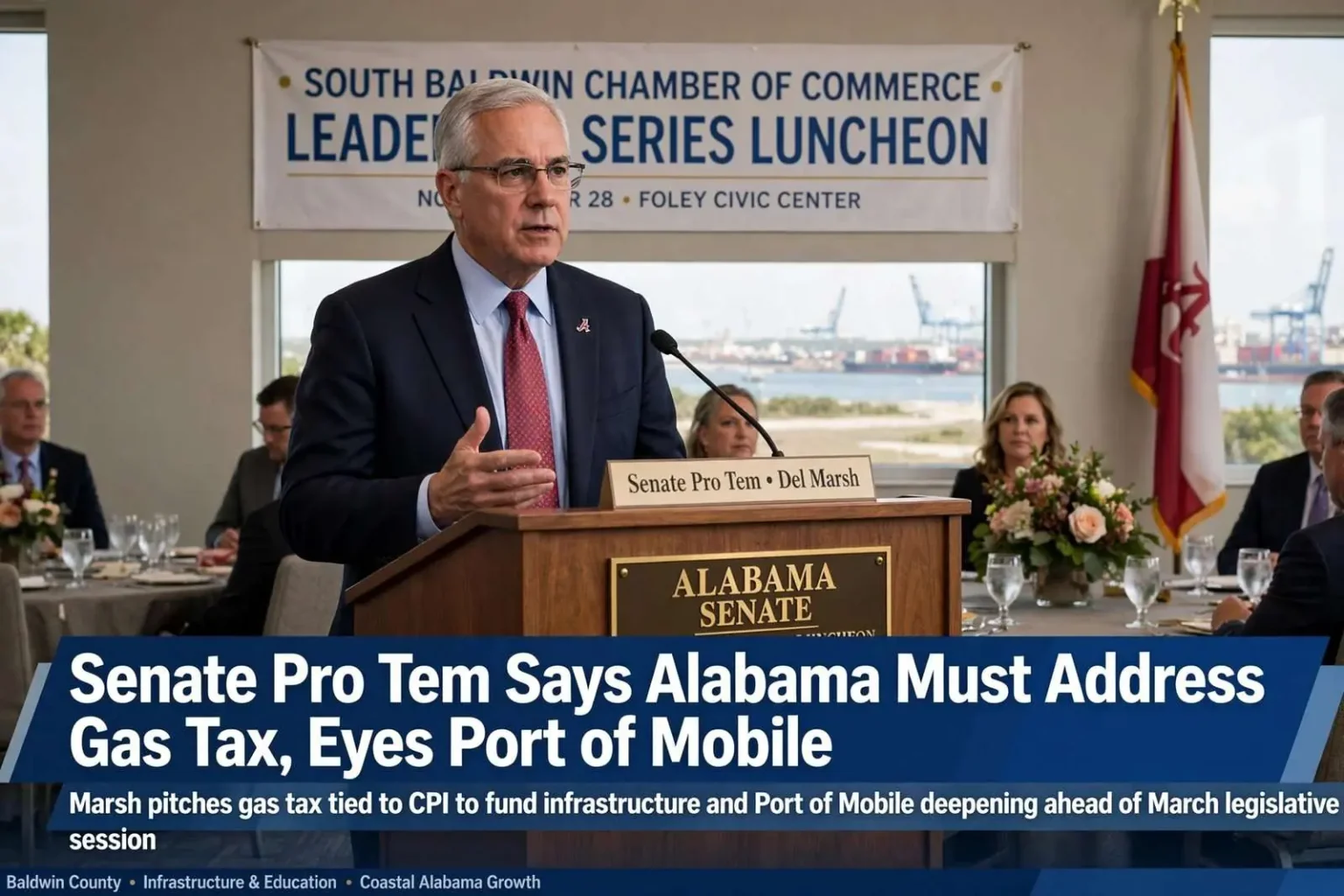
When the Alabama Legislature convenes in March, Senate Pro Tem Del Marsh says a gas tax is likely to come up “a lot” — and he thinks it is vital to the state’s infrastructure future.
Marsh made the comments Nov. 28 at the Leadership Series Luncheon at the Foley Civic Center, part of the South Baldwin Chamber of Commerce’s ongoing series, addressing a Baldwin County business audience on the two major issues he said were on his mind: education and infrastructure. Speaking in one of the state’s fastest-growing counties, he tied the discussion directly to the growth pressures that have made roads, bridges and port capacity a daily concern for coastal Alabama.
“I’ll say the dreaded word — a gas tax,” he told the crowd, acknowledging how politically charged the subject has been in a state that has avoided raising its fuel tax for decades. His framing suggested he expects the debate to be unavoidable rather than optional, and that the Legislature’s next session would be shaped by how lawmakers confront it.
The Port of Mobile at the center of the plan
Marsh pointed to the Port of Mobile as a key component of any infrastructure strategy. “If we can deepen that port then we can double the amount of commerce coming and going and that’s important to the state of Alabama,” Marsh said, adding that talks included sending a share of any tax increase to the port authority and pursuing federal matching money to deepen the harbor.
The structure he outlined reflects how port projects are typically financed. Deepening a harbor to accommodate larger, deeper-draft vessels requires enormous capital spending, and federal cost-sharing programs are designed so that state and local partners who put money on the table can unlock matching federal dollars. Dedicating a slice of a state fuel-tax increase to the port authority would give Alabama the local contribution needed to pursue that federal money — a mechanism that turns a modest state levy into a much larger investment.
The commerce argument behind it is straightforward. Container ships and bulk carriers get larger every year, and ports that cannot receive them watch that cargo divert to cities whose harbors have been deepened. Marsh’s claim that a deepened port could double the amount of commerce moving through Mobile underscores what he sees as the return on the investment: more cargo moving through Alabama means more jobs on the docks, more freight on the state’s highways and rail lines, and more industrial development gravitating to sites along the Mobile River and the interstate corridors that feed it.
Marsh said Gov. Kay Ivey is on board. “Any infrastructure bill the governor is going to be connected with will have an element for the port in it,” he said, aligning the Senate’s leadership with the governor’s office on the direction of the legislation ahead. That unity between the two chambers’ leadership and the governor’s office is often the difference between an infrastructure bill that passes and one that stalls, since a major revenue proposal typically needs all three to move through the State House in a single session.
Why the gas tax has been stuck since 1992
Raising the gas tax has been politically difficult since it was last increased to 18 cents per gallon in 1992. Marsh noted that cars get more miles per gallon now while the flat tax has stayed the same for 26 years, a combination that has quietly eroded what the tax can fund. As vehicles burn less fuel per mile, a per-gallon tax collects less revenue even as traffic grows and construction costs climb.
The arithmetic is the crux of the problem for every state with a flat fuel levy. Alabama’s 18-cent rate was set when vehicles traveled fewer total miles on less fuel-efficient engines, and each year of improving fuel economy and rising pavement costs has stretched the same revenue thinner. Highway departments across the country have faced the same squeeze, and a growing number of states have turned to some form of indexation to close the gap. A tax designed to make drivers pay for the roads they use no longer tracks actual road use when the same gallon of gas moves a car twice as far as it did when the rate was fixed.
Marsh proposed tying future increases to the Consumer Price Index, with floors and ceilings so the rate could not rise more than a set amount each year. The CPI structure is a common compromise: it lets the tax keep pace with inflation automatically, while the floor and ceiling give lawmakers and the public a guarantee against sudden swings in either direction. Whether that design can win the votes needed in March will test how much appetite the Legislature and the public have for ending the 26-year freeze.
Education: one plan from pre-K through college
On education, Marsh said the state needs a comprehensive plan spanning pre-K, K-12 and higher education rather than separate efforts for each level. The argument is one that has gained traction among policymakers: when early childhood programs, public schools, community colleges and universities each pursue their own strategies, students fall through the gaps between them, and the state’s investment in one stage can be undone by weaknesses in the next.
A seamless pipeline approach links the stages directly. Pre-K prepares children for kindergarten readiness standards, K-12 curricula align with the skills community colleges and universities expect, and higher education programs connect to the workforce needs of employers — including the industrial and logistics employers that port expansion is expected to attract. For a state trying to raise educational attainment while competing for industrial investment, the two agendas reinforce each other.
Marsh’s audience in Foley had a direct stake in both subjects. Baldwin County’s school system is among the fastest-growing in Alabama, adding students each year as families move to the coast, and the county’s roads — from the beach routes to the Interstate 10 corridor — have absorbed growth that the state’s existing funding formulas have struggled to match. Infrastructure and education are the two services expanding counties feel the pinch of first.
What Baldwin County’s growth means for the debate
The venue for the remarks was telling. South Baldwin County has been transformed over recent decades by coastal development, retirement migration and tourism, and the chamber’s Leadership Series brings state leaders face to face with the local business community on exactly the issues that growth creates. A senator talking about road funding in Foley is talking about the bridges, beach highways and interstate bottlenecks that his audience drives every day, and the luncheon format gives those residents a rare direct hearing on the state’s budget priorities.
Baldwin and Mobile counties together represent the state’s coastal economy, anchored by the port, the shipbuilding industry, tourism and a fast-growing population base. When Marsh links a gas tax to port deepening and road building, the connection lands differently there than it might in other parts of the state: coastal residents see the freight, the traffic and the growth that the investment is meant to serve.
The politics remain formidable regardless of geography. A Legislature that has not raised the gas tax in 26 years will weigh any proposal against constituents’ resistance to paying more at the pump, and the CPI-indexed structure with floors and ceilings is designed partly to answer that resistance by making increases predictable and bounded. Marsh’s willingness to say “the dreaded word” out loud to a business audience signals that the Senate’s leadership intends to have the argument in public rather than defer it for another session.
What comes next in March
The legislative session that convenes in March will show whether the groundwork laid by those remarks translates into a bill. The elements Marsh described — a fuel-tax increase tied to the Consumer Price Index, a dedicated share for the port authority, the pursuit of federal matching money for harbor deepening, and a comprehensive education plan — sketch the outlines of what a major infrastructure-and-education package would look like if it advances. Committee hearings, budget estimates and public comment will all shape the final version, and each stage gives supporters and opponents another chance to weigh in before any vote is called.
Each piece carries its own constituency. Highway and bridge needs argue for the tax; the port component gives coastal lawmakers a stake; the federal match promises to multiply the state’s money; and the education plank broadens the package beyond asphalt. Marsh’s remarks at the Foley luncheon served as an early test of how the argument plays with the public — delivered plainly, with the “dreaded word” spoken first, and framed as a choice about the state’s competitiveness rather than merely a new levy.
For residents of Baldwin County and the rest of the state, the practical stakes will show up in the quality of the roads they drive every day, the growth of the port that employs their neighbors and the schools their children move through. Whether the March session delivers on the outline Marsh described will determine whether those needs finally get the revenue stream that 26 years of flat funding have left unmet.