
Mobile Agrees to $25,000 Fine Over Removal of Semmes Statue, Attorney General Says
Alabama's attorney general says Mobile violated the Memorial Preservation Act by removing the Raphael Semmes statue and will pay a $25,000 fine.
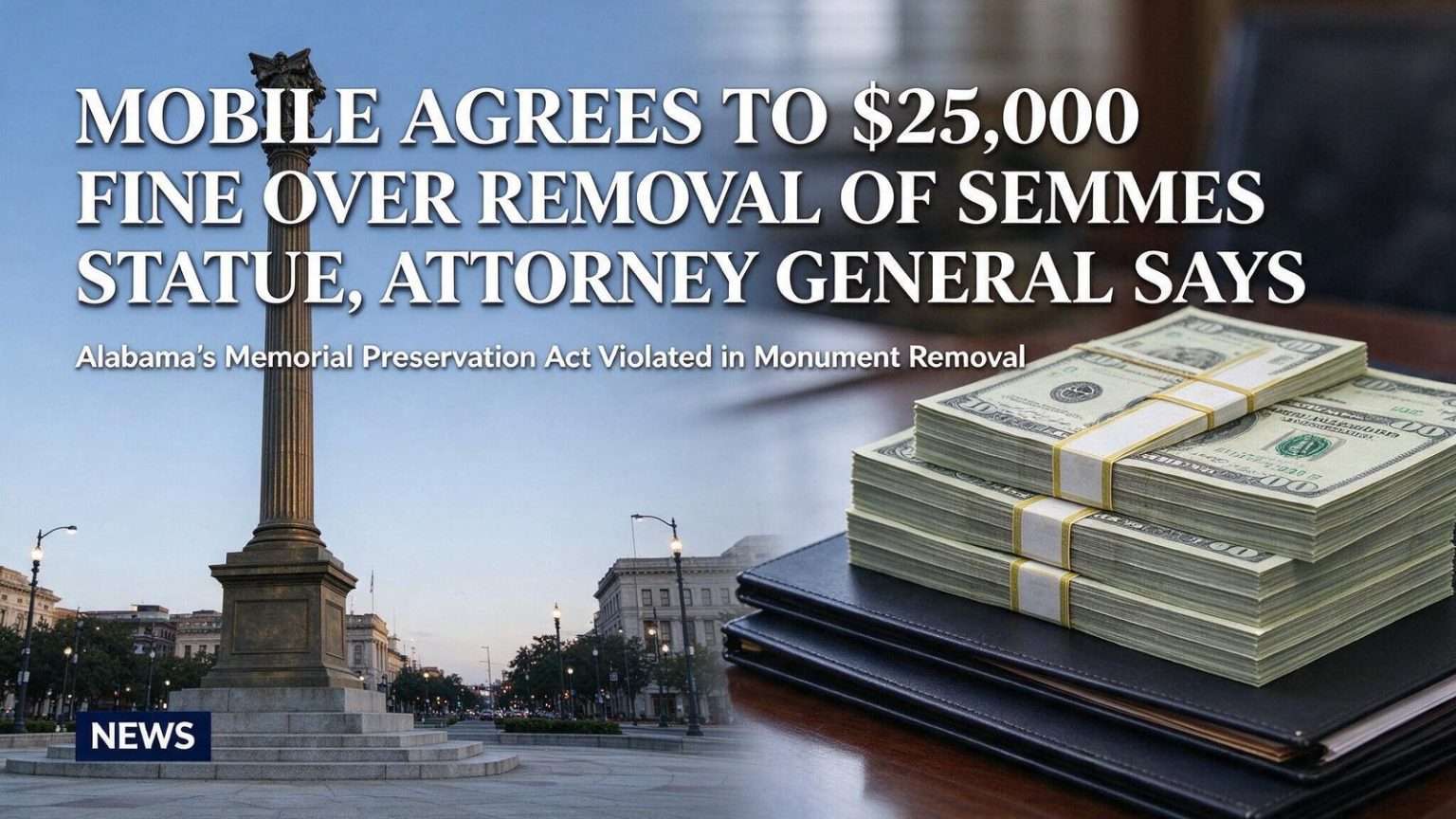
MOBILE, Ala. — The City of Mobile violated Alabama’s Memorial Preservation Act when it took down a statue of Confederate Adm. Raphael Semmes, Attorney General Steve Marshall said Monday, and the city has agreed to pay the $25,000 penalty the law requires. The announcement closed a chapter in the state’s running legal and political fight over Confederate monuments — and put Mobile in the company of Alabama cities that have learned the act has teeth.
Marshall announced his determination in the case after the city acknowledged that the removal was intended to be permanent. According to the attorney general, the city agreed to pay the fine without a court order, and the state and the city entered into a legal agreement resolving the matter. The resolution spared both sides a courtroom fight over the meaning of the statute, but it left the underlying policy dispute — who decides what stands on public ground in Alabama — very much alive.
What the Law Requires
The Alabama Memorial Preservation Act, passed by the Legislature in 2017, restricts the removal or alteration of architecturally significant buildings, memorial buildings, memorial streets and monuments that have stood on public property for 40 years or more. The statute assigns enforcement authority to the attorney general, in the same way his office is empowered to bring civil actions to protect state interests. In practice, that makes the act unusual among state monument laws: rather than relying on private plaintiffs or local referendums, it hands enforcement to the state’s top lawyer, who can investigate a removal, make a public determination, and demand the fine the law prescribes.
The law’s supporters framed it in 2017 as a shield against the wave of monument removals then sweeping the country, arguing that memorials of every era deserve protection from political swings at the municipal level. Critics countered that it stripped communities of the right to decide what their own parks and squares commemorate, and that it used state power to override local judgment. Mobile’s experience is a case study in how that argument plays out: the act does not stop a city from taking down a monument, but it makes doing so an expensive public admission of a legal violation.
The penalty structure is deliberately simple. The fine set by the act is a flat $25,000 for a violation — not scaled to the monument’s value, the cost of its removal, or the city’s budget. For a municipality, the number is modest; for a state statute, the symbolism of a city paying it is substantial, because it creates a public record that the law was broken and a precedent that the attorney general will enforce it.
The Statue and the Admiral
The monument at the center of the case honored Raphael Semmes, the naval officer who commanded the Confederate commerce raider CSS Alabama and holds a particular place in Mobile’s history. Semmes later made his home in Mobile, practicing law in the city after the war, and the statue that commemorated him was among the oldest Confederate monuments in the state — a 120-year-old bronze figure, by the attorney general’s description, that had stood on public property within the city for more than a century.
Monuments of that age occupy a complicated position in Gulf Coast cities. They were erected decades after the war itself, in eras when Confederate memory was being consciously shaped across the South, and they have stood long enough to become woven into the physical identity of the blocks where they rise. To preservationists, that longevity is precisely why they deserve protection; to others, the same longevity is the problem — a century of standing over a public square is a century of civic meaning, including the meanings that changed.
The Removal
“On June 4, the City of Mobile removed a 120-year-old statue of Admiral Raphael Semmes from public property within the city,” Marshall said. “Now that the City has acknowledged its intent to remove the monument permanently, the facts surrounding the removal and a plain reading of the law led me to determine that the Act was violated.”
The removal came at one of the most charged moments in modern American civic life, when cities across the country were re-examining the Confederate symbols in their public spaces. Mobile’s decision placed it among a wave of Southern municipalities acting quickly — often overnight, with cranes arriving before dawn — to take down monuments that had stood for generations. The speed of those removals was itself part of the controversy: cities moved before courts could intervene, and states like Alabama had written their monument laws in anticipation of exactly that.
Under the Memorial Preservation Act, the question was never whether Mobile had the physical ability to remove the statue — it plainly did — but whether a city could do so lawfully and permanently. The statue was well past the act’s 40-year threshold, standing on public property within the city, and the removal was not a temporary relocation for construction or conservation. Once the city confirmed its intent was permanent, the elements of a violation were, in the attorney general’s reading, complete.
The Agreement
Marshall said the city agreed to pay the fine without a court order, and the state and the city entered into a legal agreement resolving the matter. That mechanism matters for more than bookkeeping. A negotiated agreement avoids a precedent-setting court ruling that could have clarified — or expanded — the act’s reach, and it leaves both parties room to characterize the outcome: the state as vindicated in its enforcement, the city as having paid a statutory fine while standing by its decision to remove the monument.
For Mobile’s taxpayers, the $25,000 is the direct cost of the removal’s legal aftermath, separate from the operational expense of the removal itself. For the state, the payment completes the first fully resolved enforcement cycle under the act in one of Alabama’s largest cities — a demonstration that the statute’s penalty provision is not theoretical.
Whether the agreement settles anything in the larger sense is another question. The Semmes statue debate joined arguments that cities across Alabama and the South have been having for years — about history and heritage, about who public squares belong to, and about whether a state legislature should override a city’s judgment about its own landmarks. The Memorial Preservation Act was written to force those arguments into the open, and its enforcement in Mobile did exactly that: the monument came down, the state demanded the price the law set, and the city paid it.
The agreement also settles how the matter ends procedurally, which has practical value for a city government that prefers to spend its legal capital elsewhere. Litigation under the act could have dragged through months of motions and appeals, with the statue itself sitting in storage while the two sides argued. A negotiated resolution closes the file cleanly: the state gets its determination and its fine, the city keeps its policy outcome, and neither party has an incentive to reopen the question. In municipal terms, that is what a workable compromise looks like — even when the underlying disagreement remains as sharp as ever.
What Comes Next
The agreement resolves the legal question raised by the Semmes removal, but it does not resolve the political one. Alabama’s monument law remains on the books, and the attorney general’s office has shown it will apply the same standard to any city that follows Mobile’s path. Municipal leaders weighing similar decisions now do so with the Mobile precedent in front of them: removal is possible, permanence triggers the act, and the price is $25,000 plus the state’s public determination of a violation.
For Mobilians, the episode was a reminder of how much meaning can attach to a single bronze figure on a downtown corner. The statue’s absence changes the streetscape it had defined for 120 years; the fine’s payment writes the removal into the city’s legal record; and the debate it crystallized — about memory, governance, and who decides — continues in city councils and legislative chambers across the state.
The Legislature could, in theory, revisit the act’s terms, as lawmakers have debated amendments covering everything from exemptions to penalties since its passage. Until it does, the framework that governed Mobile’s case stands: monuments 40 years or older on public property are presumed protected, the attorney general enforces that presumption, and violations carry the flat fine the city has now paid.
What the agreement cannot do is restore the status quo ante, and few on either side expect it to. The statue is down, the city’s intent to keep it down is on the record, and the state’s position — that the law was violated and the price was paid — is now a matter of documented agreement between Mobile and the state of Alabama. In the long argument over Southern monuments, that is not a conclusion. It is a data point: one city, one statue, one fine, and a statute that has now proven it will be enforced.


