

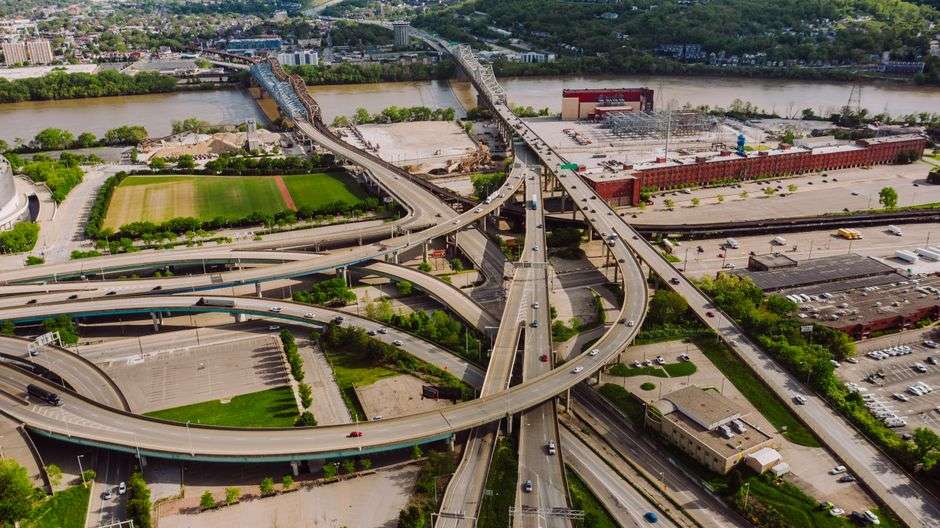
Ballooning construction costs have forced the long-delayed, multibillion-dollar I-10 Mobile River Bridge and Bayway project to be split into two phases, with work finally slated to begin before the end of the year.
The Alabama Department of Transportation announced that the decades-old effort to improve Interstate 10 with a six-lane bridge over the Mobile River and a six-lane highway over Mobile Bay is moving forward with renewed support from local, state and federal officials. Because of increased building costs and unanticipated engineering challenges, the project will now come to fruition in halves.
What gets built first
The Mobile River Bridge will be completed in the first phase of the project, along with interchange improvements in Mobile and Baldwin counties leading up to the highway, according to ALDOT. Instead of beginning construction on a new bayway at the same time, the department will re-stripe the existing bayway to carry three lanes in each direction.
The first phase is expected to begin by the end of 2026 and end around 2031. The cost of that work alone is estimated at $3.2 billion.
“Updated engineering analysis revealed that constructing a completely new bayway structure concurrently with the Mobile River Bridge would cost substantially more than originally anticipated, pushing the total project cost beyond a financially viable level,” ALDOT said in a statement. “Phasing the project, alongside financial and procedural flexibility granted by the Trump administration, will allow the project to move forward. This flexibility allows for the preservation of certain grant funds within a phased approach, reducing costs.”
How it will be paid for
ALDOT expects to invest hundreds of millions of dollars from state and federal funding sources into the project over the course of construction. Currently, the entire effort has just under $1 billion in financial commitments. The state has pledged $250 million, and the federal government has awarded roughly $675 million.
The state has applied for a federal loan through the Transportation Infrastructure Finance and Innovation Act program to cover the remaining costs. ALDOT said it anticipates receiving a loan from the program that will jumpstart construction later this year.
The toll schedule
No tolls will be collected to pay for the bayway’s construction until the Mobile River Bridge opens. The Bankhead and Wallace Tunnels will remain open as toll-free options, along with the U.S. Highway 98 Causeway and the Africatown Bridge.
When tolling begins, the rates will be structured as follows:
• $60 unlimited monthly commuter pass, roughly $1.36 per trip for daily users.
• $3 per-trip ALGO Pass rate.
• $7.70 for users with interoperable transponders.
Local officials line up behind the plan
Elected officials at all levels praised the announcement. Mobile Mayor Spiro Cheriogotis said in a statement that a number of the city’s forthcoming projects depend on the bridge’s construction.
“This project will benefit our city and the entire Mobile Bay region,” he said. “The city of Mobile is committed to working with our partners at the local, state and federal level to get this project across the finish line. The future of Mobile has never been brighter.”
Merceria Ludgood, a member of the Mobile County Commission and chairwoman of the Mobile Metropolitan Planning Organization, said the new bridge will relieve traffic in Mobile’s Africatown community. Because most trucking and hazardous cargo traffic will take the Mobile River Bridge once it opens, she said the community founded by descendants of the Clotilda slave ship’s survivors “will breathe a sigh of relief.”
State Rep. Sam Jones, D-Mobile, said action must be taken now to prevent the project’s cost from increasing further.
“Any delays will only increase the costs, so I think it’s quite important we get it started and get it done because the cost won’t reduce in the future years,” Jones said in a statement.
A project defined by delay
The I-10 crossing has been studied, debated and redesigned for the better part of two decades. Earlier versions of the project foundered over tolling disputes, environmental reviews and funding gaps, and previous tolling proposals drew enough public opposition to help reshape local elections. Splitting the construction into phases is the latest attempt to reconcile an escalating price tag with the political and financial realities of building one of the largest infrastructure projects on the Gulf Coast.
For commuters, the near-term changes will be modest: a restriped bayway with six total lanes, no tolls until the bridge opens, and the existing toll-free alternatives across the bay. The larger transformation, a new six-lane span over the Mobile River, now has a start date, a budget and a construction timeline for the first time in years.
ALDOT says it will provide further construction scheduling details as the TIFIA loan process concludes and contracts are awarded.