For years, fishers, swimmers and environmental groups have complained that mud and silt from dredging in the Mobile Bay shipping channel has smothered seagrass, harmed oysters and clouded water that was once far clearer. Now those complaints are closer to prompting a federal ban on the practice, known as “thin-layer placement.” The shift from local grievance to pending federal law marks a rare moment when a dispute long argued at public meetings around the bay may be settled in Washington, and it puts Alabama’s congressional delegation at the center of a question that affects the state’s most productive estuary.
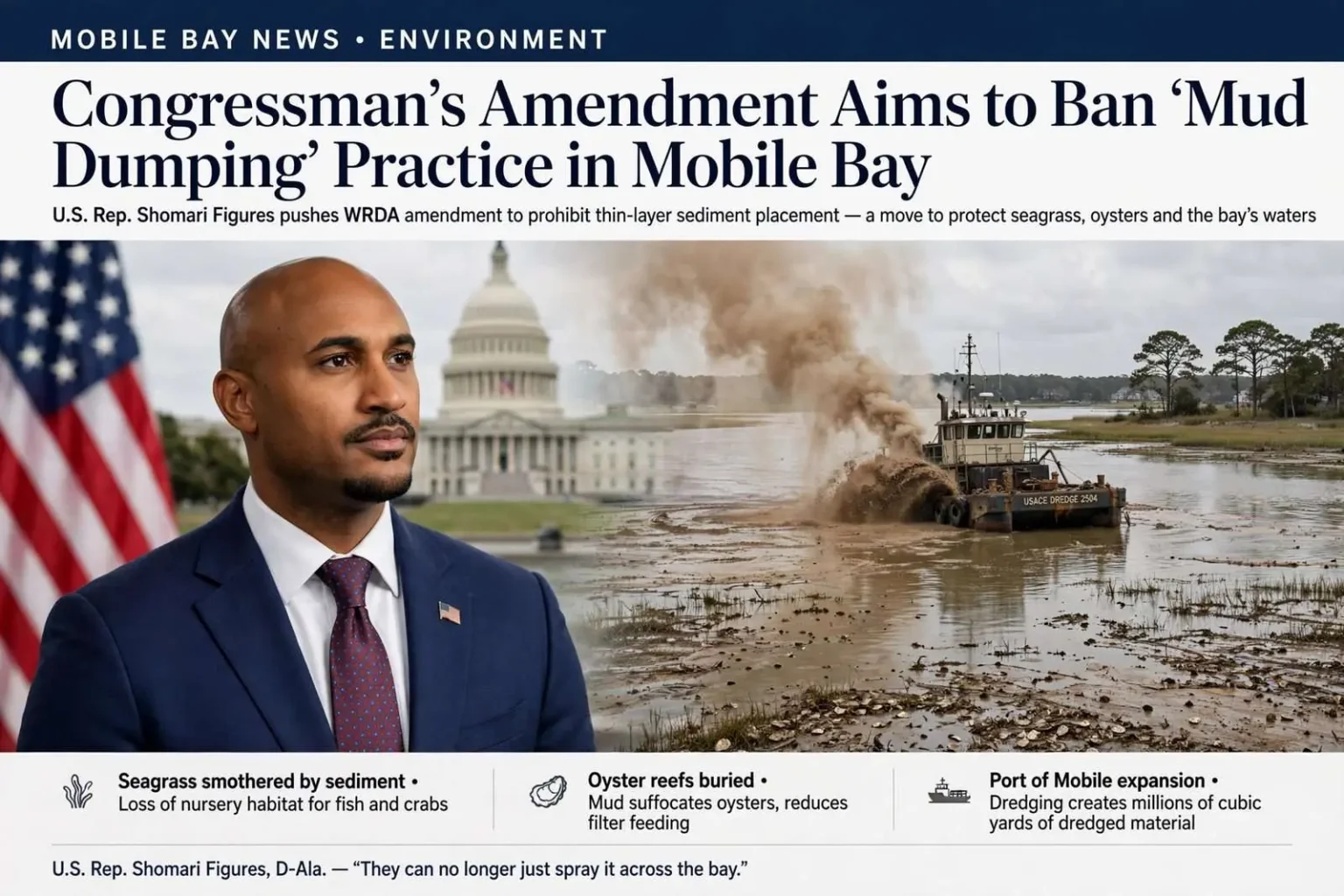
U.S. Rep. Shomari Figures, D-Ala., said he included an amendment in the 2026 Water Resources Development Act, or WRDA, that would prohibit the U.S. Army Corps of Engineers from using thin-layer placement in most circumstances. “It essentially removes that option away from the Corps to dispose of dredged material,” Figures said. “They can no longer just spray it across the bay.” The amendment’s placement in WRDA is significant: the legislation is the vehicle through which Congress authorizes the Corps’ civil works projects, which means the restriction would be written into the very law governing how the Corps operates in waterways like Mobile Bay.
The Corps has been completing a major effort to deepen and widen the Mobile shipping channel so larger ships can access the Port of Mobile, and has used thin-layer placement to dispose of dredged material during that work. The channel project is among the most consequential infrastructure undertakings in the state’s history: the port is one of the busiest on the Gulf of Mexico, and accommodating deeper-drafted container ships has been marketed as a generational economic advantage for south Alabama. The trade-off has been volume — dredging a channel on that scale produces enormous quantities of sediment that must go somewhere.
Thin-layer placement is the Corps’ term for spreading that dredged material in a relatively shallow layer across the bay bottom rather than piling it in a confined disposal area. The method disperses the sediment over a wide footprint, which the agency argues minimizes the depth of impact at any one spot. Critics counter that the practice simply spreads the damage across more of the bay, coating the shallow bottoms where submerged grasses and oyster reefs live.
What the Practice Does to the Bay
William Strickland, executive director of Mobile Baykeeper, said the practice clouds the water, blocks sunlight from reaching seagrass and can smother oysters, reducing marine life in the areas where it is used. Those effects compound each other. Seagrass beds are the bay’s nurseries — habitat for juvenile fish, blue crabs and the small organisms the food web depends on — and they survive only where sunlight reaches the bottom. Sediment suspended in the water column dims that light; sediment settled on the leaves buries it entirely.
Oysters suffer along a parallel track. Eastern oysters filter bay water and build reef structure that shelters other species, but a layer of fine mud settling over a reef can suffocate the animals or bury the hard bottom their larvae need to attach to. Fishers who have worked the bay for decades have described the same sequence: a placement area is used, the water turns opaque, and the fishing in the shadow of it goes quiet for a season or more.
The Army Corps has defended the practice, saying the sediment is a natural resource that can provide a beneficial use to the ecosystem when managed properly. The agency’s position holds that dredged material is not waste: bays and deltas are built by sediment, and placing it in thin layers can, under the right conditions, nourish marshes and offset subsidence rather than harm them. The dispute between the Corps and its critics is ultimately about where that line falls — and in Mobile Bay, opponents have concluded that the line cannot be trusted to the agency doing the disposing.
Alabama passed a state law in February limiting the practice, requiring that 70% of dredged material go toward beneficial use projects and excluding thin-layer placement from that category. The statute was the state’s first concrete answer to the complaints, and it reframed the debate by definition: under Alabama law, spraying dredged silt across the bay floor no longer counts as a “beneficial use” no matter how the Corps characterizes it. The measure also set the state on a collision course with federal practice, since the Corps’ projects proceed under federal authority even when they affect state waters.
The federal amendment would go further, allowing exceptions only for emergencies or when no timely alternative exists. That narrow carve-out is the amendment’s answer to the Corps’ most predictable objection: that in storm recovery or channel emergencies, the agency needs disposal options it can deploy quickly. Figures’ language keeps those contingencies available while removing thin-layer placement as the routine, default disposal method it has become during the channel project.
The measure advanced unanimously out of the House Transportation and Infrastructure Committee and awaits a vote from the full House, with Figures saying he expects bipartisan support to carry it through the Senate as well. Unanimous committee passage is notable for a restriction on a federal agency’s core operating practice, and it reflects how the politics of the issue cut across party lines. Coastal delegations from both parties have watched the Corps’ disposal practices in their own districts, and a restriction aimed at one bay’s grievance resonates in every coastal state where dredged material ends up where fishing and conservation interests would rather it did not.
For Figures, a first-term congressman whose district includes a long stretch of the Mobile Bay region, the amendment is also a statement about his state’s economic identity. The bay supports a commercial and recreational seafood economy, a charter fishing industry, and the quality of life that draws new residents to Baldwin and Mobile counties — assets his office argues deserve protection alongside the port expansion that generates them.
The Broader Bill and What It Means for South Alabama
The broader WRDA bill also includes $50 million for infrastructure projects across south Alabama, including wastewater improvements in Black Belt communities that lack access to public sewer systems. That provision addresses one of the state’s longest-running infrastructure failures. Across the Black Belt — the mostly rural, historically impoverished band of counties across central Alabama — many homes rely on failing septic systems or straight pipes that discharge untreated wastewater into yards, creeks and ditches, because the soil often will not percolate and public sewer lines have never reached them.
The wastewater problem in the Black Belt is not cosmetic. Families living with failing systems face repeated exposure to sewage in their own yards, health departments have documented parasite infections in counties without sewer access, and the cost of repeatedly replacing failed septic systems falls on households least able to bear it. Federal water infrastructure bills have historically been the main source of funding at the scale needed to extend sewer lines and build treatment capacity in those counties, which is why the $50 million in the WRDA bill is being treated in south Alabama as more than a routine appropriation.
The pairing of the two provisions in a single bill captures the two ends of the same water story. At one end is the port — the industrial engine whose channel must be deepened and whose dredged material must be managed; at the other are the rural communities whose basic sanitation needs have gone unmet for generations. WRDA, by authorizing both the Corps’ project constraints and the infrastructure money, becomes the single legislative vehicle that touches both.
For the bay’s defenders, the amendment’s progress through committee is the culmination of a campaign that has run through years of public meetings, water-quality monitoring and complaints from the people who actually use the bay. Mobile Baykeeper and allied groups have documented the effects of placement areas on seagrass and oyster habitat and pushed state legislators to act first — producing the February state law — before taking the fight to the federal level. The strategy now has results at both tiers of government, and the federal measure would close the gap the state law could not reach on its own.
What happens next depends on the full House and then the Senate. Bills carried through WRDA typically move on a two-year cycle, and amendments that clear committee unanimously have historically fared well on the floor, where water projects are among the least partisan items Congress considers. Figures’ stated expectation of bipartisan support in the Senate reflects that dynamic — and the fact that Alabama’s senators, like its representatives, have constituents on both sides of the port economy and the bay.
For the residents who have watched the water cloud over placement areas — the fishers whose seasons have been affected, the swimmers at the bay’s public beaches, the oystermen working reefs their families have tended for generations — the amendment represents something they have rarely had: a prospective rule rather than a retrospective complaint. If it becomes law, the Corps would have to find other ways to manage the millions of cubic yards of sediment that a maintained channel produces, from confined disposal sites to the genuine beneficial uses the state law now defines.
The dispute is, at bottom, about whether Mobile Bay’s shallow waters are a dumping ground or an asset. The Corps sees sediment to manage; Figures, Strickland and the bay’s users see a nursery, a fishery and a heritage that a spray of silt can undo in a season. Congress is now positioned to settle the question — with a unanimous committee vote behind the restriction, a state law already on the books, and a $50 million down payment on the region’s water infrastructure riding in the same bill.