Gulf Shores Delays Vote on Tax Incentive Program for Waterway and Beach Walking Districts
Gulf Shores has delayed a vote on a new tax rebate program meant to attract year-round businesses to its Waterway Village and Beach Walking districts, with a public input session set for July 21.
Gulf Shores officials have postponed a decision on a proposed tax incentive program aimed at drawing year-round businesses to the city’s Waterway Village District and Beach Walking District, opting instead to gather more public input before moving forward. The delay puts one of the city’s most ambitious economic development tools on hold while residents and business owners get a fuller chance to weigh in on how, and whether, it should work.
The program was introduced during the City Council’s July 6 work session, where it drew mixed reactions from residents and local business owners. Work sessions are where Gulf Shores’ council takes up proposals before they reach a formal vote, and the reaction to this one was lively enough that the council chose not to push it straight through. In a beach town where the character of development is a permanent civic preoccupation, a program that promises tax rebates to developers is guaranteed to draw scrutiny from every angle — those who want more year-round vitality and those who worry about giving away revenue the city might need.
How the Proposed Incentive Would Work
As proposed, the incentive would let eligible developers receive a rebate of up to 50% of new sales tax, property tax, and lodging tax revenue for up to 20 years. The structure is designed to split the difference between the city’s interest in attracting investment and its interest in not surrendering revenue on projects that would have been built anyway: the rebates apply only to new tax revenue generated by a qualifying project, so existing businesses and existing tax receipts are untouched. The 20-year horizon is aimed at the kind of long-horizon, higher-capital projects that take years to stabilize and can reshape a district.
Blake Phelps, the city’s director of economic development and public affairs, said the rebates would be performance-based, issued only after a project is completed, fully operational, and generating new tax revenue for the city. That timing matters: the developer carries the risk up front, and the city pays nothing until real, measurable new revenue exists. If a project fails or underperforms, the rebate never materializes. Performance-based rebates are generally considered the most defensible form of development incentive precisely because they cannot subsidize a promise — only a finished product.
The program is designed to draw destination restaurants, mixed-use developments, entertainment venues, boutique hotels, and specialty retail, with the retail component targeted specifically at the Waterway area. Those categories describe the gap between what the two districts have now and what the city envisions for them: attractions that pull visitors and locals in the off-season, rather than businesses that live or die by the summer tourist peak.
The Two Districts the Program Targets
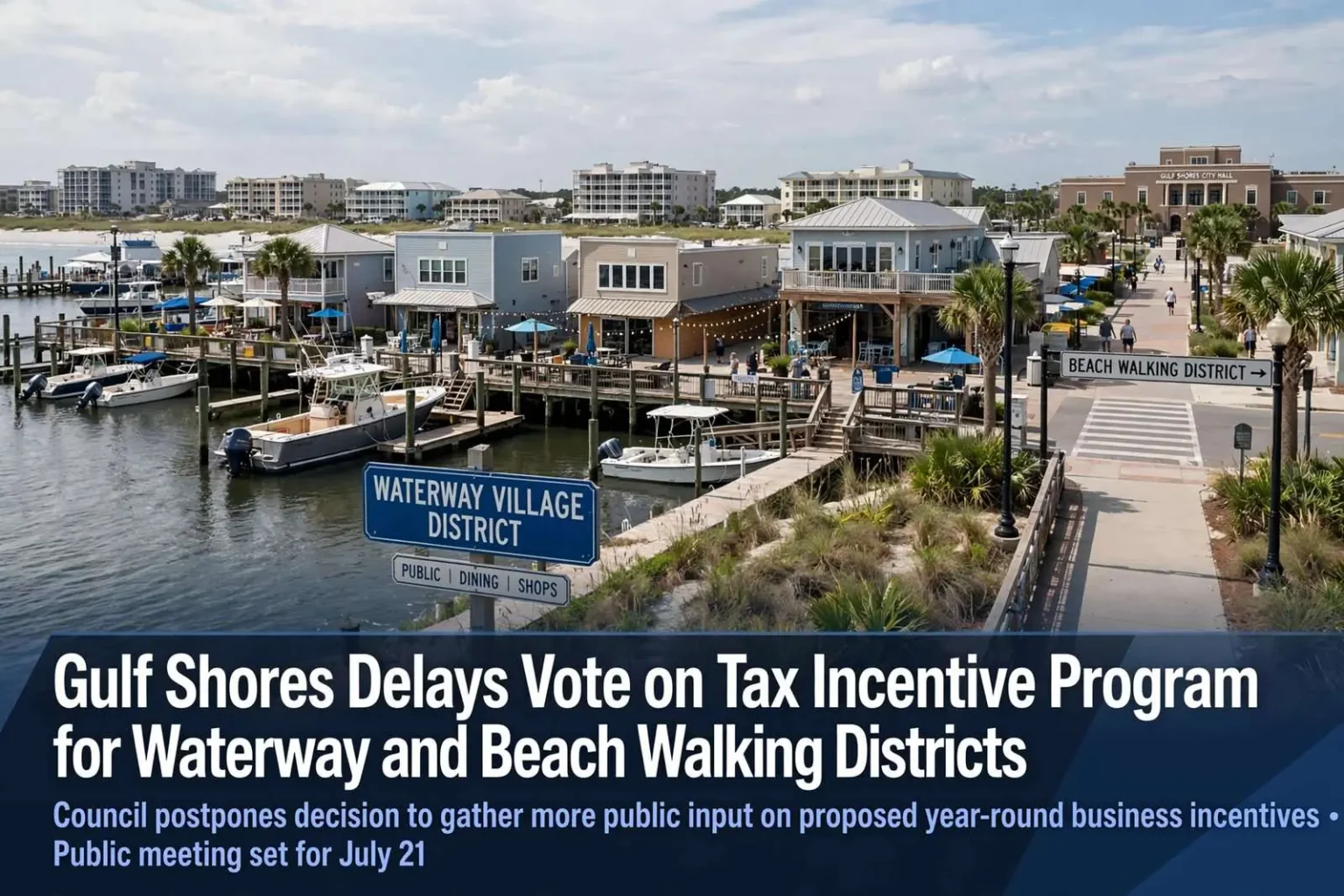
The Waterway Village District runs along the Intracoastal Waterway through the older, northern part of Gulf Shores, an area the city has worked for years to redevelop from its working-past into a walkable village of shops, dining, and waterfront activity. The Beach Walking District, on the Gulf side, ties together the pedestrian corridors connecting the beach to the surrounding blocks. Both areas are central to the city’s long-held goal of becoming more than a seasonal destination — a place with a real year-round economy and street life that does not evaporate in October.
That goal explains the program’s emphasis on year-round operation. Gulf Shores’ economy is dominated by the summer season, when vacation rentals, restaurants, and attractions do the bulk of their annual business and the city collects most of its lodging tax. Businesses that serve the tourist wave close or idle in the off-season, and the shoulder months leave the town quieter than residents would like. Incentives aimed specifically at businesses that commit to operating twelve months a year are a direct attempt to change that rhythm.
Scoring the Projects
Developers would need to apply through a review committee that scores projects on factors such as capital investment, job creation, public improvements, architectural quality, local ownership, and year-round operation, with higher-scoring projects eligible for larger or longer rebates. The scoring rubric is where a program like this earns or loses public trust: it determines whether the biggest rebates go to the biggest checkbooks or to the projects that best serve the community’s stated priorities.
Each factor in the rubric reflects a specific public interest. Capital investment favors projects substantial enough to change a district. Job creation ties the rebate to employment rather than just construction. Public improvements — sidewalks, streetscape, parking, drainage — deliver value even beyond the private project’s footprint. Architectural quality guards against the cheapest possible design winning on cost. Local ownership rewards entrepreneurs already invested in the community. And the year-round operation criterion, weighted alongside the rest, keeps the program pointed at its central purpose: extending Gulf Shores’ economic season.
Why the Council Hit Pause
Mayor Robert Craft said the council needs more information before moving forward and wants residents to have a chance to weigh in as well. The pause reflects the genuine divide such programs create. Supporters see rebates as the price of transforming underused districts and competing with other beach towns for investment dollars. Skeptics ask why the city should rebate half of new tax revenue when developers might build anyway, and whether a twenty-year commitment locks the city into terms it will regret as conditions change. Both questions deserve answers backed by detail, which is exactly what the extra input period is meant to provide.
The city will hold a public input session July 21 at 10 a.m. in Council Chambers, with the City Council expected to revisit the program at its July 27 meeting. That schedule gives residents two weeks to review the proposal and prepare comments, and it gives the council a defined date to decide whether to adopt, amend, or further delay the program. Public sessions in Gulf Shores’ Council Chambers tend to draw engaged crowds on development matters, and a July morning session about tax policy will test how many residents are willing to trade a beach morning for a seat in the room.
The outcome of the July 27 discussion will shape not just the incentive program but the tone of future economic development debates in the city. A program adopted with strong public input carries a legitimacy that helps it survive later second-guessing; one adopted over loud objections invites repeal efforts and council turnover battles. The deliberate pace the council has chosen is, in that sense, a hedge as much as a delay.
A City Already Rewriting Its Blueprint
The proposal comes as Gulf Shores also begins a 16-month process to update its long-term development, transportation, and land use plan through 2045. The timing is not accidental. Incentive programs and comprehensive plans answer the same question — what should Gulf Shores look like in twenty years — from different directions, and adopting one while drafting the other invites the city to make sure they agree.
A comprehensive plan update of that scope will examine where growth should go, how traffic should move, and what the beachfront, the waterway, and the older neighborhoods should each become. If the incentive program is adopted in the middle of that process, its design can be adjusted to match the emerging plan; if the plan is finished first, the program’s target districts and priorities can be validated against it. Either way, the two exercises reinforce each other, and both depend on the same input from the same residents.
What Residents Should Watch For
For residents trying to evaluate the proposal before the July 21 session, the questions worth pressing are concrete ones. How will “new tax revenue” be measured, and who verifies that a rebate is paid only on genuinely new receipts? What happens if a project receives its rebate and then converts away from year-round operation? How large is the pool of potential rebates the city could owe in a worst case, and what cap, if any, applies? The answers to those questions separate a disciplined incentive program from an open-ended giveaway, and they are the kind of details that public input sessions exist to surface.
Business owners in the two districts have a particular stake. Existing businesses will not directly lose revenue to the rebates, which attach only to new tax generation, but they will compete with the subsidized new arrivals — a destination restaurant with a twenty-year rebate enjoys a cost structure an existing restaurant cannot match. Whether that competition is a feature or a flaw of the program is exactly the debate the council will hear on July 27.
The broader context is a city that has repeatedly used public investment to upgrade its public realm, from its beach nourishment efforts to its shared-use path network to its work redeveloping the waterway area. Those projects show a city willing to spend for long-term returns; the incentive question is whether private tax rebates belong in the same toolbox. The council’s decision, expected when it revisits the program on July 27, will signal how Gulf Shores intends to pursue its year-round ambitions — by paying developers to build the town it wants, or by other means entirely.