Gulf Shores Highway 59 Project Receives $14.4 Million Federal Grant
A $14.4 million federal BUILD grant will fund a wider Highway 59, a new pedestrian bridge over the Intracoastal Waterway and expanded bike and pedestrian paths in Gulf Shores.
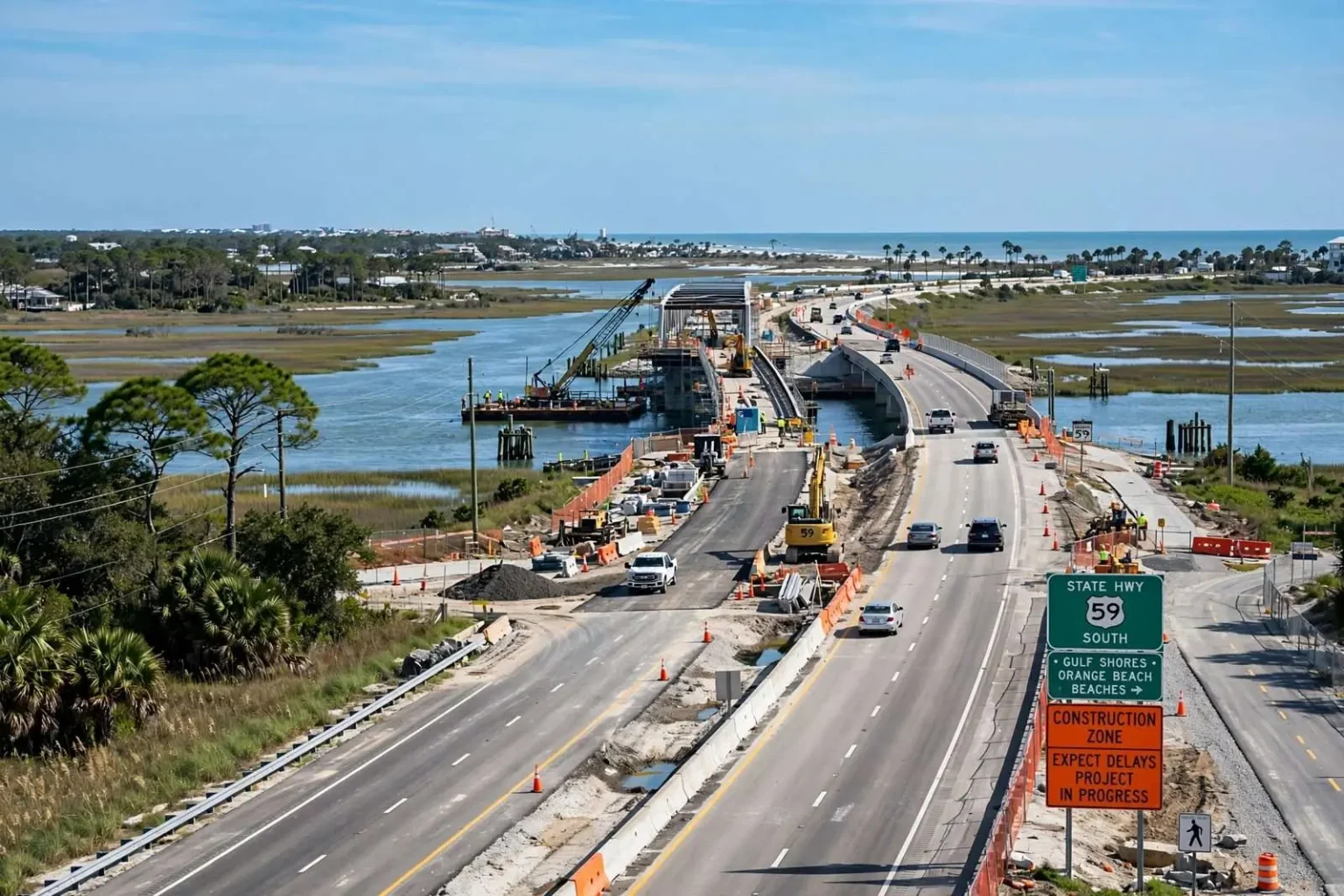
The City of Gulf Shores has been awarded a $14,404,831 federal grant to fund a major expansion of State Highway 59, U.S. Senator Richard Shelby announced. The money comes through the U.S. Department of Transportation’s Better Utilizing Investment to Leverage Development (BUILD) Grant Program, which targets infrastructure projects with strong economic development potential. For a beach city whose single main artery carries virtually all of its through traffic, the award ranks among the most significant federal investments the corridor has received, and it arrives as Baldwin County’s coastal communities continue to absorb some of the fastest population and tourism growth in the state.
“This is excellent news for the City of Gulf Shores and our Gulf Coast region,” Shelby said. “The $14.4 million BUILD grant from DOT will enhance the safety and efficiency along Highway 59, as well as alleviating excessive traffic. I look forward to working with my colleagues and Transportation Secretary Chao as we continue to prioritize the infrastructure needs of Alabama and the nation.” The senator’s office has long positioned transportation funding as a priority for Alabama’s coastal counties, and the BUILD program’s competitive structure means the Gulf Shores application succeeded against projects from communities across the country, a signal that federal reviewers judged the highway’s congestion problems severe and the project’s benefits substantial.
Where the money will go
Highway 59 serves as the primary corridor connecting Interstate 10 to the beaches of Gulf Shores and Orange Beach, and it regularly sees heavy congestion during peak tourist season and hurricane evacuations. In summer, the highway funnels a visitor surge toward the beach towns, with traffic backing up for miles at intersections in Foley, Summerdale and Gulf Shores on peak weekends. In storm season, the same road becomes the evacuation route out, which transforms ordinary congestion into a public safety problem when residents and visitors are ordered to leave the coast ahead of a landfall. The grant funding will pay for roughly two miles of new southbound lane on Highway 59 between County Road 8 and Alabama State Highway 180, adding a third lane to help relieve that bottleneck.
The project also includes construction of a new pedestrian bridge over the Gulf Intracoastal Waterway and shared-use paths along Highway 59 from 20th Avenue to County Road 4. The waterway bridge matters because the Intracoastal cuts the beach communities off from the mainland for anyone on foot or bicycle, and a dedicated crossing gives cyclists and pedestrians a safe alternative to riding the highway bridge shoulders. The shared-use paths stitch the segment together for walkers and riders, connecting neighborhoods and businesses along the corridor that previously had no protected route.
Separately, County Road 6 will be widened from a two-lane road into a divided four-lane boulevard that includes dedicated cycling lanes and a shared-use pedestrian path, along with new two-lane roads, bike lanes and sidewalks elsewhere in the project area. The County Road 6 work is designed to give local traffic an alternative to Highway 59 for short trips within the city, taking grocery runs, school commutes and restaurant traffic off the main artery and freeing its lanes for through travel. Building the sidewalk and cycling network into the design from the start, rather than bolting it on later, reflects the multimodal approach the federal BUILD program explicitly favors when it scores applications.
Gulf Shores Mayor Robert Craft said the improvements go beyond easing traffic; they’re also about public safety and emergency preparedness in a city that swells with visitors each summer and faces regular hurricane threats. “We recognize that multimodal transportation infrastructure improvements are critical to the long term sustainability of our community,” Craft said. “This project will provide safe bicycle and pedestrian routes, ease traffic congestion, improve emergency response and expedite the evacuation process for our residents and the millions of visitors we host annually. I would like to thank Senator Richard Shelby and our Congressional Delegation for their assistance with this grant process. This project would not be possible without their unwavering support.”
Why the corridor matters so much
The mayor’s emphasis on evacuation echoes a reality Gulf Shores residents know well. Coastal Alabama has absorbed repeated hurricane impacts over the past two decades, and each evacuation order sends the same surge of vehicles north on Highway 59 toward Interstate 10, the single choke point every leaving motorist must pass. When that flow is slowed, emergency managers must move evacuation timelines earlier and broader, and residents who wait too long can find themselves crawling through gridlock as weather deteriorates. A third southbound lane between County Road 8 and Highway 180 directly widens the funnel at one of its narrowest points, and the improved parallel network on County Road 6 gives responders additional capacity to move equipment and reach neighborhoods during and after a storm.
The economic logic is just as direct. Tourism drives the Gulf Shores economy, and the beachfront tax base that funds city services depends on visitors being able to arrive, move around and leave without spending hours in traffic. Baldwin County has been among Alabama’s fastest-growing counties for years, and the beach corridor’s seasonal population regularly overwhelms roads laid out for a much smaller permanent community. Every added lane mile and every new path segment extends the useful life of the corridor that the local economy runs on.
For day-to-day users of the highway, the improvements should be noticeable in the details as much as in the lane counts. The sidewalk and shared-use path network means families staying in the beach district can walk or cycle to shops and restaurants without driving, a small change that removes hundreds of short car trips from the corridor on a busy weekend. The pedestrian bridge over the Intracoastal Waterway opens the waterway’s western bank to non-motorized travel for the first time in a meaningful way. Emergency vehicles gain from the divided boulevard design on County Road 6, which provides turn lanes and median refuges that older two-lane sections lack.
Project work of this scale moves through design, right-of-way and construction phases, and residents can expect the visible benefits to arrive incrementally as segments are completed. The city’s challenge will be sequencing construction around peak tourist season, when the corridor is at its busiest and lane closures are most disruptive. Cities along the coast have learned to concentrate major road work in the off-season months, and Gulf Shores is expected to follow the same playbook as the project advances.
The BUILD Grant Program, a competitive federal funding source, has become an important tool for coastal Alabama communities looking to keep pace with rapid tourism-driven growth without placing the entire financial burden of major infrastructure projects on local taxpayers. The program’s predecessor grants have funded road, bridge and transit projects across the country, and its scoring rewards applications that pair congestion relief with safety, economic development and environmental benefits — a combination the Gulf Shores application assembled deliberately. For the city, the $14.4 million award converts a long-discussed corridor plan into a funded project, and it reinforces the delegation-level partnership that Mayor Craft credited: a city with a plan, a federal program built for exactly this kind of multimodal upgrade, and a congressional delegation willing to press the case. When the work is finished, the stretch of Highway 59 between County Road 8 and Highway 180, the County Road 6 boulevard and the new paths and pedestrian bridge will together give Gulf Shores the most complete transportation network the beach corridor has ever had.
Behind the announcement sits the practical question every coastal city faces when a project this size lands: how the pieces fit together. The two miles of new southbound lane on Highway 59 address the stretch that carries the heaviest combined load of local, tourist and evacuation traffic, between County Road 8 and State Highway 180, where beach traffic from the Fort Morgan peninsula and the west end of Gulf Shores merges with through traffic heading toward the beaches. Adding the third lane there targets the spot where backups historically begin, and pairing it with the County Road 6 boulevard means local drivers get a genuine alternative rather than simply more room on the same road.
The multimodal elements are not decorative additions, either. Along the Alabama coast, bicycle and pedestrian infrastructure has become part of the tourism product itself, with visitors increasingly expecting to reach beaches, shops and restaurants without a car. The shared-use paths from 20th Avenue to County Road 4 and the cycling lanes on the widened County Road 6 give Gulf Shores a connected network of that kind, linking the beach district to inland neighborhoods. The pedestrian bridge over the Gulf Intracoastal Waterway completes a link that has been physically missing, since the waterway’s bridges have historically served vehicles only, forcing anyone on foot or bike onto dangerous shoulder riding or long detours.
A regional project with countywide effects
The benefits will not stop at the Gulf Shores city limits. Highway 59 runs through Foley and Summerdale before reaching Interstate 10, and relief at the southern end of the corridor reduces the standing congestion that bleeds north through those towns on peak days. Baldwin County’s municipalities have coordinated on corridor planning for years precisely because traffic does not respect city boundaries, and an upgrade of this scale at the corridor’s beach end improves conditions for commuters and freight moving through the entire southern county. County Road 6 itself ties into the broader grid that serves the rapidly growing unincorporated areas between Gulf Shores and Elberta, giving new subdivisions a second paved route toward the beaches.
For local residents, the sequence of practical improvements adds up in everyday ways: shorter backups at the summer peak, a faster and safer evacuation route when storms threaten, safer ways for children to walk and cycle, and emergency vehicles that can move without fighting the same bottleneck everyone else does. The city swells by multiples of its resident population during tourist season, and infrastructure sized for that reality is what keeps the growth sustainable. Senator Shelby’s office has made transportation investment across Alabama a signature priority, and the BUILD award shows how federal programs can pair with local planning to deliver projects that a city the size of Gulf Shores could not fund alone.
The grant announcement also lands amid a broader run of coastal infrastructure investment in south Baldwin County, as state, county and municipal governments work through backlogged road projects after years of record growth. Gulf Shores officials have consistently framed the city’s challenge as managing success: the beaches that draw millions of visitors each year are the same asset that strains the roads serving them. This project is the most concrete answer yet to that challenge, converting federal dollars into lanes, paths, a pedestrian bridge and a boulevard designed for the traffic of the next generation rather than the last one.