Alabama Senate Votes to Ban Mud Dumping in Mobile Bay
The Alabama Senate passed a bill ending thin-layer dredge disposal in Mobile Bay, sending the measure to Gov. Kay Ivey after years of pressure.
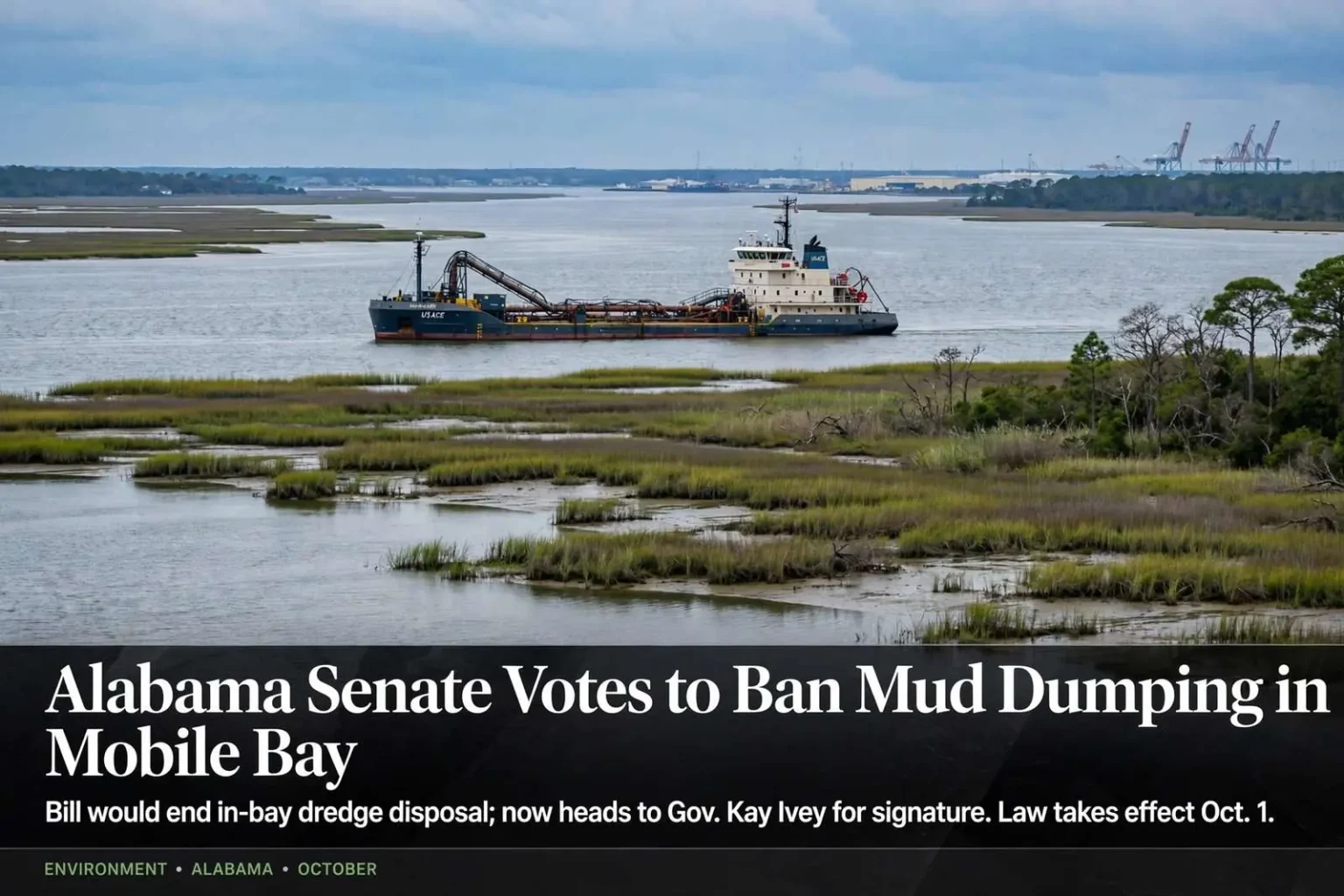
The Alabama State Senate voted to put an end to “thin-layer” dredge disposal inside Mobile Bay, a practice that has drawn years of criticism from environmental groups, fishermen and coastal residents who say it clouds the water and smothers marine habitat. The bill now heads to Gov. Kay Ivey’s desk for her signature. If she signs it, the new law would take effect Oct. 1.
State Rep. Rhett Marques, R-Enterprise, originally filed the legislation, and state Sen. Chris Elliott, R-Josephine, carried the bill through the Senate. With the vote, Alabama joins a growing list of states, including Florida, Georgia, Louisiana and North Carolina, that have adopted policies restricting the in-bay dumping of dredged material.
Thin-layer disposal is the practice of spreading dredged sediment — mud and silt removed from shipping channels to keep them deep enough for commercial vessels — in a thin sheet across portions of the bay floor rather than transporting it to upland sites or open water. The Army Corps of Engineers, which maintains the federal shipping channel that runs the length of Mobile Bay to the port, has used the method for years as a comparatively cheap way to handle the enormous volume of material the channel produces. Critics have countered that the sediment clouds the water, reduces light penetration needed by underwater grasses, and buries the bottom-dwelling organisms that form the base of the bay’s food web.
How the state law closes a loophole
The state legislation is designed to work alongside federal law. It mirrors a measure championed by U.S. Sen. Katie Britt in 2024 that requires the Army Corps of Engineers to put at least 70 percent of dredged material toward “beneficial use,” such as marsh creation, shoreline protection, industrial or commercial applications, and restoration of eroding coastal habitats.
After Britt’s federal legislation passed, the Corps’ Mobile District began describing its in-bay dredge disposal as a form of beneficial use. Alabama’s new state law closes that loophole, explicitly stating that dumping dredged material inside Mobile Bay does not qualify.
The distinction matters because the federal beneficial-use requirement created an accountability framework: if the Corps must devote most of its dredged material to uses like marsh restoration or shoreline protection, the material becomes an asset for coastal resilience rather than a disposal problem. Reclassifying ordinary in-bay dumping as “beneficial” without changing the practice would have hollowed out that requirement in the very bay where the Corps does its largest volumes of work. The state law forecloses that interpretation in Alabama waters, requiring that material placed under the state’s jurisdiction genuinely serve one of the approved purposes.
Supporters of the bill say the change aligns Alabama with the direction Gulf Coast policy has been moving for years, as neighboring states have restricted in-bay disposal and pushed the Corps toward placement options that protect or rebuild habitat. Marsh creation projects built with dredged material have been used across the Gulf to restore eroding shorelines, and advocates argue that Alabama’s dredge volumes could fund a steady pipeline of such projects if they are directed to the right places.
Advocates: a milestone, not the finish line
Environmental advocates who have pushed for years to end the practice called the Senate vote a milestone, while cautioning that the fight is not over. “This is a huge win for the people of Coastal Alabama, but it is not the end,” said William Strickland, executive director of Mobile Baykeeper. “This is the beginning of a revival of our waters. The passage of the bill to end mud-dumping shows what happens when our communities unite around our waters.”
Strickland said advocates now want to see the practice banned permanently at the federal level as well, and he is calling on Sen. Britt to include language addressing the issue in the next Water Resources Development Act. “The people who rely on our waters know there is much more work to do to bring them back,” Strickland said. “I am proud to stand with my friends who depend on our waters’ health for our way of life.”
The Water Resources Development Act, known as WRDA, is the vehicle Congress uses to authorize the Army Corps’ civil works projects, and it passes on a regular cycle. Because the Corps’ authority over the federal channel comes from federal law, a permanent ban on in-bay disposal in Mobile Bay would ultimately need to be written into federal legislation — which is why Strickland and other advocates are aiming at the next WRDA reauthorization rather than treating the state law as the final word.
The coalition behind the bill
The bill drew a broad coalition of support from across the Gulf Coast region. Backers included the mayors of Bayou La Batre, Spanish Fort and Daphne, along with the Baldwin REALTORS, Alabama’s Beaches: The Gulf Coast Convention & Visitors Bureau, and several property owners associations.
The breadth of that coalition reflected the range of interests that in-bay disposal touches. Mayors in communities on both sides of the bay — from the seafood capital of Bayou La Batre to the growing eastern shore cities of Spanish Fort and Daphne — answered concerns from residents about water clarity, fishing quality and the health of shorelines in their jurisdictions. Real estate and tourism organizations weighed the bay’s condition against property values and the coastal economy that markets Alabama’s beaches and waterways to visitors.
Commercial fishing interests also lined up behind the legislation, including the Alabama Commercial Fishermens Association, Eat Alabama Wild Seafood, Admiral Shellfish Company, Bama Bay Oyster Farm and the Organized Seafood Association of Alabama. Their unified front was notable in an industry whose segments do not always agree on policy, and it signaled to lawmakers that the bay’s working waterfront viewed the disposal question as existential rather than merely environmental.
The fishing industry’s support carried particular weight. Oyster farmers and commercial harvesters work the bay’s waters daily, and sedimentation is among the most direct threats to their livelihoods: oysters need clean, hard bottom to attach and grow, and repeated deposits of fine sediment can bury productive reef areas. Shrimpers and finfishermen depend on the same habitat chain, from the small organisms on the bay floor up to the species they harvest. For an industry already strained by imports, hurricanes and rising costs, the prospect of losing more productive bottom to disposal was one more pressure the groups said they could not absorb.
What happens next
With Senate passage complete, attention turns to the governor’s office. If Gov. Ivey signs the bill as expected by its supporters, the new law takes effect Oct. 1, and state regulators will have explicit statutory direction that in-bay dumping in Mobile Bay cannot be counted as beneficial use. The Corps’ Mobile District would continue to maintain the shipping channel — a responsibility tied to the port’s role as one of the Gulf’s busiest — but would need to plan for disposal and placement strategies that comply with the new standard.
Supporters say the transition will require investment in alternatives: upland containment sites, habitat restoration projects, and placement areas that serve shoreline protection or marsh creation. Some of that capacity already exists along the bay and the lower Mobile-Tensaw Delta, and engineers have long identified sites where dredged material could rebuild eroding shorelines rather than blanket the bay floor. The cost of those alternatives is higher than thin-layer disposal in the short term, which is exactly the trade-off the bill’s supporters say is worth making to protect the bay’s ecology and the economies that depend on it.
Why Mobile Bay matters
Mobile Bay is the receiving water for the fourth-largest river system in the United States by flow, draining much of Alabama and parts of Georgia and Mississippi into the Gulf. Its mix of fresh and salt water sustains one of the region’s most important estuaries — nursery habitat for Gulf fish and shellfish, wintering grounds for waterfowl, and the working waters of a commercial seafood industry centered in Bayou La Batre and Bayou Coden communities.
The bay also carries the shipping lane for the Port of Mobile, whose expansion has made channel deepening and maintenance dredging a permanent, recurring operation. That collision of roles — industrial harbor and productive estuary in the same confined basin — is what made thin-layer disposal such a persistent flashpoint, and why the question of where dredged material goes has become one of the defining coastal policy debates of the decade in Alabama.
For the coastal residents, fishermen and advocacy groups who spent years pressing the issue, the Senate vote marks the point where Alabama’s law finally says plainly what they have argued all along: Mobile Bay is a resource to be protected, not a disposal site. The next chapters — the governor’s signature, the Corps’ compliance plans, and the push for a federal ban — will determine how fully that principle takes hold.