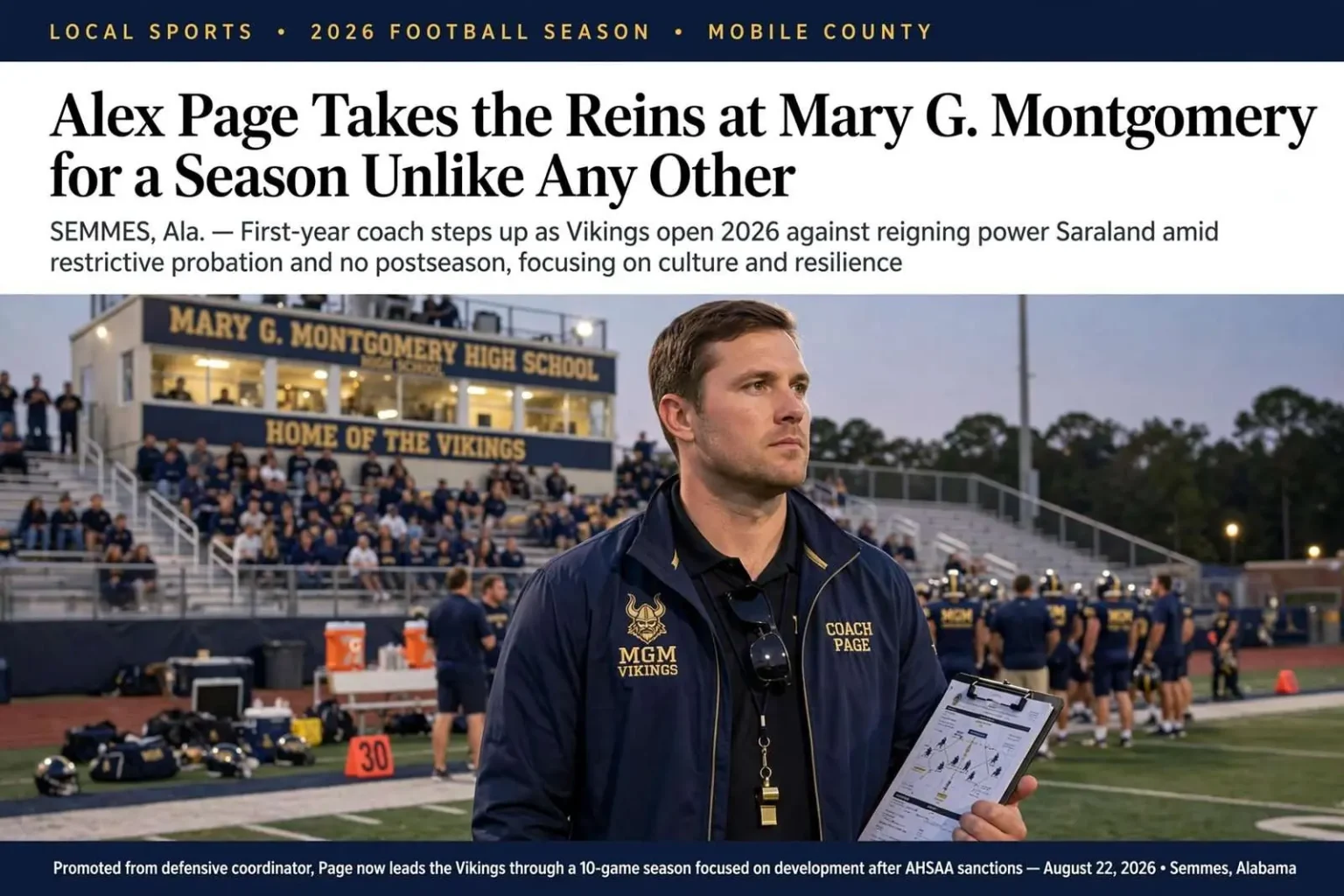
SEMMES, Ala. — Few programs in South Alabama entered the 2026 football season carrying as much off-field weight as Mary G. Montgomery, and few opened against a tougher assignment. The Vikings began their year at home against Saraland, a program that has reached the state championship game in each of the past four seasons. It is the kind of opener that would test any roster. For MGM, it arrives at the end of an unusual and difficult stretch.
Mary G. Montgomery High School sits in Semmes, one of Mobile County’s newer cities, and its football program has long been a point of community identity in an area that grew rapidly in recent decades. The Vikings compete in one of the most demanding classifications in the state, where every region game is played against programs with deep rosters and established traditions. Home Friday nights still draw the crowds, the marching band and the booster-club fundraisers that define small-city Alabama football, even in a year when the stakes on the field are different from those at most schools.
What the Program Is Working Through
The Alabama High School Athletic Association placed Mary G. Montgomery on restrictive probation for recruiting violations. The ruling suspended then-head coach Zach Golson for one year, barring him from coaching at any AHSAA member school during that period, and prohibited the team from participating in the postseason. That last penalty reshapes the season entirely. With no playoff path available, MGM’s year consists of its 10 regular-season games and nothing beyond them.
Restrictive probation is among the most serious penalties the AHSAA can assess, short of complete removal from competition. In addition to barring playoff participation, it typically carries increased oversight of the program and the threat of further sanctions if any additional rules violations occur. The association governs athletic competition for hundreds of member schools across the state and treats improper recruiting — any attempt to draw athletes to a school outside the rules governing transfer and eligibility — as a foundational violation, because it strikes at the fairness of competition itself.
The program also lost some players connected to the recruiting violations that produced the sanctions. Roster turnover of that kind, layered on top of a coaching change, leaves a staff piecing together depth charts with limited varsity experience. Underclassmen who might otherwise have spent the year developing on special teams and in spot duty are instead pressed into larger roles. For a program that already faced the state’s most demanding schedule, the attrition made an uphill climb steeper.
Defensive coordinator Alex Page was promoted to head coach in the aftermath, inheriting a team that must find its motivation somewhere other than the postseason bracket. Promoting from within gave the Vikings continuity at a moment when continuity mattered. Page knows the defensive personnel, the assistant coaches and the players’ families, and stepping up from defensive coordinator means the schemes and terminology the roster learned in the spring carry over rather than reset.
Playing for Something Other Than the Playoffs
A season without a postseason is a genuine coaching challenge. Progress has to be measured week to week — in development, in the standard a program sets for itself, in what returning players carry into next year. For a roster of teenagers, showing up with intent for 10 games that lead nowhere on paper is not a small ask.
Coaches who have navigated playoff-banned seasons describe them as a test of program culture rather than talent. Practice habits, grades, leadership development and weight-room gains become the currency of the year, because those are the things that survive into next season when the postseason eligibility returns. Senior players in such years often take on outsized roles, asked to model effort for younger teammates who will benefit from it in seasons they will not be around for. How a team handles the stretch says more about its foundation than any win-loss record can.
Drawing Saraland first does at least remove any ambiguity about the level of competition. The Spartans have been the measuring stick in the area for half a decade, building a run of four consecutive state championship game appearances that few programs in any classification can match. Saraland’s rise over that span has been built on sustained roster talent, strong community support and a program structure that other Mobile County schools have studied and tried to emulate. Facing that caliber of opponent in week one gives a rebuilding staff an immediate, unfiltered read on where its roster stands.
For the MGM players, the opener also carries the emotional weight of playing for a staff and a student body that has absorbed months of difficult headlines. Home openers elsewhere are celebrations; this one doubled as a statement about resilience. Whatever the score, the program’s response to adversity will be watched closely by rival schools and by an AHSAA that will be monitoring the program through its probationary period.
A Busy Night Across the Area
The MGM-Saraland matchup headlined a slate of 18 games involving Mobile County and Baldwin County teams. The area’s season had already opened the night before, when Spanish Fort scored a late touchdown to win its opener, setting an early tone for the Eastern Shore program.
Across the two counties, week one follows a familiar rhythm. Stadiums in Mobile, Prichard, Daphne, Fairhope, Gulf Shores, Foley and points between fill with the season’s largest early crowds, and the results — however meaningless they prove to be in the standings — shape perceptions that last through September. For programs with playoff aspirations, a strong opener builds early region positioning momentum. For teams in transition years like MGM, the opener is about establishing an identity that can carry a roster through ten games.
The 2026 season across South Alabama features the usual collection of storylines: veteran programs reloading rather than rebuilding, coaches in their first years at new posts, and several programs navigating the fallout of difficult offseasons. What separates MGM’s situation is the combination of sanctions, personnel losses and a coaching change arriving at once, all while opening against the area’s standard-bearer.
The path forward for the Vikings runs through the rest of the regular season and into the offseason. The returning players who log varsity snaps this fall will enter 2027 with experience they would not otherwise have accumulated, and the coaching staff will have a full season of game film to build from. The probation will eventually lift, the postseason ban will expire, and the program will have the chance to compete for a playoff berth again — but the work of getting there begins now, in front of home crowds that have watched the community’s school absorb more scrutiny than any of its neighbors.
The schedule itself offers no soft landing spots. Mobile County’s 6A and 7A region landscape is dotted with programs that have made deep playoff runs in recent years, and MGM’s non-region slate was built to challenge rather than pad a record. Week-to-week opponents will bring different styles — some power-running games that test a young front seven, others spread offenses that stress an inexperienced secondary. Every Friday becomes a measuring stick for where the roster actually stands, which is precisely the kind of feedback a first-year head coach needs when building for the seasons ahead.
Boosters, families and season-ticket holders have continued to show up, and that support matters more in a year like this than in any contending season. Friday night crowds fund the program through concession stands and memberships, and the visible presence of a loyal fan base is often the difference in keeping teenagers engaged when the season loses its on-paper stakes. Programs that survive sanctions with their community intact almost always rebound faster than those where empty stands compound the penalty.
What Restrictive Probation Means Going Forward
For families following the case, the mechanics of the AHSAA’s penalty matter. Restrictive probation does not end a school’s membership or cancel its schedule; teams still play, region standings are still recorded, and individual players remain eligible to compete. What it removes is the reward at the end — the chance to extend a season into November. Schools under restrictive probation also face heightened reporting requirements, and any subsequent violation during the probationary window can trigger escalating penalties that touch other sports programs as well.
The sanction against Golson, barring him from coaching at any AHSAA member school for a full year, reflects the association’s approach to accountability in recruiting cases: penalties attach to individuals as well as institutions. A one-year coaching ban means the person cannot simply continue the same duties under a different title, and it removes him from the sideline entirely during the season in question.
For the Semmes community, the season becomes an exercise in patience. High school football in Alabama is measured in playoff runs, and a year without one feels, to many supporters, like a year without a finish. But programs across the state have walked this road before and returned to contention, and the measure of Mary G. Montgomery in 2026 will not be found in the standings. It will be found in whether a young, shorthanded roster under a first-year head coach competes every Friday night — starting with the most demanding test South Alabama can offer, right at home against Saraland.