
Driver Wounded in Mobile Drive-By Shooting on Basil Street
Mobile police say a man suffered non-life-threatening injuries when someone fired shots at his vehicle on Basil Street Sunday evening.
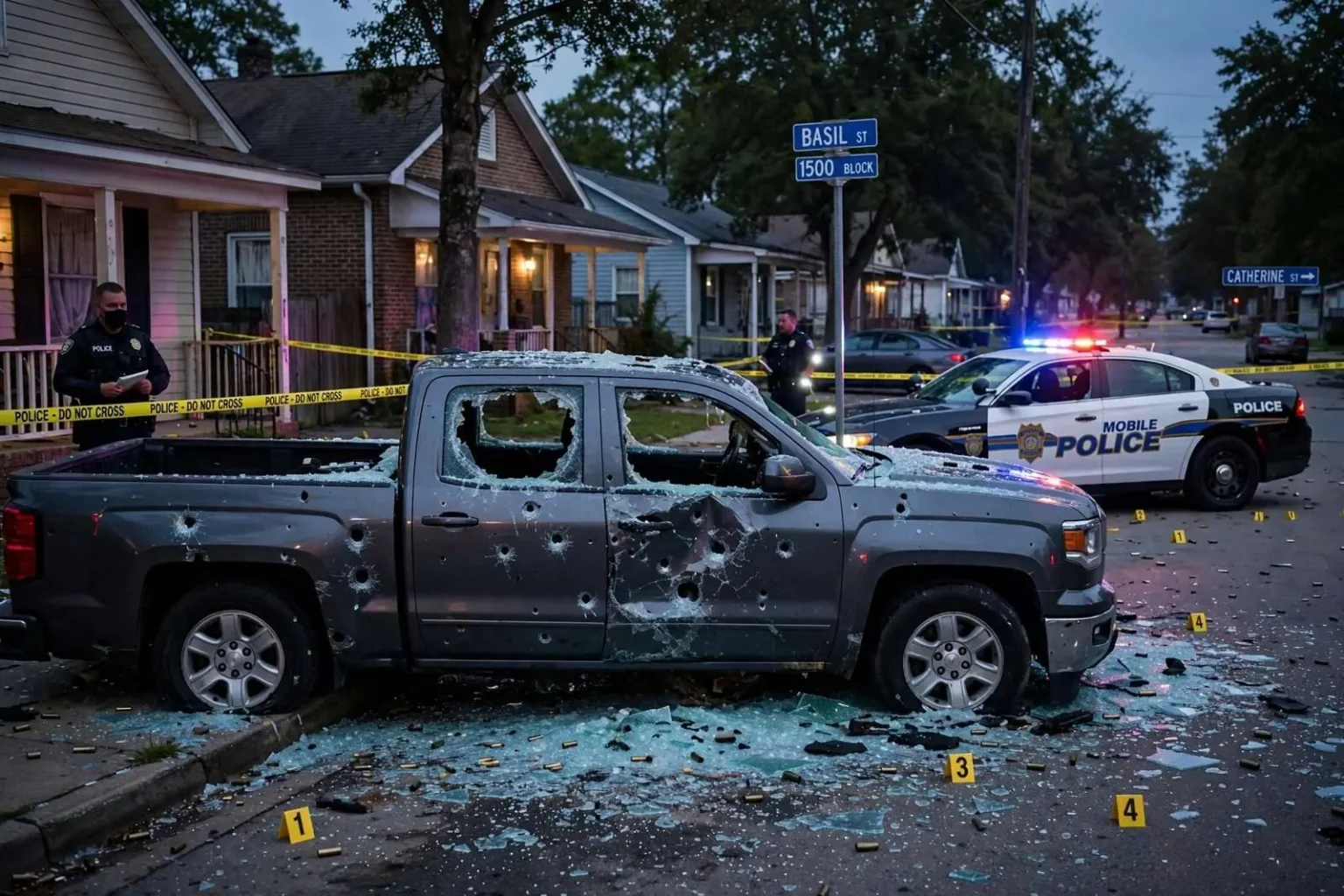
Mobile police say a man was injured Sunday evening in a drive-by shooting on Basil Street, off Catherine Street, in another incident of gunfire that left a neighborhood cleaning up broken glass and investigators searching for a suspect who fled before help arrived.
Officers responded to the 1500 block of Basil Street at 6:53 p.m. after reports of shots fired in the area. When they arrived, they found a man who had been wounded and the aftermath of a burst of gunfire that had caught up with him as he drove through the neighborhood. The scene, in a residential stretch off Catherine Street, drew a police presence into the evening hours as officers canvassed the block and spoke with residents who had heard the shots ring out just before 7 p.m.
According to police, the man told investigators he was driving near Gaston Street when another vehicle pulled up behind him and the occupant fired multiple shots. The suspect fled before officers arrived, leaving investigators with a wounded driver, a damaged vehicle, and the difficult task of reconstructing a shooting that lasted only seconds and ended somewhere out of sight.
The Victim’s Condition
The victim was taken to University Hospital with injuries described as not life-threatening, a detail that will come as a relief to a family and a neighborhood that has seen too many such calls end differently. University Hospital, the region’s major trauma center, handles the bulk of serious gunshot wounds in the Mobile area, and emergency staff there are a routine stop for Mobile police investigators working shooting cases.
Investigators said the man was expected to recover. That prognosis gives police time to follow up with him as his condition allows, since victims of drive-by shootings are often the best — and sometimes the only — sources of information about the vehicle, the shooter, and the moments before the gunfire started. Early, detailed victim interviews frequently determine whether a drive-by case can be developed at all.
Photographs from the scene showed glass from a shattered window inside a truck parked in front of a nearby house, marking where the gunfire caught up with him. Stray rounds and shattered glass reaching nearby parked vehicles and homes are a signature of drive-by shootings, and they illustrate the risk these incidents pose to everyone on a residential block — not just the intended or actual target.
What Investigators Face
No arrest had been announced as of late Sunday. Police did not release a description of the shooter’s vehicle or say whether the driver was targeted, both of which shape how the investigation proceeds. Detectives will work to answer the fundamental question in any drive-by case: whether the shooting was a targeted attack arising from a specific dispute, or indiscriminate gunfire with a victim who happened to be in the wrong place.
Mobile police typically pursue several lines of evidence in shootings of this kind. Officers canvass the neighborhood for witnesses and doorbell or surveillance cameras, which have become increasingly valuable to investigators as homeowners and businesses add them. Detectives collect shell casings, check whether nearby cameras captured the vehicle’s movements, and trace the route the victim was driving to determine where the shots began. Bullet damage on vehicles and buildings can help establish the direction and position of the shooter.
The 6:53 p.m. timing means the shooting occurred in early evening, when residents were home and outdoors, and detectives will want to hear from anyone who saw a vehicle following another through the area near Gaston Street or heard multiple shots. Witness tips, often anonymous, are how many Mobile drive-by cases ultimately get solved when physical evidence alone cannot identify a shooter.
The Neighborhood Where It Happened
Basil Street runs off Catherine Street in central Mobile, in a residential part of the city where the streets are lined with modest homes and the blocks sit within easy reach of downtown. The area, like much of central Mobile, is served by the Mobile Police Department’s patrol divisions, and evening shots-fired calls in these neighborhoods are among the most frequent and most frustrating calls officers respond to.
Gaston Street, where the victim said the vehicle pulled up behind him, sits in the same central-Mobile grid, meaning the shooting likely spanned more than one block as the victim drove and the shooter’s vehicle closed in. That movement complicates the scene work: police must treat multiple locations as part of one crime scene, collecting evidence along the path the gunfire traveled.
Residents of these central Mobile neighborhoods have repeatedly voiced concern about gunfire, and community groups in the city have organized against the violence through vigils, mentoring programs, and cooperation with police. Each drive-by — even one that ends with an expected recovery rather than a death — reinforces the cycle that local leaders describe: broken glass, children kept indoors, and neighbors who hear gunfire and hesitate to talk.
Gun Violence and the Police Response in Mobile
Drive-by shootings are a persistent feature of Mobile’s crime landscape, and the police department has repeatedly emphasized that gunfire in residential areas endangers far more than those involved in any dispute. Rounds fired from a moving vehicle travel into homes and across yards, and the department has investigated numerous cases in which bystanders, homes, and vehicles were struck even when no person was hit.
The department’s standard response to a shots-fired call involves securing the scene, rendering aid, and immediately working the canvass — knocking on doors, checking for cameras, and talking to anyone outside. Investigators from the department’s specialized units typically take over once the initial patrol response secures the area. Cases with an identified surviving victim move with the victim’s cooperation; cases where victims or witnesses decline to talk are far harder to close, a reality police leaders in Mobile have acknowledged for years.
Police also lean on Crimestoppers, which allows tipsters to submit information anonymously and qualify for cash rewards, a channel that has produced arrests in Mobile shooting cases where witnesses feared being identified. Tips can be submitted by phone, through the Crimestoppers app, or online, and anonymity is protected by the program’s structure — an arrangement designed for exactly the kind of neighborhood shooting in which people see things but worry about retaliation.
What Comes Next
For now, the case remains open, with no arrest announced and no description of the suspect vehicle released. Detectives will continue following up with the victim at the hospital, reviewing any camera footage from the area, and processing whatever physical evidence was recovered Sunday evening. Updates, when they come, are likely to arrive through the police department’s public channels or in the form of an arrest announcement if the investigation produces a suspect.
Meanwhile, police are asking anyone with information about the shooting to come forward — whether they saw a vehicle chasing another through the streets near Basil, Catherine, and Gaston, heard the shots around 6:53 p.m., or have camera footage from the area. In drive-by cases, a single tip about a car seen speeding away has repeatedly been the thread that unravels the whole incident.
The wounded driver’s expected recovery is the one clearly good outcome in an otherwise familiar Mobile scenario: a Sunday evening, a residential street, a burst of gunfire from a passing car, a shattered window in a neighbor’s truck, and a shooter still unidentified. The investigation continues, and the neighborhood — like so many across the city — is left hoping that the next shots-fired call in their blocks never comes.
Inside a Drive-By Investigation
Drive-by shootings present some of the hardest cases investigators face. The shooter is mobile, the encounter is brief, and the evidence is scattered along a moving line through a neighborhood rather than concentrated at one address. In this case, police must account for two vehicles, at least two locations — the area near Gaston Street where the gunfire began and the 1500 block of Basil Street where it ended — and a suspect who vanished into the evening traffic of central Mobile.
The vehicle itself becomes the central lead. Investigators will want any description of make, model, color, or damage, and they will check the area for cameras that might have captured it before, during, or after the shooting. Mobile police have increasingly used camera networks and business surveillance in shooting cases, and even a partial plate or a distinctive feature like a broken taillight has closed cases that initially seemed hopeless.
Shell casings, if any were recovered along the route, can be matched through ballistic databases to other shootings — sometimes linking a single vehicle to multiple incidents and giving prosecutors a far stronger case than one shooting alone would support. That forensic work takes days to weeks, which is one reason early arrest announcements are uncommon in drive-by cases even when the investigation is moving quickly behind the scenes.
The victim’s own account will be tested against the evidence. Investigators treat initial statements as starting points rather than conclusions, particularly in cases where the victim was driving and under fire. Whether the driver was targeted or caught in someone else’s dispute remains an open question police have not answered publicly, and it is one of the first things detectives hope to resolve as the victim recovers and follow-up interviews become possible.
The Cost of a Single Burst of Gunfire
Beyond the wounded driver, the shooting left its mark on the block itself. The truck parked in front of the nearby house, its shattered window raining glass into the cab, was not the target of anyone’s dispute — it was simply parked where a stray round or a swerving vehicle found it. Neighbors along Basil Street spent the evening with police tape and patrol cars at the end of their block, and with the knowledge that gunfire had crossed their street before 7 p.m. on a Sunday.
Public health researchers and police leaders alike have documented the ripple effects of such incidents. Residents who hear shots experience lasting stress; property damage from stray rounds costs families who can least afford it; and children who grow up around gunfire carry the consequences into their schooling and health. Community organizations across Mobile have pushed for investments — mentoring, violence interruption, neighborhood revitalization — aimed at breaking the cycle that produces repeat scenes like the one on Basil Street.
For the police department, each unsolved drive-by is also a data point in a larger accountability problem. Cases that go unsolved erode the trust that produces witness cooperation in the next case, a dynamic commanders in Mobile have worked to counter through community policing efforts, neighborhood meetings, and public appeals for tips after high-profile shootings.
How Residents Can Help
The department’s message after shootings like this one is consistent: someone in the neighborhood almost always saw or heard something that matters. A car idling near the corner before the shots. A vehicle pulling out fast right after. Voices, headlights, a direction of travel. None of those details may seem significant on their own, but assembled, they give detectives the timeline they need to work the case.
Anonymous tips through Crimestoppers remain the safest route for residents worried about being identified, and the program pays rewards for information that leads to arrests in felony cases. Investigators also accept tips directly through the Mobile Police Department, and for those willing to be interviewed, even a follow-up conversation days later can supply the detail that breaks the case open.
The wounded man is expected to recover, and that fact will allow the investigation to continue with his help. Whether an arrest follows depends in part on what the neighborhood knows and what it chooses to share. Until then, the 1500 block of Basil Street joins the list of Mobile streets where gunfire arrived from a passing car, and the city’s investigators — as they have in so many cases before — will try to trace those seconds of violence back to the person responsible.