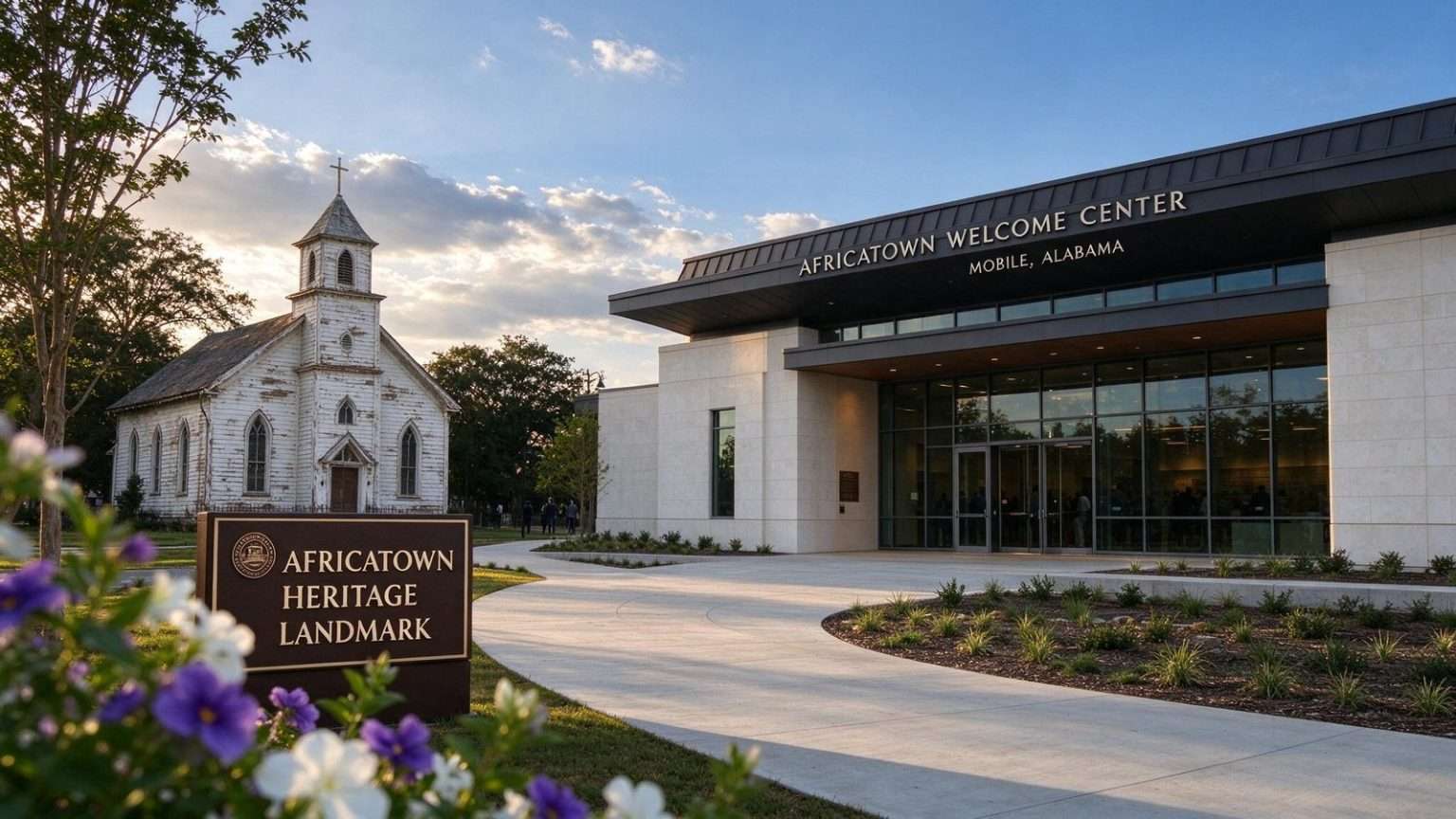
Construction on the new Africatown Welcome Center is nearly finished, and the City of Mobile is now turning its attention to what will go inside, asking community members to share stories, photographs and artifacts tied to Africatown’s history. Officials say those personal contributions are essential to telling the community’s story once the center opens — a recognition that the building itself, however well built, is only a shell until the families who lived this history fill it with their own records, objects, and memories.
‘We Don’t Have Anything If We Don’t Have Their Stories’
“We don’t have anything if we don’t have their stories, their pictures and their artifacts,” said Shonnda Smith, the city’s public works executive director. The call for contributions is aimed squarely at the descendants of the community’s founders and the families who have lived in Africatown through its generations — the people whose attics, albums, and family Bibles hold the documents and objects that no museum purchase or archival acquisition can replicate. City officials have emphasized that items need not be grand to matter: a photograph of a family gathering, a church program, a work ledger, or a household object passed down through generations can all help anchor the story the center is meant to tell.
Community members with stories, photos or artifacts to contribute can email [email protected] or call 251-208-1199. Officials have indicated that contributions can take many forms — some families may lend or donate objects, while others may simply sit for conversations so their accounts can be recorded for exhibits and educational programming. The outreach treats residents as partners in the project rather than subjects of it, an approach historians of Africatown have long argued for, given how much of the community’s documented history has historically been told by outsiders.
The neighborhood that grew from that founding sits just north of downtown Mobile, along the waterways that shaped its history. Generations of descendants remained on or near the original settlement, even as industry crowded the surrounding land and the wider city changed around it. Churches, family plots, and long-standing institutions carry the community’s memory in their walls, and residents have spent decades working to protect that heritage while pushing for the investment and attention the neighborhood’s history has always merited. The welcome center’s arrival is the most visible piece of that push to date.
A Community Born From the Clotilda
Africatown was founded in 1866 by survivors of the Clotilda, the last known slave ship to arrive in the United States. The ship had carried more than a hundred West Africans across the Atlantic decades after the international slave trade had been outlawed, and after emancipation, the survivors pooled their resources, bought land north of Mobile, and built a community of their own — complete with its own church, school, and traditions carried from their homelands. That founding story, kept alive for generations by descendants even when the wider world paid little attention, is the foundation on which everything else about Africatown rests.
The discovery of the Clotilda’s remains in the Mobile River renewed national and international attention on the community, and the years since have brought a wave of projects aimed at documenting and honoring that history. The welcome center is part of that broader effort, designed to give visitors an organized starting point for understanding a story that spans continents — from West Africa, across the Middle Passage, to the founding of a free Black community on the outskirts of Mobile and its life through the century and a half that followed.
The Building and Its Setting
The welcome center, located off Africatown Boulevard, is intended to serve as the starting point for visitors who want to learn about the community’s history before continuing on to other sites, including the Africatown Heritage House and the Clotilda landing site. That framing matters for how the story gets told: rather than a single destination, Africatown’s historic landscape works as a sequence, and the welcome center is positioned as the place where that sequence begins. Visitors arriving from downtown Mobile or the interstate will get orientation, context, and direction before moving on to the sites themselves.
The $5.1 million project broke ground in May of last year, and the city hopes to complete this phase of the work by December so the center can open to the public. Construction schedules for civic buildings of this size typically run through exterior work, interior finishes, and exhibit installation in sequence, and the city’s push for a December completion reflects both the momentum behind the project and the community’s long wait to see it realized. Once open, the center is expected to host a steady flow of school groups, tourists, researchers, and descendants returning to walk ground their ancestors made.
City leaders have described the center as a working building as much as a monument — a place for programming, community meetings, and educational visits rather than a static display. That operational vision shapes the call for contributions, since exhibits built from living families’ materials can rotate and grow as more items surface, giving residents a reason to stay engaged long after opening day. A center that continues to gather the community’s history after the ribbon is cut serves both missions at once: it keeps the story current, and it keeps the community inside the institution that tells it.
What the Center Means for Visitors
For visitors, the welcome center solves a practical problem that has accompanied Africatown’s rising profile: knowing where to start. Interest in the community surged after the Clotilda’s identification, and travelers have arrived in Mobile looking for the story without always knowing which sites to see or in what order. A staffed welcome center off Africatown Boulevard gives the city a front door for that traffic — a place to hand visitors a map, a short orientation, and a reason to spend time — and money — in the neighborhood itself rather than passing through on the way somewhere else.
Heritage tourism on this scale carries real economic weight for a neighborhood that has seen decades of disinvestment. Visitors who stop at a welcome center eat at nearby restaurants, buy gas, and support small businesses in the surrounding area, and studies of heritage destinations consistently show that well-interpreted sites extend the length and value of visits. City officials have framed the center as both a cultural institution and a neighborhood asset, and the two goals are intertwined: the better the story is told, the more benefit flows back to the community that lived it.
Why Community Contributions Matter
The push for community contributions reflects a truth about Africatown’s history that archives alone cannot supply. Official records from the Clotilda’s era documented the crime of its voyage and little else; the interior lives of the founders — their names in freedom, their families, their church, their choices — survived instead in the memories and belongings of descendants. Every photograph, letter, or object a family contributes adds a layer that no historian working from government records could recover, and collectively those contributions will determine how fully the center can tell the story from the community’s own point of view.
City officials have encouraged families not to worry about whether an item seems important enough to offer. Curators and historians working with the center can assess significance, and even items that do not go on display may hold research value, helping scholars confirm dates, identify people in photographs, or document daily life in the neighborhood through the decades. The outreach is as much about building a relationship between the center and the families it represents as it is about filling exhibit cases, and officials have stressed that the process will respect the wishes of families who prefer to keep heirlooms at home while still sharing their stories.
A Broader Reckoning With History
The welcome center arrives amid a wider effort to give Africatown’s history the public standing it has long deserved. The community’s story has moved from family memory to national conversation in a few short years, drawing journalists, filmmakers, historians, and descendants of the wider African diaspora to a neighborhood whose founding families arrived as captives and built something enduring anyway. Institutions across Mobile have partnered on the effort, and the welcome center’s role as the front door to that story gives it outsized importance among the city’s cultural projects.
For the residents of Africatown, the December target carries an emotional weight that construction milestones rarely do. The neighborhood has watched plans announced, studies completed, and promises made over many years, and the sight of a nearly finished building off Africatown Boulevard represents tangible progress toward a long-held goal. Families with stories, photographs, and artifacts to share can start the conversation now — by email at [email protected] or by phone at 251-208-1199 — so that when the doors open, the community’s own voice is built into the walls from day one.