Pensacola Mothers Who Lost Sons to Gunfire Urge Young People to Put the Guns Down
Three Pensacola mothers who lost sons to gun violence spoke at city hall, urging young people to end retaliation as police work unsolved shootings.
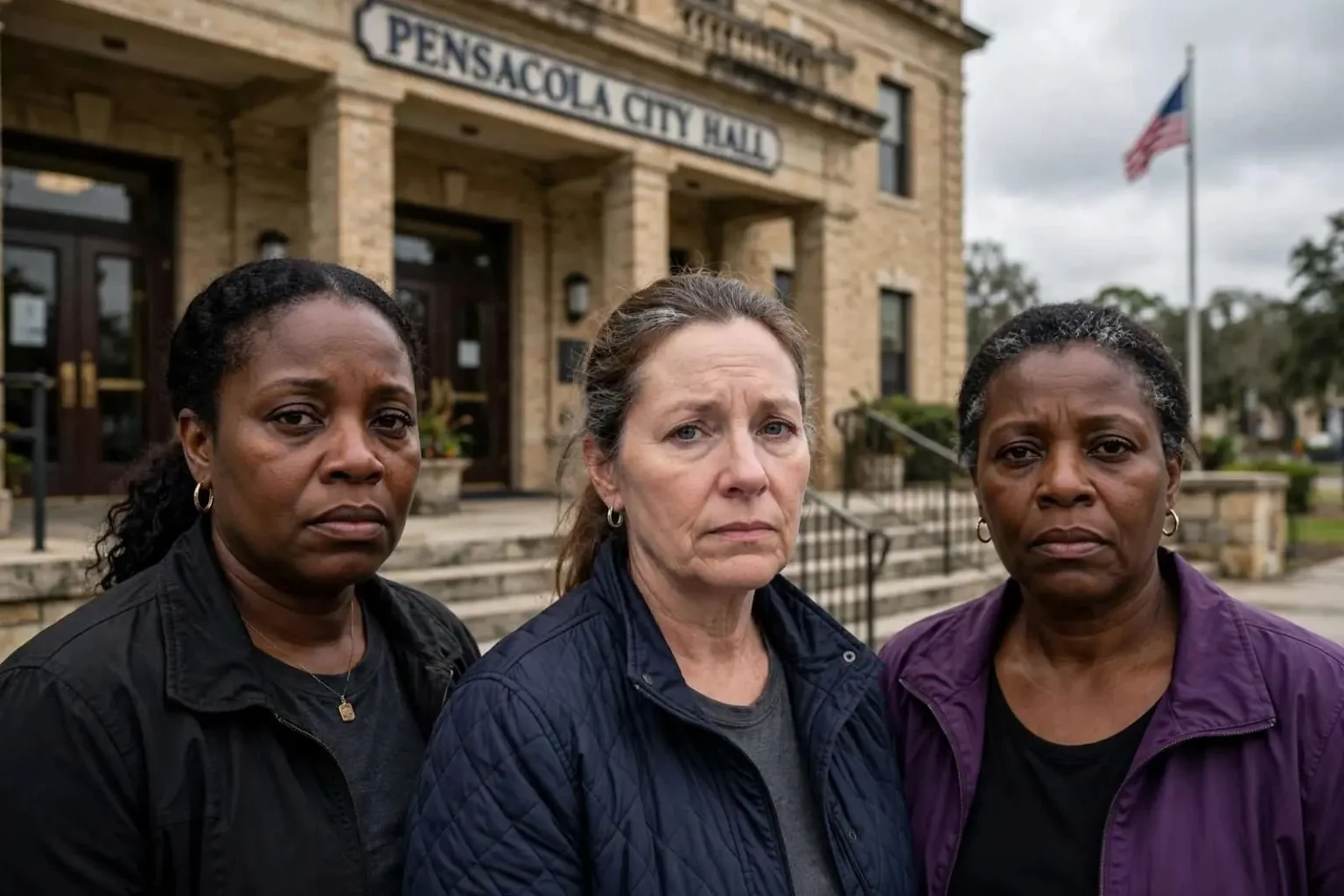
Three Pensacola mothers who each lost a son to gun violence stood together at Pensacola City Hall this week, delivering a shared plea to young people across the area: put the guns down. The women appeared side by side not as officials or program administrators, but as parents carrying losses that no amount of time has softened, and their message was aimed squarely at the young men of the community whom they fear could be next.
Mayor Grover Robinson brought the women before the public during a Facebook Live broadcast, a format the mayor’s office has used to speak directly with residents about issues facing the city. The broadcast came as Pensacola police worked a string of recent shootings, several of which remain unsolved, and the mothers hoped their voices might reach someone who knows something that could move those cases forward.
Three Families, the Same Loss
Lashunda Dortch’s 19-year-old son, Ke’Avian Sanders, was shot and killed outside the Platinum Club early on Black Friday morning. The timing made the loss all the more jarring. A night when much of the city was thinking about holiday shopping and family gatherings became, for her family, the night their lives split into before and after.
“My baby is gone,” Dortch said during the broadcast. “He was only 19 years old.”
Cindy Martin’s son, Matthew Cox, was killed inside her own home in 2012. That same year, Rosa Dukes lost her son, Broderick Johnson. The three women came to the mayor’s broadcast from different neighborhoods and different circumstances, but the loss that binds them is identical, and each of them described it in strikingly similar terms.
“We’re just asking everybody to put the guns down,” Martin said. “Retaliation is not the answer.”
Martin said the pain never fades, and every new homicide reported in the news reopens it. For families of homicide victims in Pensacola, each headline about another shooting arrives with a weight that outsiders rarely see, returning them to the worst day of their lives as though it had just happened.
“We feel the same pain as that mother so we have to go through this over and over again,” she said.
Dortch described the moment she learned her son had been shot, a moment she said changed everything. Her words conveyed the physical shock of such news, the way the body responds to loss before the mind can begin to absorb it.
“I feel like somebody just took my heart and ripped it out of my chest,” she said. “I feel lost because I know that my baby is not coming back.”
A Call to Talk, Not Retaliate
The three women are urging young men in the area to resolve conflicts by talking through their problems rather than reaching for a weapon. Their appeal reflects a pattern police and community leaders across the Gulf Coast have described for years: disputes that begin as arguments, insults or minor altercations escalate quickly once a gun is introduced, and the first shooting often sets off a cycle in which friends or relatives of the victim feel obligated to respond in kind.
“You’re not going to resolve anything,” Dortch said. “Another mother or another father will have to go through the same thing I’m going through right now. It’s just senseless.”
The mothers’ message carries particular weight in Pensacola, where a series of shootings in recent weeks has kept detectives busy and left several cases without arrests. Investigators with the Pensacola Police Department routinely note that homicide cases are solved when witnesses come forward, and that in close-knit neighborhoods the people with the most useful information are often the same people most reluctant to share it. That dynamic is exactly what the mothers set out to address, urging young people to break the silence that lets shooters stay free.
Many of the recent shootings, including the killing at the Platinum Club, remain unsolved. Police are asking anyone with information to come forward. Tips can be submitted anonymously to Crime Stoppers at 850-433-STOP.
How Anonymous Tips Work
Crime Stoppers programs across the Gulf Coast allow callers and web users to submit information without giving their names. Tipsters receive a code number they can use later to follow up, and the anonymity is designed to remove the biggest barrier that keeps witnesses from talking: fear of being labeled a snitch or being drawn into the case themselves. Rewards are offered for tips that lead to arrests, and such programs have historically served as a key source of leads in cases where investigators have few willing witnesses.
For the mothers, the anonymous option is not an abstract policy. It is the tool they hope will produce an arrest in cases like the one involving Dortch’s son, and each of the women has watched cases resembling her own son’s linger without resolution. A single phone call from someone who saw something could change that.
Why Mothers Speak Out
Grief advocates and violence-prevention workers in the region have long observed that mothers of homicide victims are among the most persuasive voices in anti-violence outreach. Their credibility cannot be manufactured: when they describe what a phone call in the middle of the night sounds like, or what it means to plan a funeral for a child, young listeners hear something no lecture or public service announcement can replicate. Mayors and police chiefs in communities along the Gulf Coast have increasingly turned to these families as partners, giving them a platform precisely because their words reach audiences that official statements often miss.
Robinson’s decision to feature the mothers on the city’s broadcast fit that approach. City Hall has long served as a gathering point for community conversations in difficult periods, and the Facebook Live format allowed residents to watch from their phones and share the video directly with friends and relatives — the very audience the mothers most wanted to reach.
The mothers said they hope their appearance does more than fill a news cycle. They want young people who see the broadcast to understand that a shooting does not end when the victim is buried. It continues in hospital rooms and courtrooms and in the homes of families who never get answers, and it spreads outward to siblings, parents and grandparents who had nothing to do with the original dispute.
The Cost When Cases Stay Open
Unsolved shootings carry a cost that spreads well beyond the immediate family. When no arrest is made, the grieving process for relatives is complicated by unanswered questions, and the neighborhood is left to wonder whether the person responsible is still nearby. Detectives emphasize that homicide investigations rarely hinge on a single dramatic break. More often they are built from small pieces of information — a car seen leaving an area, a name mentioned in passing, a comment made to a friend — that only people close to the scene can provide.
That is especially true in a case like the Platinum Club shooting, which occurred in a commercial area during the early morning hours of one of the busiest shopping nights of the year. There were people around, and investigators believe some of them saw something useful. What remains missing is the willingness to come forward, which is precisely the gap the mothers’ appeal was meant to close.
A Message for Young People
The mothers directed their words at young people rather than at officials. They said they understand the pressures young men face — the temptation to answer disrespect with force, the belief that walking away costs something, the pull of old disputes that flare up again without warning. Their argument is that none of it is worth trading a life for, and that the person holding the gun has far more to lose than he realizes.
Dortch put it in the plainest terms available. A conflict that ends in a shooting does not end the conflict, she said; it multiplies it, transferring the debt to another household. Another mother or another father, in her words, will have to go through what she is going through now. The three women’s shared presence at City Hall was meant to make that arithmetic visible — three families, one identical loss, repeated across years and neighborhoods.
Community responses to gun violence along the Gulf Coast have increasingly combined enforcement with outreach, pairing investigations with mentoring programs, mediation services and victim support groups. What those efforts most depend on is trust, and the mothers said that trust begins with young people deciding that their own safety and their friends’ futures matter more than settling a score. A shooting solved is one family’s answer; a shooting prevented is a family spared entirely.
For residents who want to help, the path described during the broadcast was concrete: call Crime Stoppers at 850-433-STOP, leave the information anonymously, and let investigators do the rest. The mothers said they will keep speaking as long as the shootings continue, because silence has not protected their families and it will not protect anyone else’s. Their sons — Ke’Avian Sanders, Matthew Cox and Broderick Johnson — are the reason they stood before the cameras, and their plea to the city’s young people was the simplest one they could offer.