Baldwin County Voters Face July 27 Deadline to Register for Aug. 11 Special Primary
<p>Voters in Baldwin County and three other congressional districts have until Monday, July 27, to register ahead of Alabama's Aug. 11 Special Primary Election, state election officials say.</p>
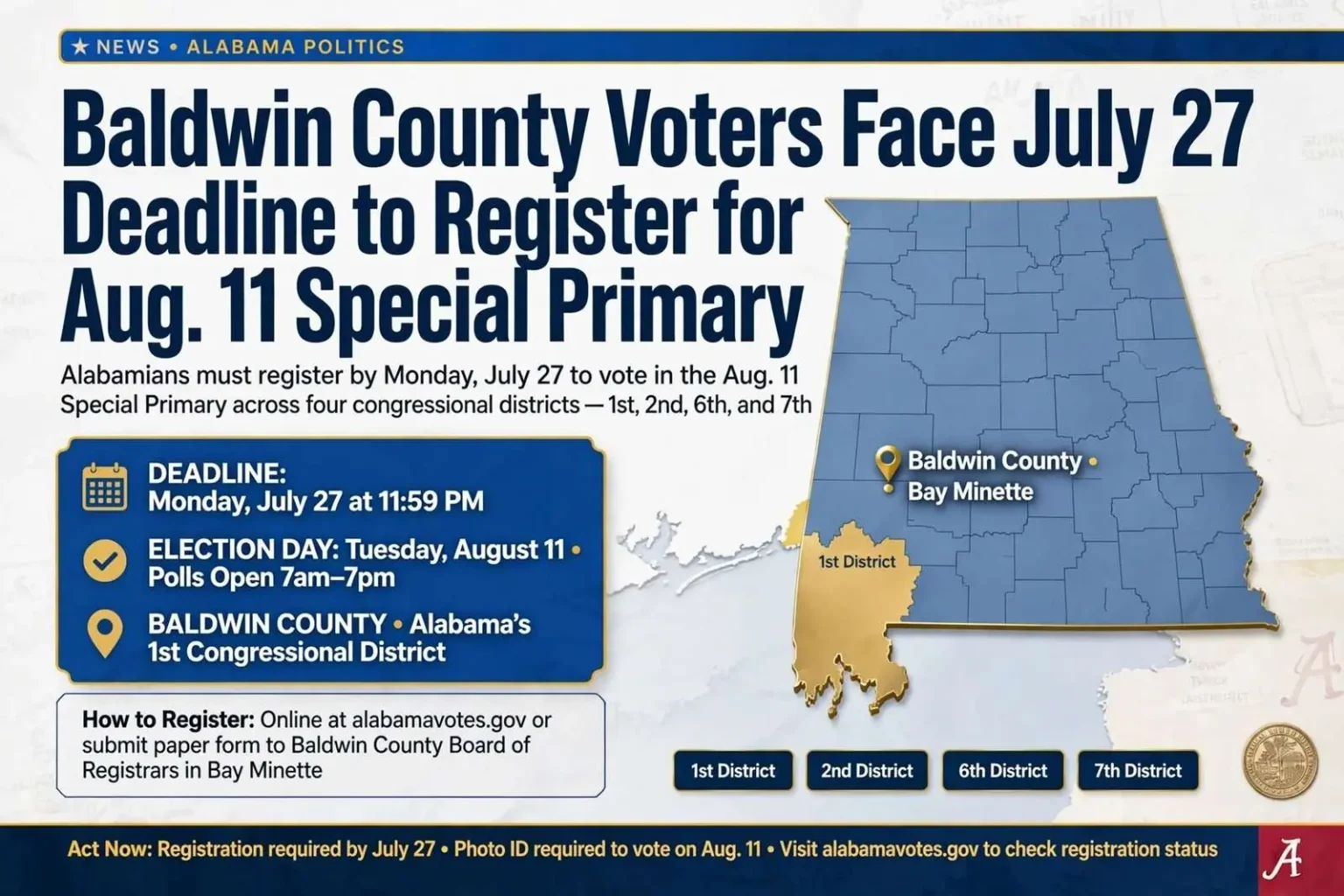
Alabamians who want to vote in the Aug. 11 Special Primary Election, including residents of Baldwin County, must register by Monday, July 27, according to the Alabama Secretary of State’s Office.
The deadline gives would-be voters in four congressional districts a hard cutoff: registration applications must be in hand by the end of the day Monday for residents to cast ballots in the August special primaries. For Baldwin County, one of Alabama’s fastest-growing counties, the deadline carries particular weight — new arrivals who have moved to the county in recent months may not yet be registered at their current addresses, and the registration clock is now running out.
Special elections run on compressed schedules compared with the regular election cycle, and election officials consistently stress that the most common mistake voters make is assuming they are already registered or that the deadline can slide. It cannot: under Alabama law, voter registration closes ahead of each election, and an application filed even a day late leaves a voter sitting out the primary.
Four districts, one Election Day
Baldwin County sits within Alabama’s 1st Congressional District, one of four congressional districts holding special primaries next month. Voters in the 2nd, 6th and 7th congressional districts will also head to the polls that day.
Alabama’s 1st District takes in the state’s entire Gulf Coast and southeastern corner — Mobile County, Baldwin County, and a stretch of the Wiregrass including communities such as Dothan — making Baldwin, with its booming population along the U.S. 98 and Alabama 181 corridors, one of its political centers of gravity. The 2nd District spans the Black Belt and the Montgomery area, the 6th wraps around Birmingham’s suburbs, and the 7th runs through west Alabama and central Birmingham — a district configured under state law to include much of the state’s minority population.
Special congressional primaries arise when a seat becomes vacant between regular elections, and Alabama’s process runs the full primary structure on a fast clock: a primary, with runoffs if needed, followed by a general election to seat a new member of Congress. Party nominees chosen on Aug. 11 will advance toward the special general election that follows.
Secretary of State Wes Allen urged eligible residents in the four participating districts to register or confirm their current registration status ahead of the deadline. State election officials say they’re working closely with local election administrators to prepare for the election.
Allen’s office serves as the state’s chief election authority, maintaining the statewide voter file and supporting the county-level officials who actually run elections. That cooperation between the state office and local probate judges, circuit clerks, and boards of registrars is the machinery behind every Alabama election — and in a special election, with weeks instead of months to prepare, that coordination matters more than usual.
How to register
Residents can register electronically through the Secretary of State’s website, or submit a paper registration form in person or by mail to their county Board of Registrars.
The online option, Alabama’s official voter registration portal, processes applications for anyone with an Alabama driver’s license or state ID, and has become the most common route for new registrants. Paper registration remains available for voters without those credentials or without internet access — forms can be picked up at county offices, libraries and other public locations, completed by hand, and delivered in person or by mail to the Board of Registrars in the voter’s county.
Baldwin County’s Board of Registrars, based in the county seat of Bay Minette, processes registrations for the county’s voters, and officials there handle address changes as well as first-time registrations. Moving within the state does not require re-registration, but a voter’s address must be current for them to be assigned to the correct precinct and district.
Who qualifies
To qualify to vote in Alabama, a person must be a U.S. citizen, an Alabama resident, and at least 18 years old by Election Day. Individuals with a disqualifying felony conviction or a court finding of mental incompetence are not eligible.
The qualifications come straight from Alabama’s constitution and election code, and they are applied uniformly across the state. The felony disqualification applies to crimes deemed crimes of moral turpitude under Alabama law, and eligibility can be restored through the state’s certificate of eligibility process or a pardon, depending on the offense. For most would-be voters, the practical requirements are simple: citizenship, residency, and age by Election Day.
Election Day logistics
On Election Day, polling locations will be open from 7 a.m. to 7 p.m., and anyone voting in person or by absentee ballot must show valid photo identification.
Alabama’s photo ID requirement has been in effect since 2014, and the list of acceptable identification covers a wide range of documents: an Alabama driver’s license or nondriver ID, a U.S. passport, a military or employee ID, a student or employee ID from an Alabama college or university, a veteran’s ID, a tribal ID, and several others. Voters who lack an acceptable photo ID can obtain a free Alabama photo voter ID card from the Secretary of State’s mobile ID unit or county offices, and voters who arrive at the polls without ID have fallback options, including a challenge process that permits a vote to be counted after identity verification.
The 7 a.m. to 7 p.m. window is Alabama’s standard polling schedule, and voters in line by closing time are entitled to cast their ballots. Precinct assignments are tied to a voter’s registered address, so a voter who has moved within Baldwin County without updating registration may need to vote at a former precinct or update their record before the deadline to avoid a problem on Election Day.
For voters who cannot make it to the polls, absentee voting runs ahead of the election through each county’s absentee election manager, with applications and ballots due by the statutory deadlines before Aug. 11.
Following the results
The Secretary of State’s Office will publish unofficial cumulative results on its website as they come in.
The statewide results page aggregates the county-by-county tallies as election officials transmit them after polls close, giving the public a single source for election-night numbers. Those figures remain unofficial until each county’s canvassing board certifies its returns and the state certifies the aggregate — a process that takes days — but the unofficial feed is where most Alabamians will follow the races as the night unfolds.
Finding your district
Voters who aren’t sure which congressional district they live in can look it up through the state’s voter information portal, and the state’s current congressional district map is also posted online.
That question is more common than it might seem, particularly for voters in areas where districts have shifted under recent redistricting, and for Baldwin County newcomers settling into a state whose political geography they are still learning. The voter information portal lets a resident enter an address and see their registered districts and polling place; the posted map shows the full boundaries of each of Alabama’s seven congressional districts.
Only voters in the 1st, 2nd, 6th and 7th districts will vote in this special primary. Residents of the 3rd, 4th and 5th districts, whose seats were not affected, will not appear on the Aug. 11 ballot.
Where to get help
Anyone with questions about registering to vote can contact the Secretary of State’s Elections Division or their local county Board of Registrars for assistance.
The Elections Division in Montgomery handles statewide questions — eligibility, registration status, absentee procedures — while the county boards handle the local details of applications and precinct assignments. Election officials recommend acting early rather than on deadline day, both to leave room for corrections and to avoid the last-day rush. For Baldwin County voters, the message from state officials is straightforward: check your registration now, and if it isn’t current, get it fixed before Monday, July 27.
Special elections and why they matter
Special primaries differ from regular elections in tempo more than in substance. Because a congressional seat has fallen vacant, the state must fill it outside the normal federal election calendar, compressing a process that ordinarily stretches across a full year into a matter of months. Candidates have only weeks to introduce themselves, campaign organizations run at sprint pace, and turnout typically runs well below a November general election — which makes every individual vote proportionally more powerful.
For the districts involved, the stakes are the usual ones of congressional representation: federal spending, coastal policy for the 1st District, and the committee seats and seniority that a new member will begin building in Washington. For Baldwin County specifically, a district that includes the coast, issues such as hurricane recovery funding, insurance markets, and the health of the tourism economy are perennial local concerns that land directly on a congressman’s desk.
Low-turnout special elections also tend to reward voters who pay close attention. With no presidential race at the top of the ballot and campaigns compressed into a few weeks, the electorate is smaller and more engaged, and organized interests focus their resources more heavily per voter. That is a reason officials like Allen emphasize preparation: the voters who arrive informed and registered are the ones who decide the outcome.
The countdown to July 27
The two weeks between the announcement and the registration deadline give procrastinating voters little margin. Registration applications filed online are typically processed quickly, but paper forms sent by mail must arrive in time, and officials advise voters not to bet on the postal service on deadline week. A voter whose application is incomplete — a missing driver’s license number, an old address — may be contacted for correction, another reason to file early rather than at the wire.
Once the deadline passes, the focus shifts to Election Day itself on Aug. 11: polls open at 7 a.m. and close at 7 p.m., photo IDs in hand, with results accumulating on the Secretary of State’s website through the evening. For the four districts holding primaries — and for Baldwin County’s voters in the 1st District — the process starts now, with a check of registration status and, if needed, a completed application before Monday, July 27.