Daphne Curbside Recycling Grew in 2007
Daphne's curbside recycling program kept more than four million pounds of material out of landfills in 2007, according to WKRG.
Originally reported September 4, 2007.
Daphne’s curbside recycling program kept more than four million pounds of material out of landfills in 2007, according to an archived local news report — a remarkable figure for a city of its size and a sign of how thoroughly the program had caught on across the Eastern Shore.
The program began in 2001, when its first year of operation collected 67,000 pounds of material. By 2007, officials said it was collecting an average of 400,000 pounds of recyclables each month, a volume that translates to roughly 4.8 million pounds a year flowing to recycling facilities instead of disposal.
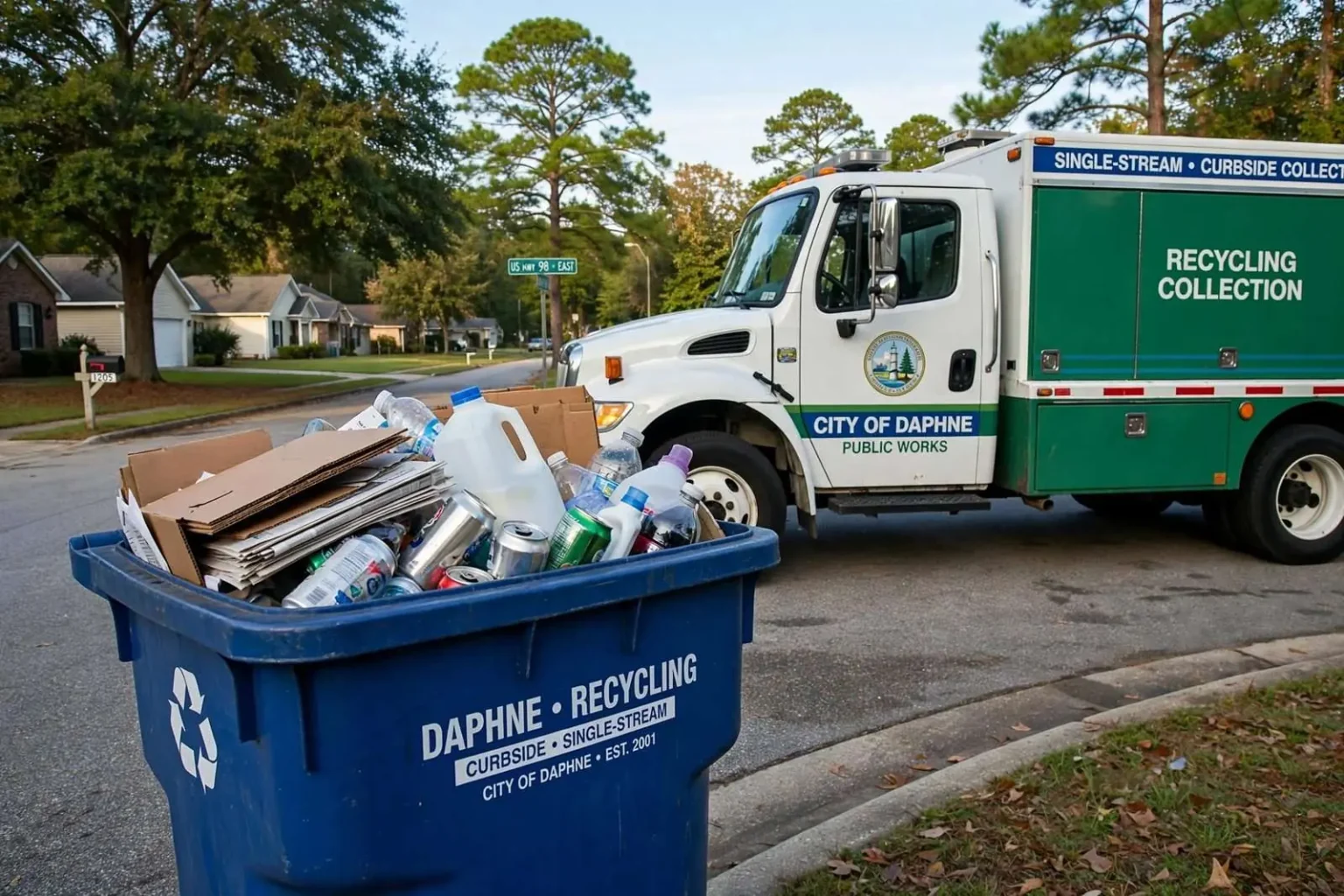
Officials said convenience was key: residents placed materials in a single bin, and specialized trucks sorted them at the curb. The approach — often called “single-stream” collection — spared households the chore of separating paper from plastic from metal, and it is widely credited with driving participation rates far higher than older multi-bin systems achieved.
The program’s growth was also linked to Daphne’s changing population, as the city’s rapid expansion through the 2000s steadily added households to the collection routes.
From 67,000 Pounds to 400,000 a Month
The growth curve behind those numbers tells the story of both a program and a city. A first-year total of 67,000 pounds in 2001 is the output of an operation finding its footing — initial subscribers, early education campaigns and the inevitable adjustment period as residents learned the routine. Six years later, the program was averaging 400,000 pounds a month, an increase of several times over in annual volume.
Part of that growth came from scale: every year added more households to the routes as Daphne’s subdivisions spread along and off U.S. Highway 98. Part came from habit: recycling programs tend to compound their gains as neighbors see neighbors participating and the routine becomes an ordinary part of household life. Officials’ remarks in the 2007 report suggest both forces at work, with the city’s changing population cited alongside the program’s own convenience.
Four million pounds in a single year is an abstraction until it is translated into physical terms — a mountain of newspapers, milk jugs, cans and cardboard that would otherwise be buried. For a city of roughly 20,000 residents at the time, the figure indicated that a large share of households were participating regularly, not just a dedicated minority.
Why Convenience Changed Everything
The single-bin, curbside-sorting approach described in the 2007 report represented the leading edge of recycling practice at the time. Early curbside programs in many cities asked residents to sort materials into separate containers, and participation rates suffered for it. Programs that consolidated collection into one bin and pushed the sorting work to the truck and the facility found that participation rose sharply, because the household effort dropped to almost nothing.
Daphne’s specialized trucks, which sorted materials at the curb, put that principle into daily practice on the city’s streets. Residents needed only to place the bin at the curb; the sorting happened on the truck bed as crews worked. The arrangement required investment — purpose-built vehicles and trained crews — but it converted recycling from a household chore into a household habit.
Convenience-driven design has since become the industry standard, and Daphne’s experience in the 2000s tracked the national pattern: wherever the household effort fell, participation followed. For city officials, the four-million-pound year was evidence that the investment in convenience-first collection had paid off.
Daphne’s Growth Decade
The program’s expansion mirrored the city’s own. In the early 2000s, Daphne was one of the fastest-growing cities in Alabama, drawing families to the Eastern Shore with its schools, its position along the I-10 corridor and its short drive to Mobile. New rooftops meant new collection routes, and the recycling program absorbed them year after year.
That growth also reflected a regional shift. Baldwin County’s population surged through the decade, and the Eastern Shore communities — Daphne, Fairhope, Spanish Fort — added services to match. Environmental programs that had once been the province of larger cities became standard municipal offerings, and Daphne’s early start in 2001 put it ahead of the curve among Alabama cities of comparable size.
The 2007 report’s emphasis on population change as a driver of recycling volume cut both ways, of course. Growth brought tax base and participation, but it also brought more waste overall. Recycling millions of pounds a year helped blunt the landfill impact of a booming city, even as the city’s total waste stream continued to climb.
Where the Recyclables Go
Materials collected at the curb in programs like Daphne’s — newspaper, cardboard, aluminum and steel cans, plastic bottles and glass — leave the truck for processing facilities where they are separated, cleaned and baled for sale to manufacturers. Each commodity follows its own market: paper becomes new paper products, aluminum is remelted with enormous energy savings compared to producing new metal, and plastics are reprocessed into containers, lumber substitutes and fibers.
The economics of recycling have always rested on those commodity markets, which rise and fall with manufacturing demand. Municipal programs balance the cost of collection against the revenue from selling materials and the avoided cost of landfill disposal — and in fast-growing cities, the avoided disposal cost is substantial, because landfill capacity is expensive to develop.
For the Eastern Shore in the 2000s, the landfill question was practical, not abstract. Baldwin County’s growth was filling disposal capacity quickly, and every pound diverted extended the life of existing facilities. Four million pounds a year out of the waste stream represented not just environmental virtue but real, measurable savings for the city’s solid-waste operation.
Recycling in the Alabama Context
Daphne’s program stood out against a statewide backdrop in which curbside recycling was, and in many places remains, the exception rather than the rule. Alabama’s smaller municipalities frequently lack the population density and budget to support household collection, and many residents across the state rely on drop-off centers or have no local option at all. Cities that offered single-stream curbside collection were — and are — ahead of much of the region.
The state’s low national ranking in recycling rates has been a standing concern for environmental officials, driven by limited infrastructure, low disposal costs that undercut recycling economics and sparse markets for recovered materials. Against that backdrop, Daphne’s 400,000-pound months in 2007 showed what a committed municipal program could accomplish even in a region where recycling was not yet standard practice.
The Eastern Shore’s demographic profile helped: growing cities with young families, suburban-style collection routes already in place for garbage, and civic pride in keeping the community clean. Programs elsewhere in Alabama that launched in the same era often struggled without one or more of those ingredients, which made Daphne’s trajectory a frequently cited local example.
The People Behind the Pounds
Programs like Daphne’s succeed on the strength of routines repeated thousands of times a week: households remembering collection day, bins set out at the curb, crews running routes in all weather. Behind the four-million-pound figure stood a quiet system of employees, schedules and community habits that made diversion possible without most residents ever thinking much about it.
City officials’ decision to publicize the tonnage in 2007 reflected more than a milestone. Publicizing results is how recycling programs sustain themselves — residents who can see that participation adds up to something concrete are more likely to keep participating, and more likely to encourage neighbors to do the same. A big number, well communicated, is itself a program tool.
Reading a 2007 Report Today
The archived report on which this article is based captured the program at a moment of demonstrable success: six years old, volume up by orders of magnitude, participation broad. Preserving those specifics — the 2001 start, the 67,000-pound first year, the 400,000-pound monthly average, the four million pounds diverted in 2007, the single-bin curbside sorting — matters because municipal program histories are rarely written down in one place.
It also records how the program was explained to the public at the time: convenience first, results in pounds, growth tied to the city’s population. That framing reflected the mid-2000s understanding of how to build participation, before later years would bring new conversations about contamination rates, global commodity markets and the evolving economics of recycled materials.
Readers today should treat the 2007 figures as what they are — an accurate snapshot of a specific year, drawn from an archived local news report — and consult the city’s current sources for information about how the program operates now. Programs evolve: routes change, accepted materials change, and collection methods change with new equipment and contracts. What the 2007 record preserves is the foundation: a city that started curbside recycling in 2001, made it easy for residents, and watched four million pounds a year stay out of the landfill as a result.