University of South Alabama Mobile
USA Foundation Adds $2 Million in Gifts, Assets Climb Past $319 Million
The University of South Alabama Foundation approved $2 million in new contributions to the Mobile school as its total assets topped $319 million.
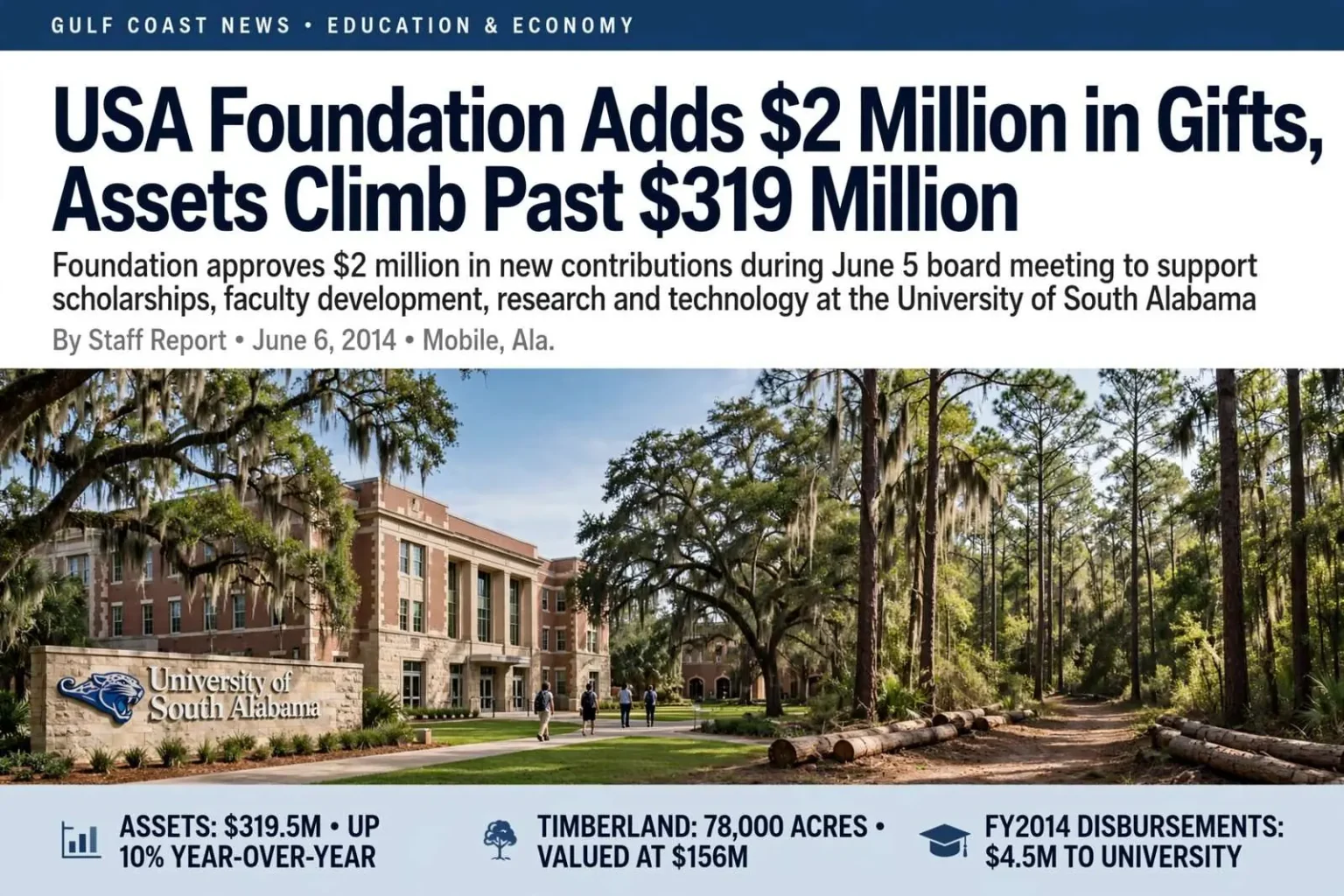
The foundation that manages endowment support for the University of South Alabama approved roughly $2 million in new contributions to the Mobile university during a June 5 board meeting, continuing a steady flow of funding for scholarships, faculty positions and campus programs.
The semi-annual disbursement, totaling just over $2 million, included $375,000 for the Whiddon Scholars Program, $110,000 for a faculty development fund, $133,400 for research graduate assistantships and $85,000 for a technology program fund. With this latest round, the foundation’s contributions to the university for the fiscal year ending June 30 reached roughly $4.5 million, similar to what it gave the previous fiscal year.
Those line items track the priorities a university foundation typically funds first. Scholarships recruit the strongest students, faculty development money keeps departments competitive in hiring and research, graduate assistantships support the research enterprise that attracts grants and faculty talent, and technology funds keep classrooms and laboratories current. The Whiddon Scholars Program, the largest single item in the disbursement, carries the name of a family whose giving has long been tied to student support at the university.
Assets Keep Growing
The foundation reported that its stock and equity holdings were valued at about $128 million in the first quarter of 2014, up from roughly $126.5 million at the end of 2013. That equity portfolio has grown nearly 13 percent since the same point the year before. Overall, the foundation’s net assets stood at about $319.5 million as of the end of March, up from $317 million three months earlier and nearly $291 million a year prior, marking almost a 10 percent increase over twelve months.
Growth of that pace matters to a university because endowment spending follows asset values. A foundation distributing a set percentage of its assets each year can fund more scholarships and more endowed positions when its portfolio climbs, and the 2014 figures put the foundation in a position to keep its annual support steady even as public funding for higher education in Alabama remained under pressure. University foundations across the state play that shock-absorbing role, and South’s foundation — with net assets approaching a third of a billion dollars — is among the larger ones.
A large share of that wealth comes from timberland. The foundation owns nearly 78,000 acres of timber property, appraised at more than $156 million, or roughly $2,006 per acre, a modest rise from an appraisal taken a few months earlier. Foundation officials said they expect timber prices to strengthen further this year as clear-cutting and thinning operations continue. The foundation planned three timber sales during 2014.
Working the Land
The first timber sale, held in April, drew ten bidders and generated more than $747,000 in sales. Hunting leases on the land brought in close to $466,000 for the year, while clear-cutting and thinning revenue totaled around $2.9 million over a ten-month stretch. Combined, the timber holdings make up roughly half of the foundation’s total net assets.
That dependence on timber is both a strength and a management challenge. Timberland produces income on a biological schedule rather than a market one — trees keep growing whether prices are up or down — and a well-run forestry program can time harvests to capture the stronger markets, holding inventory on the stump the way other investors hold stock. The foundation’s approach, spreading sales across the year and mixing clear-cuts with selective thinning, reflects that logic, as does the steady lease income from hunting rights, which converts the same acreage into revenue between harvests.
The acreage also ties the foundation to the economy of south Alabama’s rural counties, where much of its land sits. Timber remains one of the state’s largest agricultural industries by acreage and value, and institutional landowners like university foundations are significant participants in the local markets for standing timber, leases, and land sales. Appraisals rising to more than $2,000 an acre signal the kind of steady appreciation that has made Southern timberland a favored holding for endowments across the region.
How the Foundation Fits the University
The University of South Alabama, founded in the early 1960s as one of the state’s newer public universities, has grown into a major Gulf Coast institution with a large medical enterprise alongside its academic programs. Institutions of that scale rely on a mix of state appropriations, tuition, grants, and philanthropy, and the foundation’s roughly $4.5 million in annual support represents the portion of that mix most directly controlled by donor intent and investment performance.
Foundations and universities keep their finances separate for practical reasons. The foundation holds and invests the assets, manages the timber and real estate, and disburses money to the university according to board decisions, insulating the endowment from the university’s operating budget cycles. That structure lets the foundation think in decades — growing forests, compounding portfolios, and building named programs — while the university manages the academic year. The board’s twice-a-year disbursement schedule, reflected in the June 5 meeting, is the point where those two time horizons meet.
The programs funded in this round show that relationship in action. Graduate research assistantships at $133,400 support the university’s expanding research profile, which in turn attracts federal and industry grants far larger than the assistantship cost itself. Faculty development money at $110,000 helps departments retain and advance the professors who win those grants. The technology fund and the Whiddon scholarships round out a package that touches students, faculty, and research infrastructure in a single allocation.
Outlook
With net assets approaching $320 million, an equity portfolio growing at double-digit rates, and timberland that generates both harvest revenue and lease income, the foundation enters the rest of 2014 with the components of continued support in place. Officials’ expectation that timber prices will strengthen as the year’s sales proceed adds a cautiously optimistic note to the forestry side of the ledger, where most of the foundation’s wealth actually sits.
The numbers also underline how unusual the foundation’s asset mix is among university endowments its size. Half of its net assets in timber, rather than in marketable securities, gives it income streams that move independently of the stock market — hunting leases and timber sales do not care what the S&P 500 does this quarter. That diversification cushions the endowment in downturns and requires patient, specialized management in good ones, a combination the foundation’s board has balanced through years of rising appraisals and steady semi-annual disbursements to the university it supports.
For the university’s students and faculty, the practical effect of the board’s June decisions will arrive in the form of scholarship checks, research appointments, and upgraded equipment on campus in Mobile. For the foundation’s trustees, the meeting closed another half-year of managing land, markets, and giving — the three ingredients that turn 78,000 acres of Alabama forest into four and a half million dollars of annual support for public higher education on the Gulf Coast.
The April timber sale offered a snapshot of how that side of the foundation operates. Ten bidders competing for the offered tracts indicate a healthy market for standing timber in the region, where pulpwood, sawtimber, and chip-n-saw operations all draw on the same forested counties. Competitive bidding of that kind helps a seller capture closer to full value, and foundation staff use the results of each sale to calibrate expectations for the remaining sales scheduled through the year.
Clear-cutting and thinning serve different purposes in that rotation. Clear-cuts harvest a stand entirely for replanting, generating the larger paychecks and resetting the biological clock on a tract; thinning removes selected trees from a growing stand so the rest mature with more room and value. A foundation holding nearly 78,000 acres needs a continuous schedule of both to keep income steady year to year, and the $2.9 million generated over the ten-month stretch reflects that pipeline running on schedule.
What the Money Supports
Endowment income of the kind the foundation distributes is among the most flexible money a university receives. Unlike state appropriations, which arrive with strings attached, or grants, which fund specific projects, foundation disbursements reach the gaps: a scholarship that keeps a strong student enrolled, a start-up package that lands a promising professor, a piece of lab equipment no grant will cover. University administrators typically describe that flexibility as the difference between an institution that merely operates and one that can pursue a strategy.
The Whiddon Scholars name illustrates how endowed programs outlive their donors. A named scholarship funded by endowment earnings renews every year regardless of the annual budget, becoming a permanent feature of the university’s recruiting effort. Every additional dollar that flows into the endowment — from timber sales, leases, or investment growth — strengthens programs of that kind without requiring new fundraising for each class of students.
The June 5 meeting, in that sense, closed the loop on a year’s work across a portfolio of very different assets: stocks in the first quarter, timber through the spring, leases across the calendar. The board’s decision to send just over $2 million back to the university in a single disbursement — bringing the fiscal year to roughly $4.5 million — is the tangible output of that work, and the foundation’s growing asset base suggests the disbursements ahead will have every chance of matching it.