Foley Couple Charged With Capital Murder in Burglary, Arson Case
A Foley man and woman face capital murder charges after a 70-year-old friend was shot to death and his home burned during a burglary in Baldwin County.
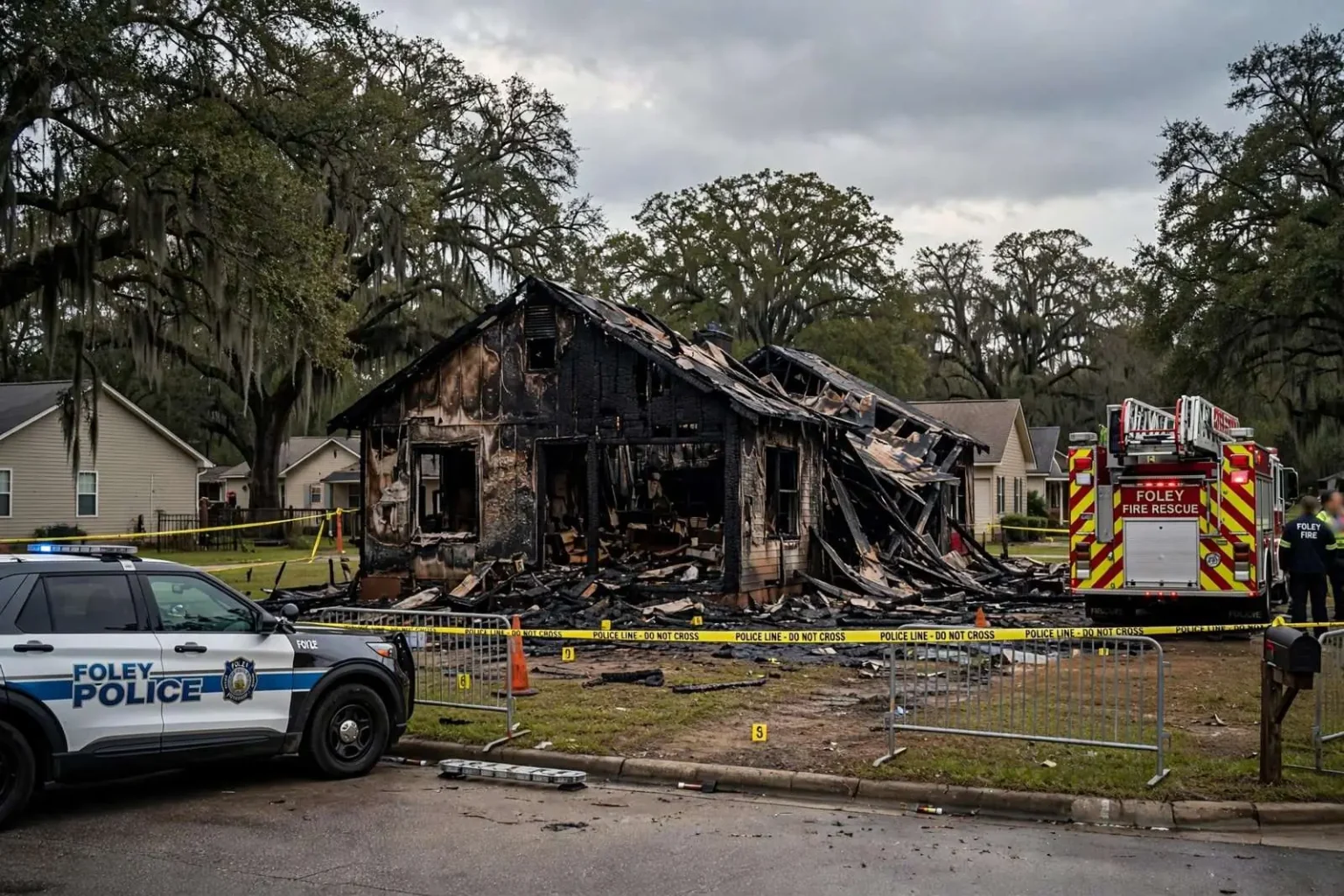
A Foley couple is facing capital murder charges following the death of a 70-year-old man whose home was burglarized and set on fire, according to Foley police. The case has landed heavily on the south Baldwin County city — a community of older neighborhoods, new subdivisions and a busy retail corridor where a killing of this kind is not part of the expected rhythm of local life.
A Burglary That Escalated Into a Homicide
Investigators say the man, who was a friend of one of the two suspects, was shot inside his home during what police described as a burglary that escalated into a homicide. His body and residence were found burned after the attack, complicating the initial investigation into what had happened. Fire is among the most difficult factors a homicide investigation can face: flames destroy or distort the physical evidence detectives depend on, and the line between a fire scene and a crime scene must be established by trained fire investigators before homicide work can even properly begin.
Foley police arrested a 33-year-old man and a 21-year-old woman, both Foley residents, on capital murder charges tied to both the arson and the burglary. Investigators said the pair’s connection to the victim, who considered one of them a friend, added a troubling dimension to what officers described as a particularly brazen crime. In cases of this kind, investigators must also untangle that relationship — the visits, phone records and shared history that explain how suspects came to be inside a victim’s home — because a known acquaintance entering a house rarely draws the suspicion a stranger would.
According to police, the attack occurred on a Sunday night, with the arrests following days later after detectives pieced together evidence from the scene, including the fire damage that investigators believe was intended to destroy evidence of the burglary and shooting. The alleged use of fire to cover the crime shaped the charges as much as the shooting itself: under Alabama’s capital murder statute, a killing committed during arson or burglary carries the death-eligible weight that an ordinary murder charge does not.
What Capital Murder Means in Alabama
Capital murder charges in Alabama are reserved for the most serious homicide cases, typically involving aggravating factors such as murder committed during the course of another felony like burglary, arson, kidnapping or robbery. The statute lists those aggravating circumstances precisely because they transform a killing into something the law treats categorically differently — a death that occurred in the course of another dangerous felony, where the defendant’s own conduct created the conditions for the killing.
Because both a burglary and an arson were allegedly involved in this case, prosecutors filed capital murder charges tied to each underlying offense, which could expose both defendants to the possibility of a death penalty sentence if convicted, pending a decision by the Baldwin County District Attorney’s office on how to proceed. That decision — whether to seek death, accept a plea to a lesser sentence of life without parole, or take the case to a jury on the capital charges alone — rests with the district attorney and is typically made only after a full review of the evidence, the defendants’ histories and the wishes of the victim’s family.
The two-defendant structure adds another layer. When a capital charge names more than one participant, Alabama law allows each person’s role — who planned, who entered, who fired, who set the fire — to be litigated individually, and outcomes for codefendants in the same case can differ sharply depending on what the evidence shows about each one’s part. Accomplice liability reaches everyone who participates in the underlying felonies, but the penalty phase of a capital case turns on the details of individual culpability.
The Investigation Continues
Foley police say the investigation remains active as detectives work to establish a full timeline of the events leading up to the killing, including how the suspects gained access to the victim’s home and what triggered the violence. Those two questions — access and trigger — will organize much of the case that prosecutors eventually present. Entry into a victim’s home by a known acquaintance suggests some degree of trust or invitation, which is precisely what makes the escalation to violence and fire so difficult for a community to absorb.
Detectives in a case of this kind will also reconstruct the Sunday night from the outside in: fire department response records, calls for service, surveillance footage from the surrounding blocks, phone data, and the physical evidence that survived the fire. Every fact recovered becomes more important in a case where so much of the scene was consumed, and the fire itself becomes evidence — its origin, its point of entry, and the accelerant patterns that investigators read like a record of what the fire was meant to hide.
Neighbors in the area where the crime occurred described shock at the killing, noting that violent crime of this nature is rare in the close-knit Baldwin County community. Foley has grown quickly in recent decades — from a small railroad and farming town into one of Baldwin County’s retail and service hubs — but its older residential sections remain the kind of places where neighbors know each other by name, which is why the loss of a longtime resident to violence inside his own home has resonated the way it has.
What Happens Next in Court
Both suspects were being held pending further court proceedings. The case is expected to move through Baldwin County’s court system in the coming months, with a preliminary hearing likely to determine whether sufficient evidence exists to send the case to a grand jury. In Alabama’s process, the preliminary hearing is the first public test of the state’s evidence — a chance for defense attorneys to hear the testimony detectives have assembled and for a district judge to decide whether the case advances.
If the case is bound over to the grand jury, that panel will decide whether to return an indictment on the capital charges. Capital cases then move at a different pace than ordinary prosecutions: the defense is entitled to additional resources, the penalty phase adds a second trial within the trial, and appeals in capital cases run through a mandatory review process that can stretch for years. Residents following the case should expect the legal process to unfold slowly, even as the police investigation continues to add detail to what happened that Sunday night.
Foley and the Question of Growth
City and county officials in Foley, a fast-growing Baldwin County community known for its retail corridor and proximity to the Gulf Coast beaches, said the department would continue to provide updates as the case develops. The city’s growth story is familiar across Baldwin County: thousands of new residents arriving each year, subdivisions extending toward the county’s farmland, and a commercial base built on the shops, antique stores and restaurants around the railroad park that anchor the city’s identity for visitors passing between Interstate 10 and the coast.
Growth brings pressure on the agencies that serve it. A police department serving a city that has multiplied in size must cover more ground, more traffic and more calls with a force that grows more slowly than the population — and the detectives assigned to a case like this one carry that load alongside it. For longtime residents, the shock of the case sits in the contrast between the Foley they know — festival weekends, farmers markets, the hum of the retail corridor — and the violence described in the charging documents.
The case will also renew familiar conversations in Baldwin County about home security and trust — the practical steps residents take after a crime like this one: lighting, cameras, locked doors, and the willingness to report unfamiliar activity to the police before it becomes a tragedy. Fire officials add their own reminder: a house fire that occurs under suspicious circumstances should always be treated as a potential crime scene, and early calls to authorities preserve evidence that cannot be recovered later.
Waiting for the Courts
For the victim’s family and friends, the coming months will mean watching the process move — the preliminary hearing, the grand jury, the long calendar of a capital case — while living with the truth of what happened inside a house they knew. Friends described the 70-year-old as a man whose ties in the community ran deep, and it is that connection that gives the case its particular weight: the violence did not come from a stranger, police say, but from someone the victim had welcomed into his life.
Whatever the courts ultimately decide, the file that began with a Sunday night fire in a Foley neighborhood will move through every stage Baldwin County’s justice system offers. The police investigation remains active, the two defendants remain in custody, and officials have committed to updating the public as the case develops — the community’s earliest and most basic assurance that the questions raised by that night will be answered, one proceeding at a time.