Fired Mobile Police Officer Turns Himself In on Theft Charge
A fired Mobile police officer turned himself in on a theft charge after an internal trial board found him guilty of multiple violations.
A Mobile police officer fired earlier this year after an internal trial board found him guilty of multiple department violations has turned himself in on a criminal theft charge stemming from the same investigation. The case marks the second stage of an accountability process that began inside the police department and has now moved into the criminal courts, where the same conduct that cost the officer his badge will be judged under state law.
Wayne Lawley, who went by “Fred” and had served with the Mobile Police Department, lost his job on Feb. 27 after a trial board determined he was guilty of four major departmental violations: conduct unbecoming an officer, unlawful conduct, violating the law enforcement code of ethics, and being untruthful during a department investigation. The combination of findings — particularly the untruthfulness determination — left little room under department rules for any outcome other than termination, and the trial board’s decision formally ended his career with the department.
Evidence gathered during the internal probe was later submitted to the Mobile County District Attorney’s Office, which pursued a criminal charge of second-degree theft of property against him. The referral followed the standard path for such cases, in which administrative findings supported by evidence of possible criminal conduct are handed to prosecutors, who decide independently whether the facts support criminal charges under Alabama law.
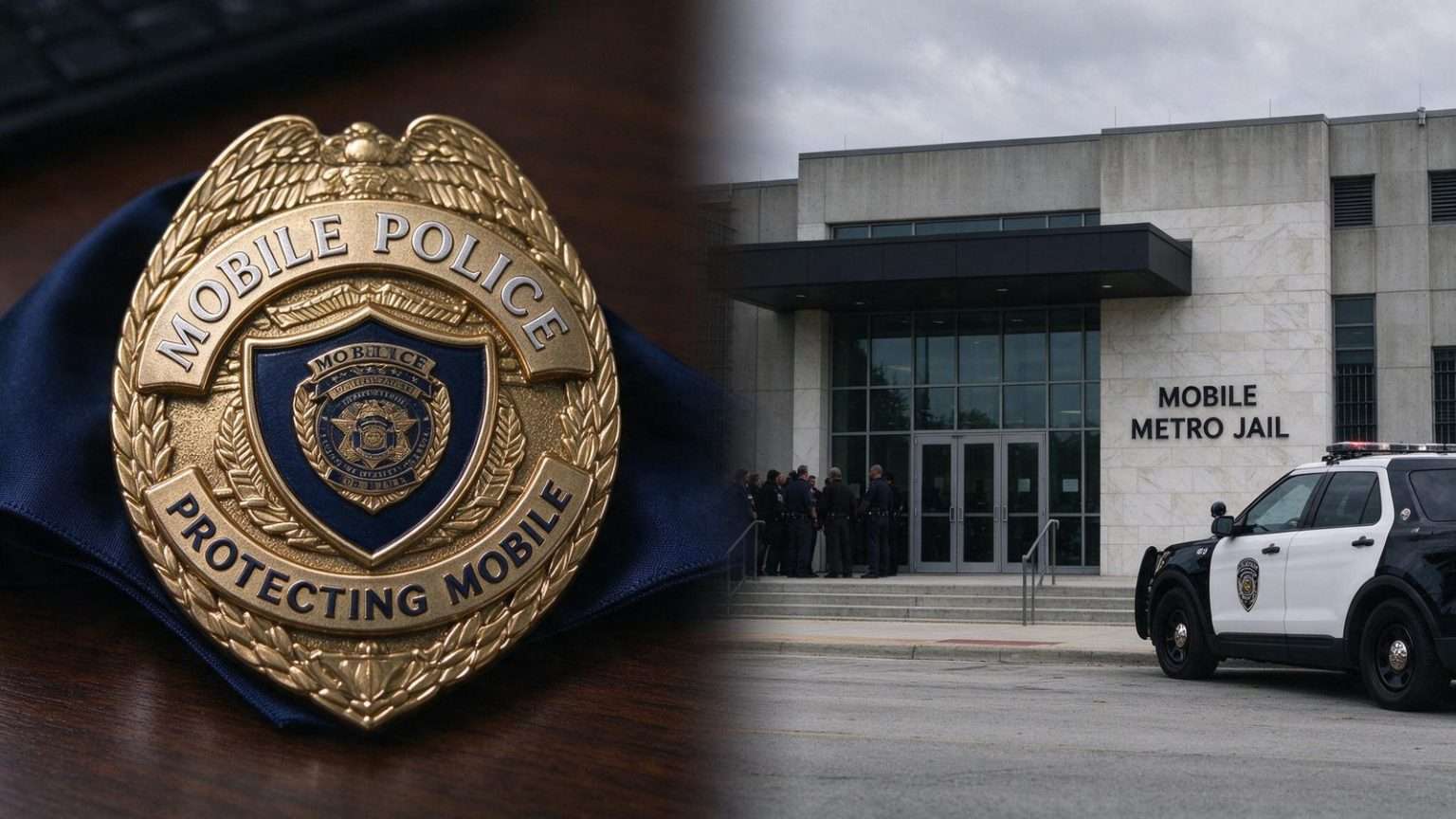
Lawley turned himself in at the Mobile Metro Jail in the afternoon and was released a short time later after posting bond. The voluntary surrender and quick bond posting followed the pattern typical for defendants facing nonviolent felony charges who arrange representation in advance, and it spared the department and the courts the logistics of an arrest. He is scheduled to appear in court in April to face the theft charge, where the case will begin its progression through the criminal docket.
How the Department’s Accountability Process Works
The termination and subsequent criminal charge highlight the department’s internal accountability process, which includes a trial board review for officers accused of serious misconduct. Trial boards function as administrative hearings within the department, where evidence is presented and findings are made on whether specific violations of departmental rules occurred. A finding of guilt on any of the four violations Lawley faced can result in termination, and the combination of conduct violations and dishonesty findings often signals a serious breach of the trust placed in sworn officers.
Untruthfulness carries particular weight in law enforcement discipline. An officer found to have been untruthful during an internal investigation is, in practical terms, compromised as a witness, since prosecutors must be able to vouch for the credibility of the officers whose reports and testimony support criminal cases. That reality is why dishonesty findings so frequently end careers, independent of the underlying conduct being investigated.
The administrative and criminal tracks run on separate timelines but draw on much of the same evidence. Because the trial board’s findings rested on materials gathered during the internal probe, the district attorney’s office received a case file that had already been assembled and reviewed, allowing prosecutors to move relatively quickly from the internal conclusion to the filing of a criminal charge.
What the Theft Charge Involves
A police department spokeswoman confirmed the case remains active and that the investigation is ongoing, though additional details about the specific circumstances of the theft allegation were not released publicly. Mobile police officials have not detailed publicly what specific property or incident led to the theft allegation, and the department has said the broader investigation remains open, leaving open the possibility of further findings or charges connected to the case.
Second-degree theft of property under Alabama law is a felony that generally applies when the property involved falls within a value range above the misdemeanor threshold but below the level that triggers first-degree charges. The classification means the case will be handled in the felony courts of Mobile County rather than district court, with an initial appearance, potential preliminary hearing, and ultimately a decision by prosecutors on whether to present the case to a grand jury or resolve it through a plea.
Because the alleged theft arose from the same investigation that ended Lawley’s employment, prosecutors will be working from a record built by the department’s own investigators. Defense counsel, in turn, will examine how the internal evidence was gathered and whether the administrative findings hold up under the higher standards of a criminal case, where the burden of proof and the rules of evidence differ significantly from a departmental trial board.
Scrutiny in Mobile and What Comes Next
Cases involving fired officers facing subsequent criminal charges tend to draw close attention in Mobile, where residents and city leaders have pushed in recent years for greater transparency in how the police department handles misconduct allegations against its own ranks. Each case that moves from an internal finding to a public courtroom becomes, in effect, a test of whether the department’s internal process and the criminal justice system reinforce one another, and the public filings in such cases are often the fullest account residents ever receive of what occurred.
The outcome of Lawley’s April court date will determine whether the criminal case proceeds to trial or is resolved through a plea agreement, and it will likely factor into ongoing conversations at City Hall about oversight of law enforcement conduct. An initial appearance sets bond conditions and schedules the next steps, but the meaningful milestones — a preliminary hearing, any grand jury action, and potential plea or trial dates — will follow in the months after April as the case works through the felony docket.
The Mobile Police Department has not indicated whether any additional officers were implicated in the same investigation that led to Lawley’s termination and criminal charge. The department has also not said whether any further administrative actions are pending, though the open status of the investigation means the possibility of additional findings remains. For now, the case stands as an example of the full accountability sequence — internal trial board, termination, referral to prosecutors, criminal charge and court appearance — working end to end in a single matter, with the April hearing the next date on the calendar.
The Human Side of a Departmental Case
For the men and women who work alongside an officer through an internal investigation, the process is a difficult one regardless of the outcome. Colleagues are often interviewed, assignments shift while the case is pending, and a trial board’s findings — whatever they determine — become part of the department’s institutional memory. Cases that end in termination and criminal charges tend to be discussed within the department for years, both as cautionary examples and as evidence of what the accountability process can produce when allegations are sustained.
For the public, the value of seeing the process play out in the open is hard to overstate. Internal disciplinary proceedings are frequently shielded from view in whole or in part, which is why the criminal court file often becomes the first place where the underlying allegations are described in detail. In Lawley’s case, that means the April hearing and any subsequent filings will draw attention not only from those following one officer’s case but from residents and advocates who have pressed for visibility into how the department polices itself.
A Broader Pattern for Mid-Sized Departments
Mobile’s sequence of internal review followed by criminal referral reflects a model many departments strive for: administrative discipline handled internally under departmental rules, with evidence of possible crimes passed to an independent prosecutor rather than resolved internally. The division matters because departmental discipline and criminal prosecution serve different purposes — one protects the integrity of the force, the other determines guilt under state law — and neither can substitute for the other.
The theft charge Lawley now faces will be adjudicated on its own merits, with the trial board’s findings providing context but not a verdict. Courts do not treat administrative conclusions as proof, and prosecutors will need to establish the elements of theft independently, from the identity of the property to the officer’s intent. That separation protects defendants and departments alike, even when both processes begin from the same file of evidence.
As the April court date approaches, the case will remain a quiet measure of whether the systems Mobile has in place — trial boards, referral protocols and open courtrooms — deliver the accountability residents have asked for. The department has taken its position through its spokeswoman’s confirmation that the case is active and the investigation ongoing; the courts will take theirs beginning in April; and the public record, for now, contains the four findings that ended one officer’s career and the single felony charge that will test them.