Mobile Police Officer Turns Himself In on Domestic Violence Charge
A Mobile police officer surrendered at the county jail after investigators secured a warrant charging him with third-degree domestic violence.
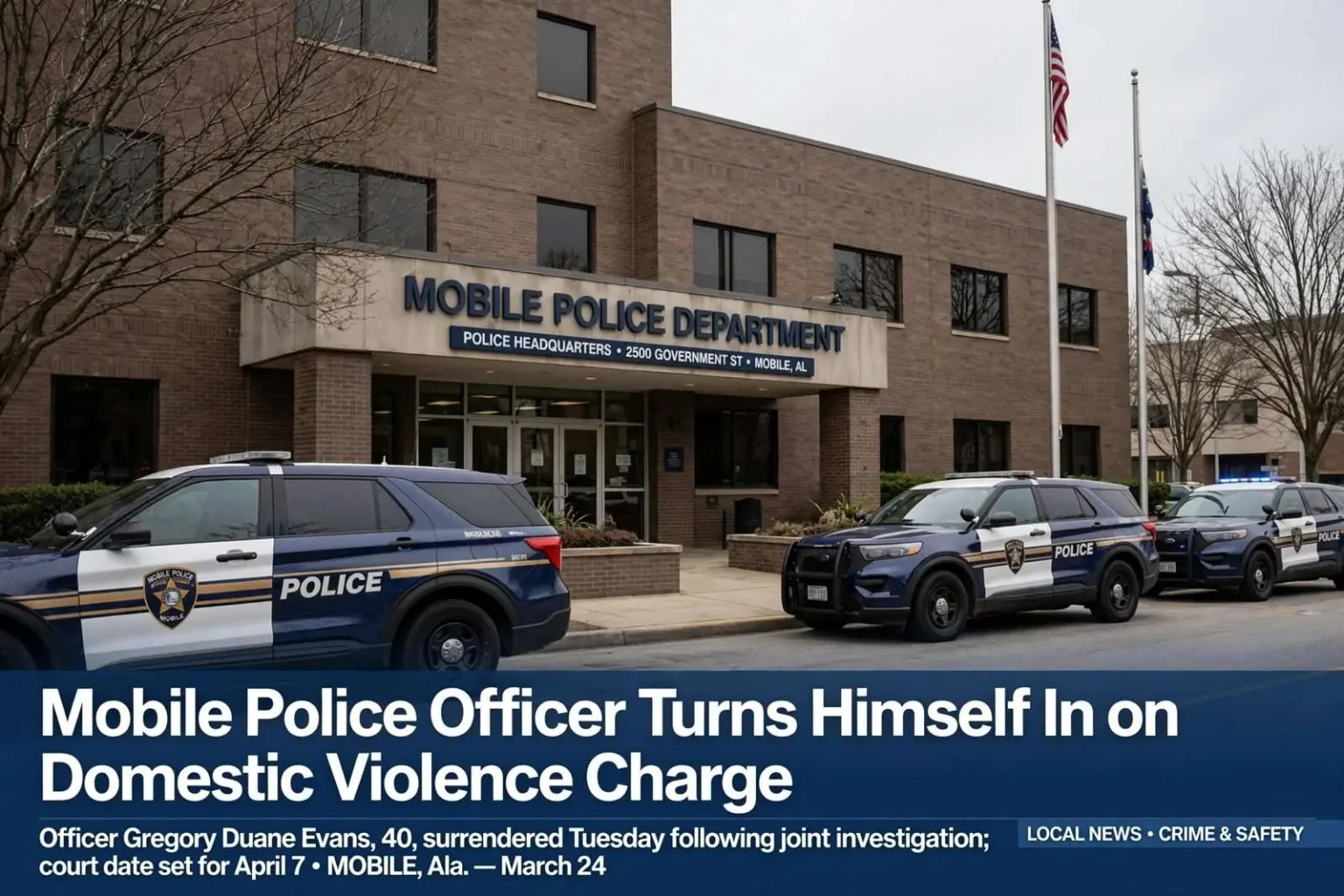
A Mobile Police Department officer turned himself in to authorities this week after investigators developed enough evidence to charge him with domestic violence involving a family member, according to a department news release.
Officer Gregory Duane Evans, 40, surrendered at Mobile Metro Jail on Tuesday, March 24, following a joint investigation by the Alabama Department of Human Resources and the Mobile Police Department into an abuse allegation. Investigators forwarded their findings to the Mobile County District Attorney’s Office, which determined there was sufficient evidence to issue a warrant charging Evans with third-degree domestic violence.
Jail records show Evans was booked around 4:35 p.m. and released roughly 15 minutes later. He is scheduled to appear in court on April 7.
Mobile Police Department spokeswoman Ashley Rains confirmed the details of the case in a statement to local media, noting that the investigation stemmed from an allegation involving Evans and a member of his family. The department has not publicly identified the alleged victim, consistent with standard practice in domestic violence cases.
Mobile Police Chief James Barber said the department opened its own internal review of the officer’s conduct alongside the criminal case. “We have begun a preliminary investigation into the actions of Officer Evans,” Barber said in a statement. “The department will act accordingly, depending on the findings of the court and the administrative investigation.”
The case highlights the dual-track process Mobile police typically follow when an officer faces criminal allegations: a criminal investigation handled through the district attorney’s office and an internal affairs review that can lead to separate disciplinary action regardless of the outcome in court. Department leadership has said in the past that officers accused of misconduct, including off-duty conduct, are held to the same legal standards as any other resident of Mobile County.
What Third-Degree Domestic Violence Means
Under Alabama law, third-degree domestic violence is the least severe of the state’s three domestic violence charges, but it is still a Class A misdemeanor — the most serious misdemeanor classification — covering acts such as assault, harassment, menacing or reckless endangerment committed against a family or household member. A conviction carries potential penalties that can include jail time, fines, mandatory intervention programs and protective order conditions, and the domestic violence designation changes how the case is handled: victims’ participation requirements, no-contact considerations and specialized court processes all come into play.
Because the charge is a misdemeanor, the case will move through district court, where a judge — not a jury — hears the evidence unless the case is bound over or otherwise escalated. The April 7 court date will be Evans’ first formal appearance in that process, where the charge will be read and the case set for further proceedings.
The Role of DHR and the Joint Investigation
The involvement of the Alabama Department of Human Resources signals that the allegation touched on the state’s family welfare apparatus. DHR investigates abuse allegations involving households it serves, particularly where children are part of the family, and when its investigators uncover evidence of a crime, the agency refers the matter to law enforcement. In this case, that referral was handled jointly with Mobile police, whose officers investigated their own colleague before passing the file to the district attorney’s office for a charging decision.
That handoff structure is deliberate. Police agencies do not charge their own officers; the decision to prosecute belongs to the district attorney, and the warrant process keeps the charging decision outside the department. For an officer-facing case, the joint approach also documents the investigation at arm’s length from the chief’s office, which helps insulate both the criminal case and any later administrative action from claims of internal favoritism.
How the Internal Track Works
The internal review Barber ordered runs on a separate clock from the criminal case. Internal affairs investigators examine whether the officer’s conduct violated department policy, whether he can continue to perform his duties while the case is pending, and what disciplinary consequences may follow. An officer can be cleared in court and still disciplined internally — or vindicated by the courts and still face policy findings — because the two processes apply different standards: criminal law on one side, the department’s rules and procedures on the other.
Departments typically limit an officer’s duties while such a review is pending, sometimes reassigning the officer away from enforcement roles until the outcome is clear. Barber’s statement stopped short of describing any interim action, saying only that the department would act according to what the court and administrative findings show. The police chief’s office has generally made such reviews a point of emphasis, arguing that public trust depends on officers being accountable through the same channels any citizen would face — and additional ones besides.
Domestic Violence Cases and Victim Privacy
The department’s decision not to identify the alleged victim follows standard practice across Alabama. Domestic violence cases carry heightened privacy concerns because the parties share a household or family relationship, and identifying a victim can discourage reporting, expose the person to retaliation and complicate prosecution. Police reports in such cases routinely withhold names, addresses and details that could reveal the family situation, even as the accused officer’s name enters the public record through the jail booking.
Advocates in the Mobile area note that the tension is real in cases involving police officers: the accused has a public role, while the alleged victim does not, and the power imbalance inside a family is compounded when one member carries a badge. Victim advocates and prosecutors work to keep protective measures in place through the court process, and judges in domestic violence cases can set no-contact conditions as a condition of any release.
What Happens Next
The case now moves on both tracks simultaneously. In district court, Evans will appear on April 7, where the misdemeanor charge will proceed through arraignment and toward either a resolution or trial. Inside the department, internal affairs will complete its preliminary review and determine what administrative steps follow, with the chief retaining authority over employment decisions regardless of the court’s schedule.
Neither track will resolve quickly. Misdemeanor dockets in Mobile County move over months, and administrative reviews take as long as the evidence requires. What the department has committed to publicly is the principle Barber stated: that the outcome in each track will determine what follows, and that an officer’s badge does not change the standard of conduct the law expects of him or her.
Accountability When the Accused Wears a Badge
Cases in which a police officer stands accused of a crime draw a level of scrutiny that ordinary cases do not, and Mobile’s leadership has generally acknowledged the reason: the department’s credibility with the public it polices depends on how it handles its own. Chiefs across Alabama have wrestled with the balance between an officer’s presumption of innocence and the department’s duty to reassure the community, and the dual-track structure — criminal prosecution plus internal review — exists precisely so neither goal is sacrificed to the other.
The public documentation of Evans’ arrest, from the news release to the booking record, reflects that approach. The department released the officer’s name, the charge, the timeline and the court date rather than handling the matter quietly, and the district attorney’s office made an independent charging decision. Civilian oversight advocates argue that transparency at the front end of a case is the best predictor of public confidence in its resolution.
The Larger Context of Domestic Violence Response
The case also arrives amid a broader regional push on domestic violence. The Mobile County District Attorney’s Office maintains a specialized unit for domestic violence prosecutions, and local courts coordinate with shelters, advocates and intervention programs to move victims and families toward safety. Alabama legislators have strengthened the state’s domestic violence statutes over the years — creating the graduated charge structure, expanding the definition of family or household members, and giving judges more tools at the point of arrest.
For the department, an allegation against one of its own officers becomes, in practice, a test of the same principles it asks the community to trust. How the criminal case resolves, and what the internal review finds, will be watched both inside the department and outside it. The uniform on the accused changes the optics of a domestic violence case; it does not change the law that applies.
Evans remains scheduled for his April 7 appearance, where the case’s next steps will be set on the record in open court. The internal review continues in parallel, and the department has said it will disclose the outcome of its administrative process once the findings are in hand. Officials have not indicated whether any interim duty restrictions have been placed on Evans while both proceedings run their course.