The Largest Law Enforcement Group in Mobile County Picks a Side
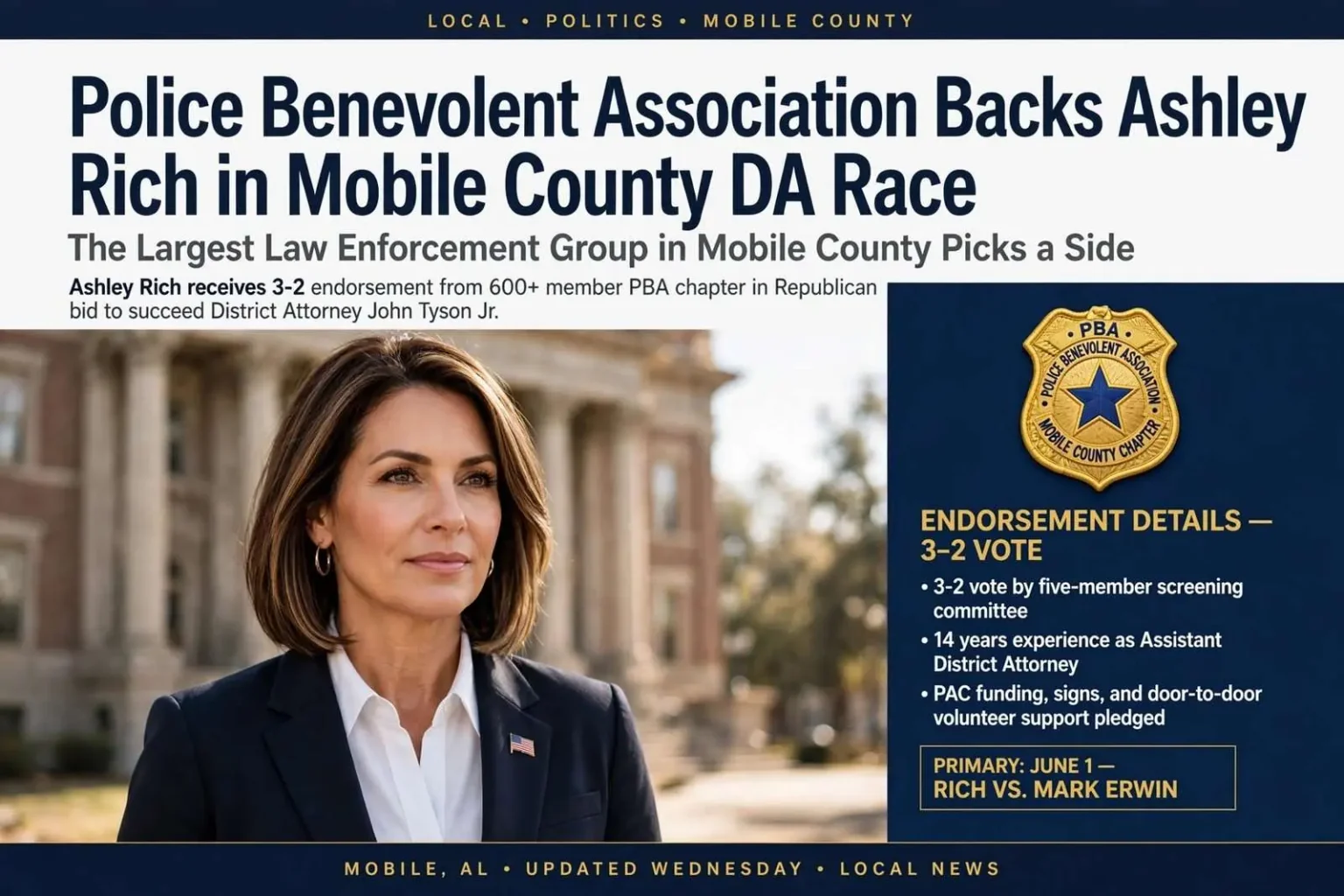
Ashley Rich won the endorsement of Mobile County’s largest association of law enforcement officers Wednesday in her Republican bid to succeed her boss, District Attorney John Tyson Jr. The Alabama Police Benevolent Association, Mobile County Chapter, which counts more than 600 members, chose the veteran assistant district attorney over Republican rival Mark Erwin in what chapter director Donald R. Scott described as an unusually close call.
Endorsements from law enforcement associations carry particular weight in district attorney races, because the office’s day-to-day working relationship is with police: prosecutors build cases from officers’ reports, testify alongside them, and rely on them to investigate. An association that represents hundreds of working officers is, in effect, telling the electorate how its members judge who would run that relationship best, and candidates in Alabama prosecutor races have long treated such endorsements as both a credential and an organizing asset.
A 3-2 Decision
The chapter’s screening committee voted 3-2 for Rich, Scott said. The five-member panel had interviewed both Republicans and Democratic candidate Don Foster on Monday night, then deliberated for longer than usual before reaching a decision.
“We interviewed all three and two really stood out,” Scott said. “They both gave great presentations on their plans for the district attorney’s office. When it came down to it, it was a 3-2 vote to endorse her.”
The narrow margin is itself informative. Screening committees of this kind typically question candidates on prosecutorial philosophy, management of the office, relationships with law enforcement agencies and specific plans for the office’s operations, then debate among themselves before voting. That the panel needed extra deliberation indicates both Republicans presented serious, well-received cases, and the association’s leadership did not treat the choice as obvious.
Scott pointed to two factors: Rich’s fourteen years of prosecutorial experience, and the fact that she had not served on Tyson’s executive management team — which, in the committee’s view, meant she should not be held accountable for changes the association believed the office had failed to make.
“It was neck and neck and we took a couple of days to think about it because it was so close,” Scott said. “It came down to her hard-nosed, vigorous prosecution of criminals and her results in getting convictions. Also, her vision and insight as far as changing the DA’s office when she gets in there were factors.”
Under Rich’s leadership, Scott said, the office would become more proficient and more professional than it had been.
Money and Manpower
The endorsement is not merely symbolic. Scott said PBA representatives would meet with Rich next week to coordinate their support, which will be both financial and organizational.
“We intend to give her PAC money for her campaign to run ads as she sees fit,” Scott said, “and if she needs us to put out signs or go door-to-door, we’ll do that as well.”
That combination of resources matters in a local race that rarely commands the advertising budgets of statewide campaigns. Direct contributions allow a campaign to place its message where voters will see it, while an association’s volunteers extending its reach door to door and sign by sign delivers something a check cannot: the visible support of the officers whose work the office touches every day.
The screening committee included Scott of the Mobile Police Department; Joe Benson of the Circuit Court Police; Shannon Payne and Lance Deleston, both of MPD; and Lanora Timmons, an investigator with the Mobile County District Attorney’s office.
The composition of the panel reflects the breadth of law enforcement work the DA’s office touches. Members drawn from the city’s police department, the court security detail and the district attorney’s own investigative staff each view a prosecutor’s performance from a different angle, from street-level casework to courtroom logistics to the internal workings of the office itself. A unanimous or near-unanimous view across those perspectives is difficult for any candidate to earn, and the split vote shows how genuinely contested the choice was.
‘I’m Absolutely Not John Tyson’
Rich, 41, also holds the endorsement of the smaller Mobile County Law Enforcement Association, which backed her shortly after she entered the race three months ago. She said she was honored to have both groups behind her.
She was particularly pleased, she said, that the PBA had weighed her on her own record rather than as a proxy for the man who hired her in 1996.
“My record speaks for itself over these past 14 years,” Rich said. “Tyson doesn’t have my experience and I don’t have his. Mark wants Tyson back in the race, but he’s not in the race. It’s between Ashley Rich and Mark Erwin. My record and my credentials. His record and his credentials. I plan to use my experience as a prosecutor to lead that office. It’s just that simple.”
Running to succeed a boss creates an awkward dynamic for any prosecutor, because the office’s record over the incumbent’s tenure is at once the candidate’s own work and the incumbent’s legacy. Rich’s framing draws a deliberate line around that problem: her years inside the office are her credential, but the association’s criticism of the office’s direction is Tyson’s to answer for, not hers. Her comment that Erwin wants Tyson back in the race, while Tyson is not running, positions the election as a choice between two individual records rather than a referendum on the incumbent.
Rich, who now heads the office’s murder team, said fourteen years inside the district attorney’s office had given her a clear view of both its strengths and its weaknesses.
“I will build on those strengths and improve on those weaknesses,” she said.
Leading the murder team places a prosecutor at the top of the office’s caseload hierarchy, handling the most serious and highest-profile prosecutions in Mobile County. It is work that demands years of trial experience, close coordination with homicide investigators and the ability to manage cases that can stretch for months, and it is the role from which Rich is now presenting her qualifications for the office’s top job.
Erwin Responds
Erwin, 41, a former chairman of the Mobile County Republican Party and now presiding municipal judge in his native Saraland, was measured in defeat.
“We had a discussion with the five members of their board and I was told on a 3-2 vote they offered the endorsement the way the three voted,” he said, “and that’s all you can say.”
Erwin’s path to the race runs through law, politics and the bench. He came to law after first planning to enter the ministry. He interned in the district attorney’s office and clerked for Circuit Judge Rusty Johnston before building a primarily civil practice.
That background gives Erwin a different professional profile from Rich’s. Where she offers fourteen years of daily criminal prosecution, he offers courtroom experience from the civil side, service as presiding judge of Saraland’s municipal court and a history of leadership in county Republican politics, including chairing the party during a period when it built strength in local races. Their contrasting resumes gave the association’s screening committee a genuine choice between two credible visions of the office.
The Democratic Field
Foster, the Democrat, is a Foley native who led the U.S. Attorney’s office for the Southern District of Alabama as a Clinton appointee, overseeing prosecutions that included Baldwin County church burnings and a rare federal capital case.
His federal resume is the deepest of the three candidates in one respect: a U.S. attorney supervises major investigations and prosecutions across the entire southern district, including complex conspiracy, fraud and violent crime cases that few state prosecutors encounter. The Baldwin County church burning prosecutions, which drew national attention when a series of rural churches was attacked, and a rare federal capital case placed his office at the center of two of the region’s most consequential criminal matters.
Foster has argued that prosecutorial and judicial offices would be better filled through nonpartisan elections.
That argument reflects a position some legal observers have long held: that the duties of a prosecutor or judge, enforcing the law evenhandedly rather than advancing a party’s agenda, are poorly served by campaigns decided on party labels. In Alabama, however, district attorney races remain partisan contests, which means the June 1 Republican primary will effectively determine who represents the party in the general election in November.
The Road Ahead
The Republican primary between Rich and Erwin is set for June 1. The winner will face Foster in the general election in November.
The primary gives the race its first decisive test. Republican primary voters in Mobile County will choose between a career criminal prosecutor running on trial experience and conviction results, and a former party chairman and sitting municipal judge running on breadth of legal and administrative experience. Each candidate now carries a distinct endorsement story, with Rich adding the county’s largest law enforcement association to the smaller group that backed her from the start.
For Rich, the PBA endorsement also delivers practical assets for the campaign’s next phase: financial support for advertising and an organized corps of law enforcement volunteers for signs and door-to-door outreach. In a race where the office’s relationship with police is central to the job description, that visible support from working officers is a credential her general election opponent will have to answer.
The sequencing of the election also shapes the argument each candidate can make. Because the primary arrives first, the Republican contest will set the terms of the November debate, and the winning candidate’s record, whether fourteen years of prosecution or a career spanning civil practice and the bench, will become the standard against which Foster’s federal prosecutorial background is measured.
Whatever the outcome, the screening committee’s deliberations made clear what officers in Mobile County are looking for in their next district attorney: vigorous prosecution, conviction results, and a vision for making the office more proficient and more professional. The remaining question, answered first by primary voters in June and then by the county as a whole in November, is which candidate they believe will deliver it.