Mobile City Council Delays Vote on Handbill Ordinance Amid Publisher Objections
Mobile's city council postponed a vote on a proposed handbill ordinance, giving time to weigh objections from a local circular publisher's attorney.
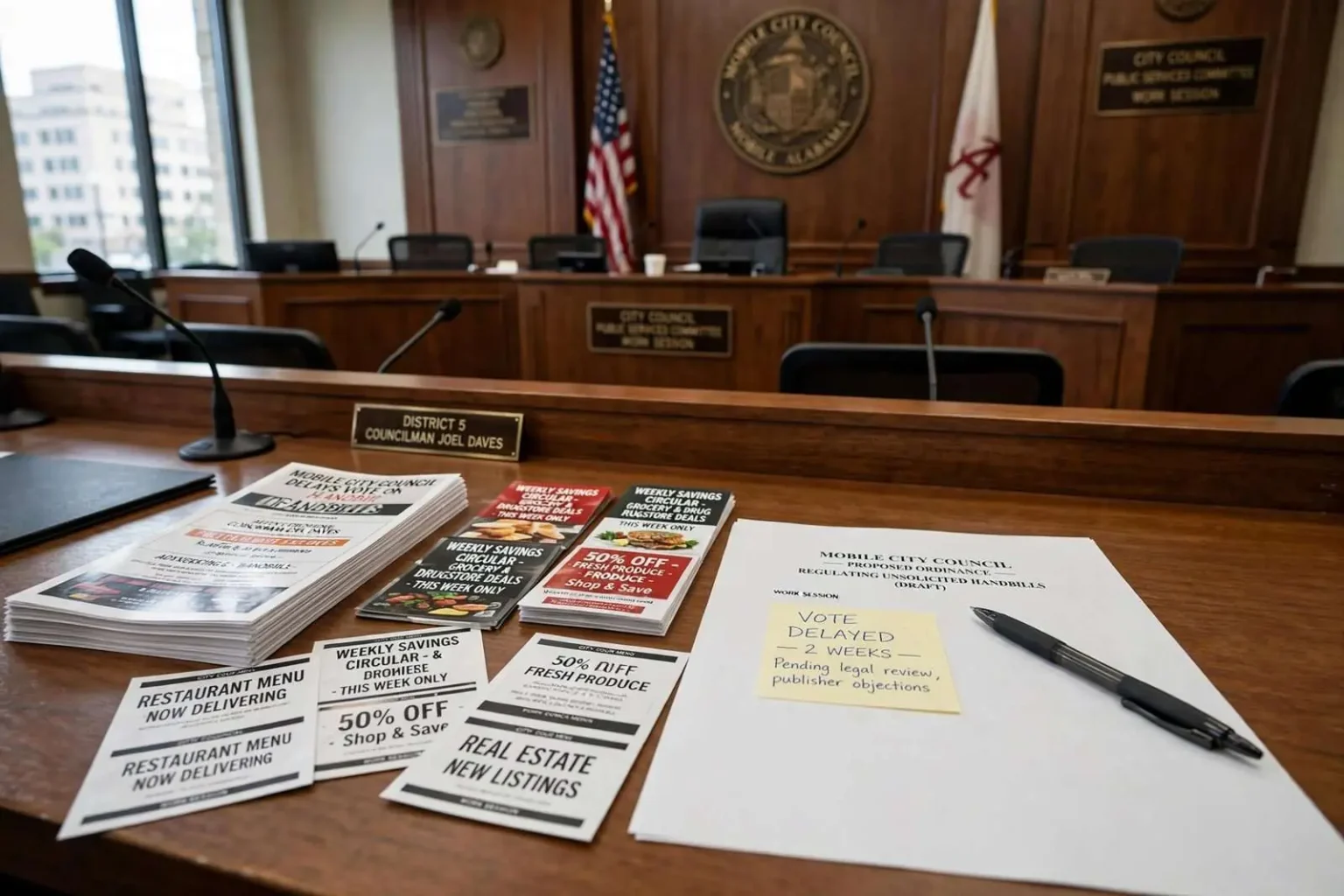
The Mobile City Council put off a vote this week on the latest draft of a proposed ordinance regulating the distribution of unsolicited printed handbills across the city, opting instead to give council members more time to review last-minute legal objections from a company affected by the rule. The delay pushed one of the council’s longer-running regulatory projects back at least two weeks and kept open a negotiation that has stretched over more than six months of drafting.
District 5 Councilman Joel Daves, who sits on the public services committee that voted in late March to recommend the ordinance for full council approval, requested the two-week delay. Daves cited both lingering questions from fellow council members and city administration officials, as well as ongoing back-and-forth with attorneys representing a company that distributes weekly, non-subscription advertising circulars throughout Mobile.
Daves said the most recent correspondence — a letter from a Mobile-based attorney representing the circular publisher — did not arrive until earlier in the week, leaving little time to fully review it before Tuesday’s scheduled vote. The letter laid out the publisher’s objections to the draft in detail, along with proposals the company said would address the city’s concerns without the litigation risk the ordinance carried.
“Mr. Daves is being reasonable to keep the lines of communication open,” said the council’s attorney, Jim Rossler, following the work session where the postponement was discussed. Rossler’s assessment reflected the practical calculus facing the council: an ordinance that survives a court challenge is worth more than one passed quickly and struck down slowly, and the letter represented the publisher’s most specific response yet to the city’s drafting.
What the Ordinance Would Do
The proposed ordinance, more than six months in the drafting, would set new rules for how unsolicited printed materials — commonly referred to as handbills — can be delivered to homes and businesses across the city. The category covers everything from the weekly advertising circulars at the center of the dispute to restaurant menus, real estate flyers and the political literature that arrives each election season.
City officials have framed the measure as a response to ongoing citywide litter complaints tied to circulars piling up in yards and driveways, particularly at vacant or unoccupied properties. Vacant houses present a recurring problem in the circular business: delivery routes are drawn from address lists, and homes where no one collects the paper can accumulate weeks of wind-scattered advertisements before a neighbor or code enforcement officer clears them. The piles feed complaint lines, generate pickup costs for the city, and drag down the appearance of streets already struggling with blight.
For the publisher, though, the circular business is a volume enterprise built on saturation delivery — the economic model depends on reaching every household in a route, not just the ones that ask for the product. Rules that let households or properties opt out, or that restrict delivery to vacant homes, cut directly into the circulation numbers that advertisers pay for, which is why the company has invested months in negotiating the ordinance’s language rather than simply complying with whatever draft emerged.
In his letter, the publisher’s attorney said his client would continue improving a “Do Not Deliver” opt-out system already in place, regardless of how the council ultimately votes, and would keep working with the city to identify vacant properties that should be excluded from delivery routes. Those commitments addressed the two complaints at the heart of the city’s litter case: residents who do not want the circulars, and the vacant properties where they pile up.
But he argued the ordinance as currently written was unconstitutionally vague, and said specific proposed changes — such as requiring carriers to carry identification and to collect materials they have delivered when asked — would protect the public interest while giving distributors clear, enforceable rules. Vagueness matters in this area of law: courts have repeatedly overturned municipal handbill rules when an ordinary person cannot tell in advance what conduct is permitted, and the company’s letter invited the city to borrow language from ordinances that have survived scrutiny elsewhere.
The legal landscape surrounding handbill regulation is unforgiving by design. Printed material sits at the intersection of property rights and the First Amendment, which protects not only political leaflets but commercial speech as well. Cities may reasonably regulate litter and the mechanics of distribution, but ordinances cannot discriminate against unwelcome publications, cannot impose burdens that swamp their litter-prevention purpose, and must define their terms precisely enough to survive a challenge. A vague ordinance, once passed, becomes a lawsuit with the city’s name on it — the outcome Daves’ delay was designed to avoid.
The Council’s Deliberate Pace
The two-week postponement fits the pattern the handbill ordinance has followed since it first emerged from the public services committee more than half a year ago. The council has rewritten the draft repeatedly as legal questions surfaced, and members have shown little appetite to force a vote while a materially affected business is still making concrete offers to cooperate.
Daves’ position also reflected the political geography of the issue. District 5 takes in much of west Mobile’s residential core, where the litter complaints are loudest and where homeowners’ associations have pressed the council to act. But the same constituents are also the circulars’ audience — the weekly advertising packages deliver grocery and drugstore deals that many households use, and a rule that eliminates the circulars entirely would trade one complaint for another.
That balance is what the publisher’s letter attempted to strike. By promising to maintain and improve the opt-out system and to scrub vacant properties from its routes voluntarily, the company effectively offered the city the outcome the ordinance was written to produce, without the enforcement apparatus. The open question is whether the council trusts a voluntary system to hold after the spotlight of the drafting process fades.
Rossler’s remark after the work session suggested the council is inclined to find out. Keeping the lines of communication open, as he put it, costs the city two weeks; passing an ordinance that invites a First Amendment challenge could cost years and legal fees. The council has chosen patience at every stage of this ordinance’s life, and Tuesday’s delay extended the pattern one more round.
Why Handbills Keep Coming Back
The dispute is Mobile’s most recent entry in a regulatory argument that cities across the country have waged for a century. Handbills predate radio, television and the internet as a way for businesses to reach households cheaply, and the weekly advertising circular remains one of the last mass-delivery print products with a working business model. Wherever saturation delivery meets suburban neglect, the same cycle appears: piles at vacant homes, complaints to city hall, a proposed ordinance, a constitutional objection, and a negotiation over how much regulation the First Amendment will tolerate.
Mobile’s version of the fight has been unusually collaborative by the standards of those battles. Rather than dashing to pass a rule and daring the publisher to sue, the council has spent more than six months redrafting, and the publisher has responded with lawyers’ letters that concede the litter problem while contesting the cure. The opt-out system the company operates — households that register are skipped on delivery routes — is the sort of mechanism many ordinances impose from outside; here it exists because the company built it, and the question before the council is whether to codify it, strengthen it, or supplement it with penalties.
The vacant-property piece may prove the easiest to settle. Neither the city nor the publisher benefits from circulars accumulating at abandoned homes, and the company has offered to work from the city’s own data to exclude those addresses. Identifying vacant properties, however, is itself a moving target in a city still working through the aftermath of blight, which is why the letter’s promise to “keep working with the city” carries more weight than a one-time concession.
What Happens Next
When the ordinance returns to the council agenda, members will weigh three options: pass the draft as written, pass it with amendments drawn from the publisher’s proposals, or hold it again while the negotiation continues. Any of the three keeps the city’s core goal — fewer scattered circulars, cleaner vacant lots, fewer complaints — within reach; what differs is the enforcement mechanism and the litigation risk attached to it.
The two-week delay also gives the city administration time to answer the questions council members raised in the work session, from how complaints would be documented to which department would handle enforcement. Ordinances that look simple on paper often reveal administrative costs in the details — inspectors, records, hearings — and the council has been deliberate about knowing those costs before voting.
For Mobile residents, the practical effect of Tuesday’s postponement is that nothing changes yet: the circulars keep arriving, the opt-out list keeps functioning, and the vacant lots keep collecting what no one collects. The council’s promise is that a rule is coming — one drafted carefully enough to last, which is, as Daves and Rossler both suggested this week, worth two more weeks of talking.