Mobile City Council Resolves HUD Funding Dispute, OKs Mowing Contracts
Mobile City Council approved a $3.3 million HUD funding plan after a dispute over neighborhood projects was resolved through talks with city staff.
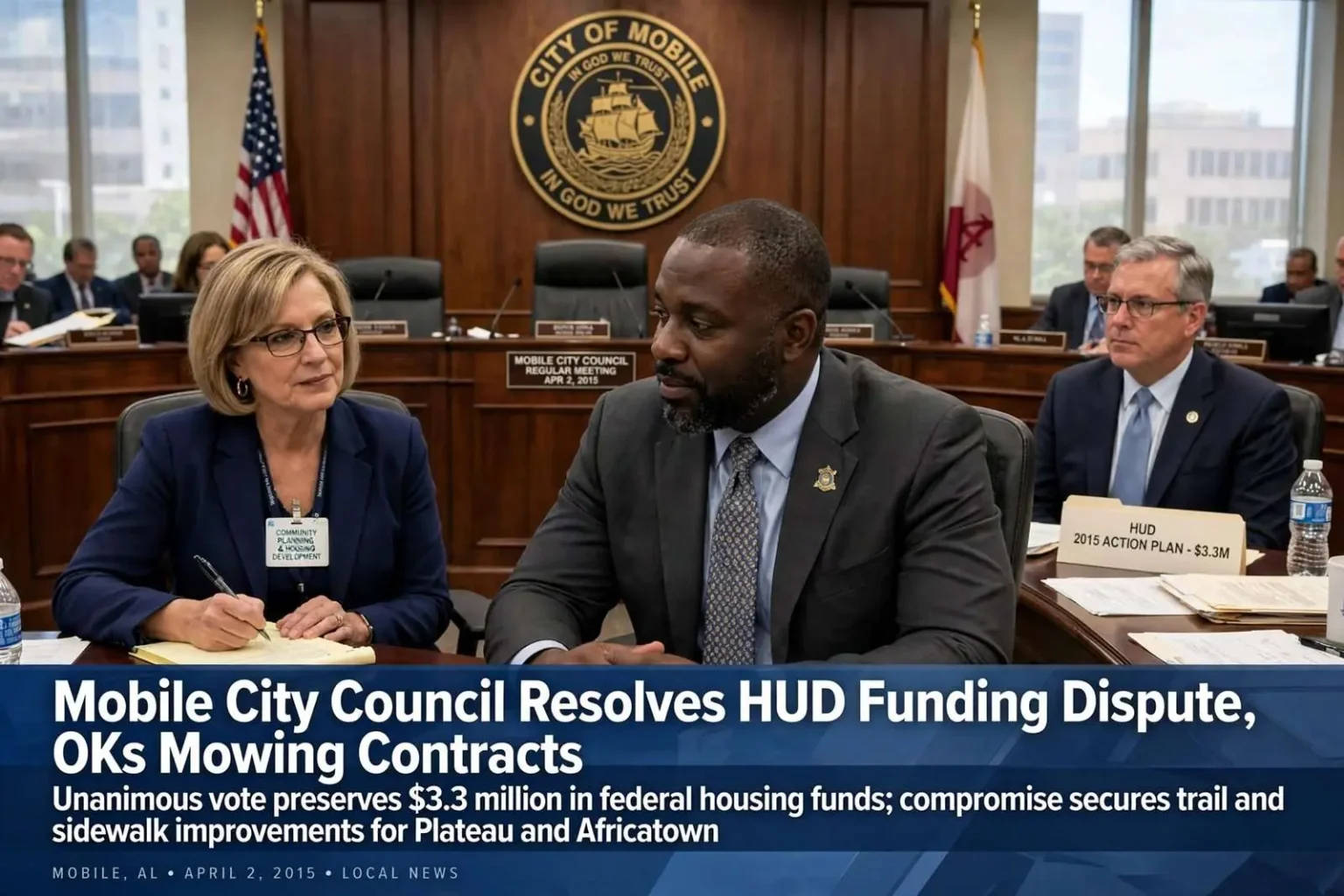
A dispute over how Mobile should spend its next round of federal housing money ended in agreement this week, as the Mobile City Council voted unanimously to approve a roughly $3.3 million funding application to the U.S. Department of Housing and Urban Development. The vote came after a tense stretch in which a council member’s push to redirect money toward neighborhood projects threatened to blow through a HUD filing deadline. The resolution capped weeks of negotiation between the council, the mayor’s office and the city’s housing staff, and it preserved Mobile’s access to the federal dollars that fund everything from sidewalk repairs to homeless services across the city.
District 2 Councilman Levon Manzie had asked that about $120,000 originally set aside for a rental rehabilitation pilot program instead go toward building a walking and fitness trail in the Plateau and Africatown area. He had also sought to shift roughly $50,000 toward repairing sidewalks along Mobile Street between Nall Street and Springhill Avenue. Both requests targeted District 2 neighborhoods north and west of downtown that have long struggled with infrastructure gaps, and Manzie argued the pilot program could wait while residents in those communities were waiting on basic amenities the rest of the city takes for granted.
The Plateau and Africatown area, just north of downtown Mobile, is a community with deep historical roots. Africatown was founded by descendants of West Africans brought to Alabama aboard the Clotilda, the last known slave ship to arrive in the United States, and the neighborhood has been the focus of renewed preservation and redevelopment efforts in recent years. Residents and advocates there have repeatedly pressed the city for improved streets, walkability and recreational resources, which is why the proposed fitness trail carried weight beyond its dollar figure.
Those requests initially stalled the city’s annual action plan, the document that governs how Mobile spends Community Development Block Grant funds, HOME Investment Partnership money and Emergency Solutions Grants. Together those three HUD programs form the backbone of the city’s housing and community development budget each year. Community Development Block Grant money, in place nationally since 1974, pays for neighborhood improvements, public facilities and services benefiting low- and moderate-income residents. HOME dollars support affordable housing construction and rehabilitation, while Emergency Solutions Grants fund shelters, street outreach and rapid rehousing for people facing homelessness.
Amending the plan on the floor would have triggered a fresh 30-day public comment period, which city staff warned could cause Mobile to miss HUD’s April 10 deadline for the 2015 funding cycle and jeopardize the entire allocation. Federal rules require that any material change to a proposed action plan be re-advertised and opened for public input before submission, a safeguard designed to keep residents informed but one that leaves cities with little scheduling flexibility. Missing the deadline would not merely have delayed the $3.3 million application; it could have put the whole year’s entitlement at risk, leaving programs and partner agencies that depend on the money without funding for the cycle.
City housing officials met with Manzie and members of Mayor Sandy Stimpson’s administration over the following week to work through the disagreement. The goal, participants said, was to find a path that respected the councilman’s priorities without dismantling the application that had already been through its public comment window. The meetings involved the city’s community planning and housing development department, the office that assembles the action plan each year and administers the grant money once HUD approves it.
A Compromise Outside the Action Plan
The city’s community planning and housing development department agreed to look for other funding avenues to address Manzie’s priorities outside the action plan itself, while also discussing ways to give council members earlier input on future HUD spending plans. That second commitment may prove the more lasting change. Council members had complained that the annual action plan typically arrives at the council chamber largely assembled, leaving elected officials little room to shape where the money goes before the comment clock starts running. Building district-level requests into the process earlier could prevent similar standoffs in future cycles.
Manzie said he was satisfied with the outcome, telling fellow council members that the “constructive dialogue” gave him confidence the walking trail and sidewalk projects he championed would move forward within the current fiscal year using other resources. He thanked the mayor’s office and housing staff for hearing out concerns about how funding decisions affect low- and moderate-income residents, and argued that elected council members are best positioned to represent constituents’ needs when spending decisions are made. His remarks suggested the episode was less about the specific dollars at stake than about the principle that neighborhood priorities deserve a genuine hearing before budgets are locked in.
With the objection withdrawn, the council’s unanimous vote sent the $3.3 million application to HUD on schedule. The money will now flow through the 2015 funding cycle, supporting the rental rehabilitation pilot as originally written along with the full slate of housing, infrastructure and services programs the plan describes. Housing staff will report back on progress toward the trail and sidewalk projects as alternative funding is identified.
Mowing Contracts and Other Council Business
Beyond the HUD vote, the council took up a handful of other routine matters that nonetheless touch daily life in neighborhoods across the city. Members postponed for two weeks a proposed ordinance that would regulate distribution of handbills and other unsolicited printed materials around the city. The delay gives city attorneys and the sponsor additional time to refine language addressing concerns about litter, private property rights and enforcement, and residents who have followed the handbill debate can expect the measure to return to the agenda once those details are settled.
Members also approved a slate of right-of-way mowing contracts with four separate landscaping contractors. Keeping rights-of-way clear of high grass and debris is one of the most visible services the city performs, particularly along major corridors and in areas where vacant lots change hands frequently. Splitting the work among multiple contractors spreads crews across the city and shortens response times between mowing cycles, an approach many Alabama municipalities have adopted after years of complaints about overgrown parcels.
The council adopted an updated electrical code for the city as well, aligning Mobile’s building standards with the most recent national model code. Updated electrical codes govern wiring methods, inspection requirements and safety standards for new construction and major renovations, and periodic adoption is standard practice for cities that want inspectors and contractors working from the same modern rulebook. Builders and electricians working in Mobile will now pull permits under the revised standards.
Finally, the council authorized the mayor to apply for a $1.5 million federal Fire Prevention and Safety Grant through the Federal Emergency Management Agency. The FP&S program, part of FEMA’s Assistance to Firefighters suite of grants, funds fire prevention education, code enforcement, arson investigation and related safety initiatives rather than equipment or apparatus. If awarded, the grant would bring a substantial federal investment into the Mobile Fire-Rescue Department’s prevention work without drawing on local tax revenue, though the application itself carries no guarantee of funding.
What the Episode Means for Mobile
The council’s willingness to hash out the housing dispute behind closed doors, rather than let it derail the funding application altogether, reflects the ongoing balancing act between neighborhood-level priorities and the bureaucratic deadlines that come with federal grant dollars in Mobile. Entitlement cities such as Mobile receive Community Development Block Grant funding each year on a formula basis, but the money arrives wrapped in federal requirements: citizen participation rules, income-targeting standards, spending deadlines and reporting obligations. Those requirements protect residents and ensure accountability, yet they also mean a single procedural misstep can put millions of dollars in limbo.
For neighborhoods like Plateau and Africatown, the practical test of this week’s compromise will be whether the promised trail and sidewalk work actually appears in the current fiscal year as Manzie expects. City officials have committed to pursuing other funding avenues, which could include capital improvement dollars, state or federal transportation funding for sidewalks, or philanthropic and partnership sources that have supported improvements elsewhere in the city. Residents along Mobile Street between Nall Street and Springhill Avenue, where the requested sidewalk repairs were targeted, will be watching for crews the same way they have watched other long-promised street work across the district.
For the administration, the episode underscored the value of early engagement with the council on the action plan before it reaches the floor. The commitment to give council members earlier input on future HUD spending plans is intended to surface district priorities while changes are still cheap to make, rather than after the public comment window has run and the HUD deadline looms. If that practice takes hold, future funding cycles may see fewer floor amendments and fewer confrontations over last-minute redirections.
The unanimous nature of the final vote also sent a signal about how the council intends to handle federal money generally. Despite genuine disagreement over how the $3.3 million should be allocated, no member was willing to hold the application hostage and risk the city’s allocation. That posture matters in Mobile, where grant-funded programs touch thousands of households through housing rehabilitation, down payment assistance, senior services, youth programs and homeless outreach funded through the same action plan.
In the end, the 2015 funding cycle application moves forward on time, the mowing contracts keep rights-of-way trimmed under four separate contractors, the electrical code modernizes building standards, and a $1.5 million federal fire safety application gets the city’s backing. The handbill ordinance will return in two weeks for further work. And the walking trail and sidewalk projects that started the dispute now carry a specific promise attached: they will move forward this fiscal year, paid for through other resources, as the price of keeping Mobile’s federal housing money flowing without interruption.