Mobile-Area Lawmaker Files Bill to Raise Minimum Wage to $10.10 in Mobile County
State Rep. Napoleon Bracy filed a bill to raise Mobile County's minimum wage to $10.10 an hour, above the federal floor, starting in 2016.
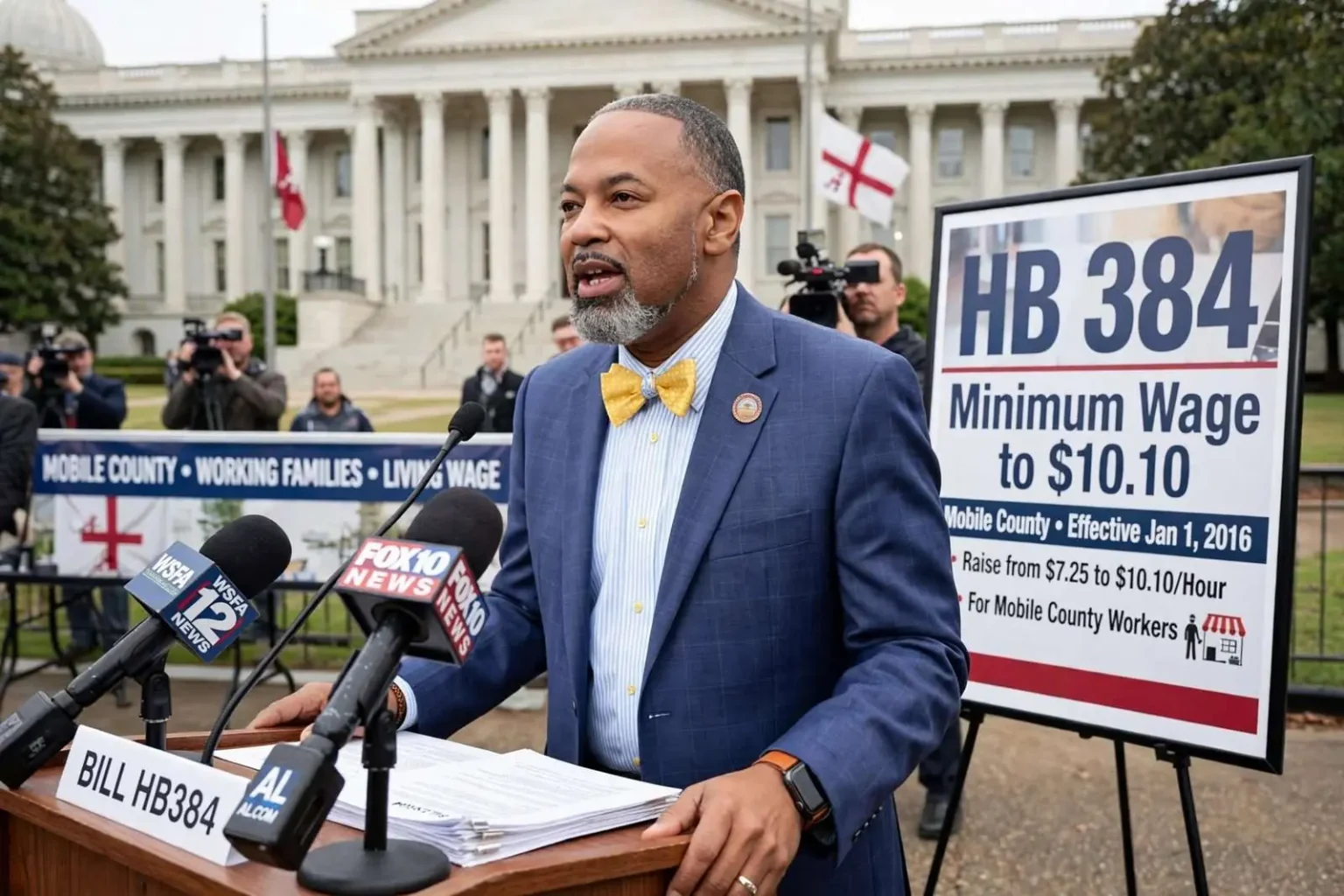
A state lawmaker representing part of Mobile has introduced legislation that would raise the minimum wage specifically within Mobile County to $10.10 an hour, well above the federal floor of $7.25 that currently applies statewide. State Rep. Napoleon Bracy, a Democrat, filed the bill, numbered HB384 in the Alabama Legislature, and announced the move in a public statement. The proposal puts Mobile County at the center of a debate playing out in statehouses across the country over whether local governments should be able to lift pay standards within their own borders when the federal and state floors have not moved.
Bracy said the legislation was aimed at working families in his district who he argued have been squeezed by rising costs of living without a corresponding increase in pay. His district takes in part of the city of Mobile, where service-sector jobs in restaurants, retail, hospitality and personal care make up a large share of the employment base and where an hourly wage at the federal minimum translates into an annual income well below what many local households need to cover rent, transportation and child care. If approved, the higher wage floor would take effect January 1, 2016, giving businesses in the county a lead time to adjust before the change kicked in.
The delayed effective date is a deliberate design choice common in wage legislation. Employers routinely plan staffing and pricing around scheduled cost changes, and a lead time of many months allows businesses to absorb a higher wage floor through normal turnover and growth rather than abrupt layoffs. Advocates of the approach argue that it answers one of the standard objections to wage increases, which is that employers caught mid-budget cannot respond in time, while opponents counter that no amount of lead time changes the underlying cost pressure on thin-margin businesses.
Why a County-Level Wage Floor
Alabama has no state minimum wage law of its own, meaning workers across the state, including in Mobile County, are covered only by the federal minimum wage unless a local or state measure like Bracy’s changes that baseline. The federal floor of $7.25 an hour has applied to Alabama workers since the last federal increase took effect, and the state has been among those that have declined to set a higher standard. That leaves Alabama in a small group of states where the practical minimum wage is set entirely in Washington, and it is precisely the gap that Bracy’s bill is designed to address at the local level.
Advocates of county- or city-specific minimum wage increases argue that cost of living varies significantly across a state as large as Alabama, and that a uniform federal floor does not reflect the economic realities faced by workers in coastal Alabama and other higher-cost areas. Housing costs along the coast, insurance rates and transportation expenses all run higher than in many parts of the state, the argument goes, so the wage needed to reach a basic standard of living differs as well. Bracy’s proposal would apply only within Mobile County rather than statewide, a structure that mirrors similar municipal and county-level minimum wage pushes that have surfaced in other parts of the country as advocates look for ways to raise pay without waiting on broader statewide or federal action.
Supporters of the approach say it allows local elected officials to respond directly to conditions in their own communities. Under this view, the officials closest to local employers and workers are best positioned to judge what wage level the local economy can sustain, and a county-specific floor functions as a laboratory for policy that a statewide mandate could never be. The counterargument, pressed by business groups and many state legislators, is that a patchwork of local wage standards complicates operations for employers who do business across municipal and county lines and invites competitive distortions between neighboring jurisdictions.
The Legislative Outlook
Any bill raising labor costs for local employers is likely to face scrutiny from business groups and lawmakers who worry about the effect on small businesses, hiring and the cost of goods and services in the affected area. Restaurant and retail operators, the categories of employers with the largest concentration of minimum-wage workers, have historically been the most vocal opponents of local wage mandates, arguing that labor costs are their largest controllable expense and that increases are passed on to customers through prices or absorbed through reduced staffing. Economists continue to debate how large those effects actually are, with research findings varying widely depending on local labor-market conditions and the size of the increase.
Alabama’s Legislature has historically been resistant to state-mandated minimum wage increases and has, in the years since, taken steps to prevent cities and counties from setting their own minimum wage rates that differ from the state standard, reflecting a broader statewide debate over whether local governments should have that authority at all. That history looms over Bracy’s bill, because the same legislative body that would have to pass his proposal contains many members who oppose local wage-setting on principle. The tension between local control arguments that Alabama legislators have often embraced on other subjects and the instinct to maintain uniform statewide labor standards gives the bill a difficult path even if it attracts support from fellow Mobile-area legislators.
For workers in Mobile County, the stakes of the debate are concrete. An increase from $7.25 to $10.10 an hour, spread across a full-time work year, would mean thousands of dollars in additional annual income for each affected worker, money that in practice flows quickly back into the local economy through rent, groceries and transportation spending. Supporters of wage increases often make this recycling argument, contending that higher pay for lower-wage workers stimulates local business activity because those workers spend nearly all of their income locally. Opponents counter that if the increase causes job losses or hours reductions, some workers end up worse off, and that the effect falls hardest on entry-level positions.
The $10.10 figure in the bill has a particular lineage in national policy debates. It matches the minimum wage proposal that congressional advocates advanced in Washington several years ago as a step toward a higher federal floor, and similar figures appeared in legislative proposals across the country as states and cities searched for a number that balanced meaningful gains for workers against employer cost concerns. By attaching a specific, widely discussed number to Mobile County, Bracy aligned his local proposal with the most prominent national benchmark available, making the bill easier to explain and defend in public discussion.
The bill also arrives amid broader economic changes in the Mobile area. The region’s economy has been diversifying around aerospace, manufacturing and port activity, developments that have brought investment and skilled positions to the county even as many residents continue to work in lower-wage service jobs. Wage advocates argue that a rising tide of high-profile investment has not lifted pay at the bottom of the labor market, and that measures like HB384 are how the benefits of growth reach households that have not seen them. Business groups respond that mandating wages risks pushing some of those same service jobs out of the county or slowing the hiring that growth would otherwise produce.
For now, Bracy’s bill remains a proposal introduced during the legislative session, one of many pieces of legislation lawmakers file each year that address wages, labor and local economic conditions. Bills filed early in a session must clear committee consideration and votes in both chambers before reaching the governor’s desk, and the overwhelming majority of legislation does not survive that process. Still, the introduction itself has value for its sponsors, forcing hearings and floor debate that put an issue on the public record and building support for future attempts.
Its introduction nonetheless puts the question of pay for Mobile County’s lowest-wage workers back in front of state lawmakers, adding to an ongoing conversation in Montgomery about whether local wage floors should be allowed to rise above the federal minimum. Whatever the fate of HB384 in the current session, the bill documents where one Mobile legislator stands on the issue and gives constituents and advocacy groups a specific proposal to rally around or oppose. The outcome will be watched not only in Mobile County but by officials in Birmingham, Huntsville and other Alabama cities where local wage debates have surfaced, and by workers and employers across the state who would be affected if the principle of local wage-setting ever takes hold.
County-level wage legislation, wherever it passes, also tends to draw attention from the state attorney general and courts, since opponents frequently test whether local governments possess the legal authority to regulate wages in the first place. Questions of preemption, the doctrine holding that state law overrides local ordinances, have shaped the fate of local minimum wage measures in other states, and any Alabama effort would likely face the same fundamental challenge. That legal uncertainty is one more reason legislators who might sympathize with the goal of higher pay have hesitated to embrace local wage floors, and it frames the wider debate Bracy’s bill now joins.