Alabama Democratic Conference Backs Herman Thomas in Senate District 33 Fight
The state party's Black political caucus endorsed former Circuit Judge Herman Thomas over incumbent Sen. Vivian Figures, giving a jolt to one of Mobile's most closely watched Democratic primaries.
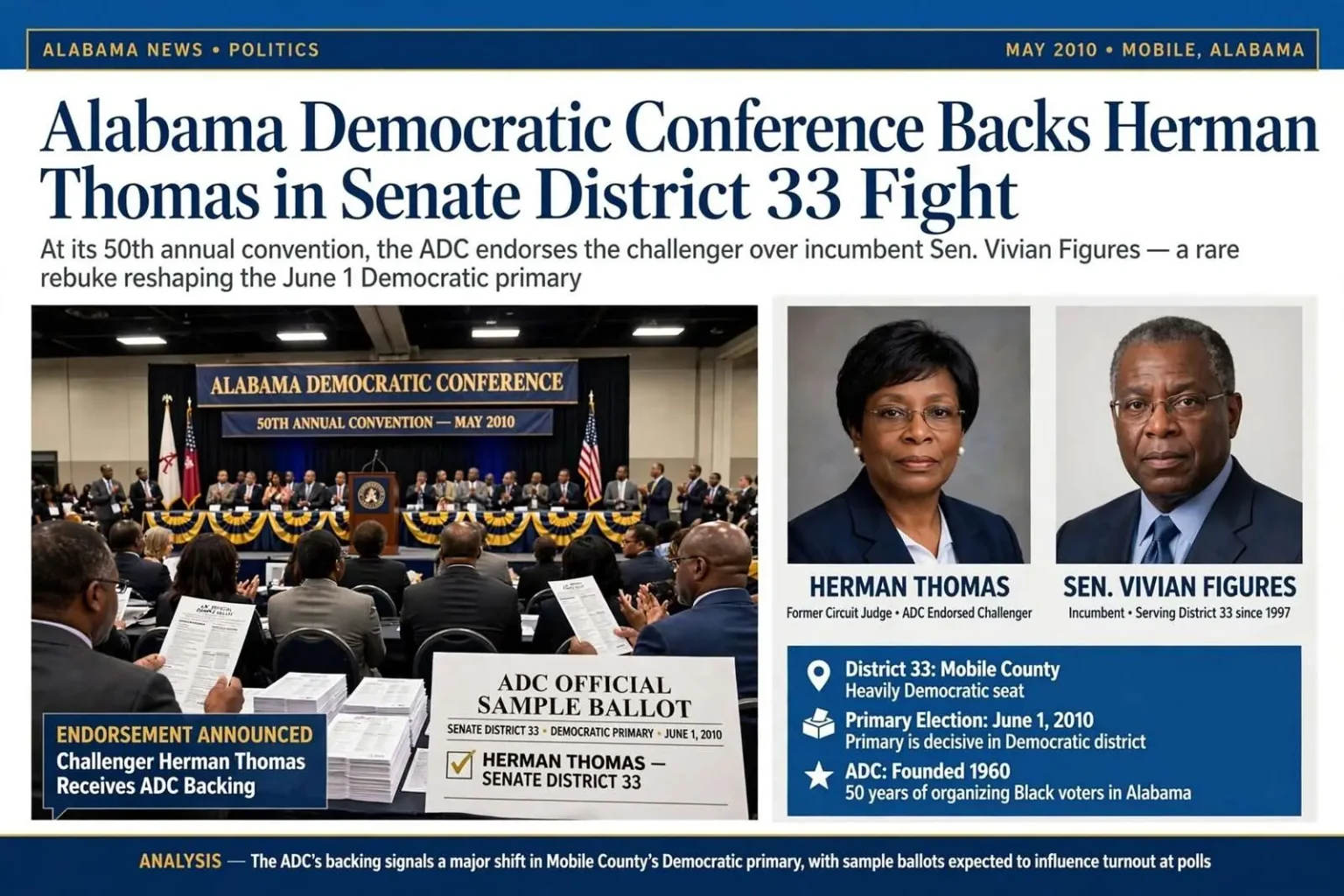
The Alabama Democratic Conference, the Black wing of the state Democratic Party, endorsed former Circuit Judge Herman Thomas for the Alabama Senate in District 33 at its 50th annual convention over the weekend. The endorsement placed the ADC behind a challenger and against an incumbent, sitting Sen. Vivian Figures, in the June 1 Democratic primary.
In a district that is overwhelmingly Democratic, the primary is effectively the decisive contest, and the ADC’s ballot card has long carried real weight in Mobile County precincts. Whoever emerges from the June 1 vote would enter the general election as the strong favorite, making the conference’s endorsement one of the most consequential signals a Mobile County Democratic candidate can receive in a primary season.
An ADC nod against a sitting senator is uncommon enough to be read as a statement. The conference has historically leaned on incumbency as a virtue, rewarding legislators who delivered for their districts, so the decision to back a challenger over a senator with more than a decade of service drew immediate attention from party observers in Montgomery and Mobile alike.
Why the Endorsement Mattered
Founded in 1960, the Alabama Democratic Conference grew out of the civil rights era as a vehicle for organizing Black voters within the state party. Through decades when formal political power in Alabama remained largely closed to Black Alabamians, the conference built a parallel structure of endorsements, sample ballots and precinct-level organizing that translated community consensus into actual votes.
Its endorsements are distributed on sample ballots at polling places across Alabama, and in low-turnout primaries they can move meaningful numbers of votes. In a midsummer primary in a district where a single hotly contested local race drives turnout, a printed ballot card handed to voters at the door of the precinct can matter as much as any television advertisement, particularly among older voters and longtime party loyalists.
The conference’s endorsement process is itself a measure of organizational strength. Candidates appear before the body, argue their records, and submit to the judgment of an institution that has been evaluating Black elected leadership in Alabama since before many of them were born. Earning the nod is both a practical electoral asset and a statement about standing within the community the conference represents.
The 2010 cycle gave the convention particular weight. With the governor’s race headline-ing the same ballot and Black political organizations courted by multiple statewide campaigns, the ADC’s choices rippled beyond the local races they formally addressed.
The Candidates
Figures had represented Senate District 33, which takes in much of Mobile, since 1997, when she succeeded her late husband, Michael Figures. She had built a legislative record on public health, tobacco regulation and education, and in 2008 she was the Democratic nominee against U.S. Sen. Jeff Sessions, a statewide race that raised her profile well beyond the district even though it ended in defeat.
Her longevity in the seat made her the establishment figure in the contest, with deep ties to the party structure, the legislative delegation and the network of community organizations that define Mobile politics. Supporters pointed to seniority accumulated over more than a decade in the Senate as the district’s best protection in a budget-conscious statehouse.
Thomas served on the Mobile County Circuit Court bench before resigning amid an investigation that led to criminal charges. He was tried and acquitted, and the case had become a fixture of the 2010 campaign season in Mobile County, surfacing again in the Republican primary for district attorney, where one candidate’s television advertising criticized the handling of the prosecution.
Thomas’s campaign had demanded that the ad be pulled, calling it an attempt to convict him of charges a jury had rejected. The dispute kept the case in public view through the spring, ensuring that voters heading into the Senate primary had already heard the arguments about his record from both directions, from critics who treated the matter as disqualifying and from supporters who pointed to the acquittal as the final word.
For his part, Thomas campaigned on his judicial experience and on the argument that the district needed an energetic advocate in Montgomery rather than an incumbent coasting on seniority. The ADC’s endorsement suggested his message had found traction within the community organizations whose judgment Figures had long been able to count on.
A Crowded Season in District 33
The winner of the Democratic primary was set to face Walter Bracy, who was running in the Republican primary for the same seat and who billed himself as the “Uncommon Candidate.” The general election was scheduled for Nov. 2. In a district where Democratic primaries have historically decided the seat, Bracy’s campaign was a long-shot effort to give Republicans a competitive presence in a part of Mobile they rarely contest seriously.
Seat: Alabama Senate District 33, centered on Mobile. Democratic primary: June 1, 2010, Vivian Figures vs. Herman Thomas. ADC endorsement: Herman Thomas.
The larger picture: the endorsement underscored how contested the Democratic coalition in Mobile had become in 2010. The same primary ballot carried the race between U.S. Rep. Artur Davis and Agriculture Commissioner Ron Sparks for governor, a contest in which the ADC and other Black political organizations had also become a central battleground.
Davis, attempting to become Alabama’s first Black governor, had made a deliberate strategy of running independently of traditional Black political organizations, a choice that drew criticism from some of their leaders even as his candidacy inspired voters far beyond the party’s regular infrastructure. Sparks, by contrast, courted the conference and its allies directly. In both races, the question of who spoke for Democratic voters in Mobile County was very much unsettled as the primary approached.
What the District Looks Like
Senate District 33 threads through some of Mobile’s most historic neighborhoods, taking in much of the city’s core along Mobile Bay. Its electorate has been among the most reliably Democratic in Alabama for decades, shaped by the civil rights era, by the labor and maritime economy of the port city, and by the political networks built through churches, civic clubs and neighborhood associations.
Because the seat so rarely faces a competitive general election, the primary functions as the real election, and the endorsement calendar that precedes it functions as the real campaign. That dynamic concentrates influence in organizations like the ADC, whose ballot card reaches the voters who actually show up in June, and it explains why both campaigns treated the convention weekend as a pivotal moment rather than a ceremonial one.
With the June 1 primary approaching, both Democratic campaigns turned toward turnout mechanics, precinct walks and the network of sample ballots that would be waiting for voters at polling places across the district. For the ADC, the 50th annual convention sent the message that after five decades, the organization still intended to shape not only which Democrats won, but which direction the party itself took in Mobile County.
The Machinery Behind a Ballot Card
The ADC’s power in a contest like this one rests on logistics as much as persuasion. The organization maintains precinct-level captains and volunteers across its counties, coordinates the printing of its sample ballots ahead of election day, and positions those ballots where voters will actually encounter them, at church gatherings, community meetings and the doors of polling places themselves. In a primary where overall turnout may barely reach a third of the electorate, that targeted apparatus can decide a race that a broad, unfocused campaign cannot.
The endorsement also functions as a credential with other organizations. Labor groups, ministerial alliances and neighborhood associations in Mobile often look to the ADC’s card as a signal of which candidates have earned standing in the community, creating a follow-on effect in which a single endorsement quietly shapes a whole stack of them.
At the same time, the conference’s choice reflects internal deliberation about the direction of Mobile’s Democratic politics. Backing a challenger against a senator who has held the seat since 1997, and who succeeded a husband whose own Senate career stretched back to the 1970s, signals a willingness to break with familiar names, something the organization has done rarely enough in its history that the choice itself became part of the story of the race.
Observers of Mobile politics noted that the 2010 cycle, with term-limited and retiring incumbents up and down the ballot, had already opened more contested seats than the county had seen in years, giving insurgent candidates like Thomas openings that a normal cycle would not have offered.
Looking Toward June 1
With the convention behind them, both Democratic campaigns settled into the short sprint to the June 1 primary. Figures leaned on her legislative record and the argument that experience in Montgomery, particularly on the budget-writing side of the Senate, could not be replaced by a first-term senator. Thomas countered with the ADC card, his courtroom resume and a pitch built on renewed attention to the district’s needs.
Whichever way the race broke, the convention weekend had already settled one question of historical interest: fifty years after its founding, the Alabama Democratic Conference remained an institution capable of moving a Mobile County primary, and its endorsement still carried the weight of a half-century of organizing behind it.