Baldwin County Clean Sweep Offers Free Christmas Tree, Bulk Item Disposal
Baldwin County residents could drop off Christmas trees, tires, furniture and other bulky waste free of charge at three landfill sites during Clean Sweep 2015.
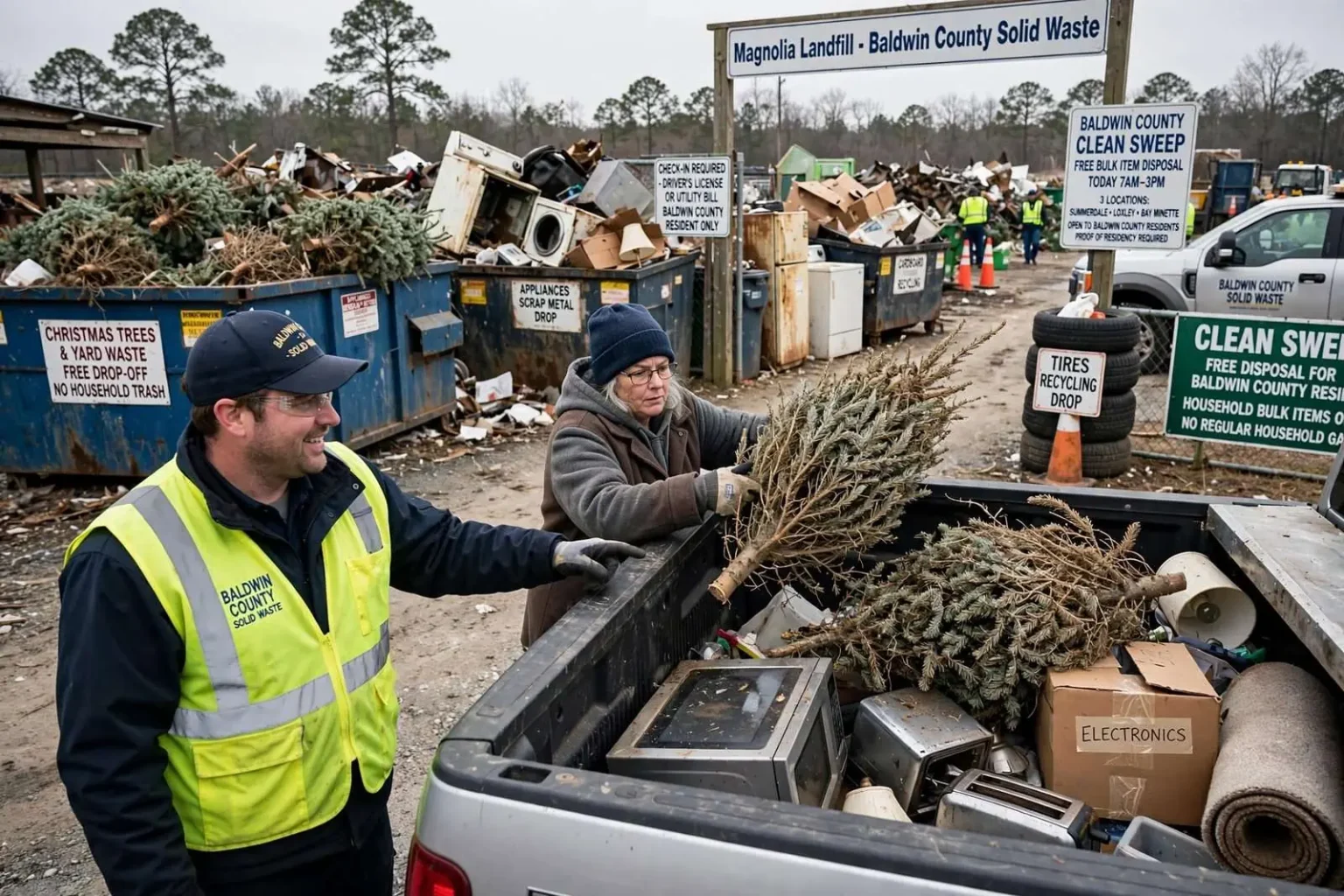
Baldwin County residents looking to get rid of leftover Christmas trees, broken appliances and other bulky household waste had a one-day opportunity to do so free of charge as the county held its annual Clean Sweep event at three landfill locations. The single-day format gave households a set window to clear out the kind of items that are too large, too awkward or too costly to handle through a normal curbside pickup. County solid waste staff greeted drivers at each gate, logged the incoming loads and directed them to the proper drop areas on each site.
The event ran from 7 a.m. to 3 p.m. at Magnolia Landfill in Summerdale, MacBride Landfill in Loxley and the Bay Minette Transfer Station. Those three facilities anchor Baldwin County’s solid waste network from one end of the county to the other, and spreading the event across all of them kept driving distances reasonable no matter where a resident lives. Summerdale sits in the southern part of the county not far from the resort communities along the Gulf, Loxley lies along the central U.S. 90 corridor between Robertsdale and the Interstate 10 interchange, and Bay Minette serves the northern end of the county near the North Baldwin communities.
Baldwin County is one of the fastest-growing counties in Alabama, and that growth shows up at the landfill gate. New subdivisions, renovated beach houses and turnover in rental property all generate bulky waste at a pace that a rural county of a generation ago never saw. Programs like Clean Sweep give the county a controlled, measured way to absorb that volume rather than letting it scatter across roadsides and vacant lots.
What Residents Could Bring
Open exclusively to Baldwin County residents, Clean Sweep allowed households to bring yard waste, Christmas trees, construction debris, cardboard, tires, electronics, furniture, appliances, scrap metal, carpet, paint and other household hazardous waste at no cost. The breadth of the list was deliberate, because each of those categories presents its own disposal challenge in ordinary weeks. Tires and paint are generally not accepted with routine trash, electronics contain materials that should not be buried in a landfill cell uncovered, and scrap metal can often be recycled rather than buried if it is collected separately.
Officials were clear that no regular household garbage would be accepted at any of the three sites. Residents who pulled in with bags of everyday kitchen trash were directed back to their normal collection service, since the event is designed to target bulky and special-handling waste rather than to replace weekly garbage pickup. Keeping household garbage out of the event also helped crews keep lines moving on a day when volumes at the three facilities run well above a typical Saturday.
Residents were required to show proof of residency along with providing their name, address and phone number in order to dispose of items for free. A driver’s license, utility bill or similar document showing a Baldwin County address satisfied the requirement at the gate. The sign-in information allows the county to track participation, document where the loads originate and demonstrate to auditors and grant reviewers how the program is used from one year to the next.
Normal fees and procedures remained in effect for commercial waste, putrescible waste and commercial tire disposal. Contractors, landscapers and businesses clearing out commercial properties were still subject to the standard tipping schedules, and loads of decaying, odor-producing waste continued to follow ordinary handling rules because of the operational burden they place on a working landfill. The free waiver applied only to household quantities brought by county residents themselves.
The distinction between household and commercial loads matters to the county’s budget. Landfill operations are funded largely through the fees paid by commercial haulers, and waiving those fees for a day would shift real costs onto the system. Restricting the free disposal to household quantities keeps the subsidy targeted at individual residents while leaving the revenue side of the operation intact.
The Post-Holiday Pileup
The event offered a convenient outlet for the kind of debris that tends to pile up after the holidays, from busted kitchen appliances to old electronics replaced by new gifts. When a new television arrives in December, the old one often sits in a garage or carport for months because there is no easy way to get rid of it. The same pattern holds for mattresses, recliners and small appliances that will never be used again but are too good to simply toss in a ditch and too bulky for a garbage cart.
It also gave residents a designated place to dispose of Christmas trees rather than leaving them curbside or in yards. Dried-out evergreens shed needles quickly, and trees left at the curb for weeks can blow into roadways or clog storm drains during winter rains. A single drop-off trip solves the problem and keeps the tree out of the weekly waste stream entirely.
According to the county’s development and environmental director, bins were also placed at locations throughout Baldwin County specifically for residents to drop off their trees. The supplemental bins gave residents in outlying communities an option that did not require a drive to Summerdale, Loxley or Bay Minette, and they kept the tree collection effort from depending entirely on the three main sites. Trees gathered through the program can be handled as yard waste and kept out of the general waste stream.
Holiday waste volumes are familiar territory along the Gulf Coast, where the Christmas season also coincides with a stream of visitors and seasonal residents. Rental properties turn over, older furnishings get replaced and the debris trail runs from Foley and Gulf Shores up through the central corridor. A single coordinated disposal day gives the whole county one answer to a problem that crosses municipal lines.
A Recurring Fixture on the County Calendar
Clean Sweep has become a recurring fixture on Baldwin County’s calendar, giving residents a straightforward way to responsibly dispose of items that don’t fit into normal weekly trash pickup. For many households, the event functions as an annual reset, a scheduled chance to empty the shed, the carport and the back corner of the yard. Regular participants have learned to plan major cleanouts around it, holding onto bulky items until the free window opens rather than paying to dispose of them piecemeal.
Just as important, the program helps keep bulky waste and holiday debris out of ditches, waterways and illegal dumping sites across the county. Baldwin County is laced with creeks and tributaries that feed Mobile Bay and the Perdido River basin, and discarded appliances, tires and construction debris dumped in low spots can choke drainage during heavy rain and leach residue into the soil. Every load that comes through a Clean Sweep gate is a load that will not be pushed down a county road at night or rolled into a creek bank.
Illegal dumping is not a victimless problem in a fast-growing county. Road crews and code enforcement officers spend staff hours responding to dump sites, and the cost of clearing them falls on the same taxpayers the dumping shortchanges. Free disposal events are one of the practical tools local governments use to cut into that cycle by removing the cost barrier that pushes some residents toward the ditch in the first place.
The stakes rise in hurricane country. Baldwin County sits on the Gulf of Mexico, and major storms regularly leave behind months of vegetative and construction debris that must be cleared quickly to reopen roads and restore drainage. A population that already knows how to use designated disposal sites, and a landfill network that has practiced handling surge volumes, is better positioned when a storm does hit.
Savings for Households
County officials have encouraged residents to watch for future Clean Sweep dates, noting that the program typically runs at least once annually. The once-a-year rhythm means a missed event can leave a household waiting months for the next one, which is why officials ask residents to plan ahead and to share the dates with neighbors who may not follow county announcements closely.
The free disposal also provides a significant cost savings compared to hauling large items to a landfill on a resident’s own dime. Standard tipping fees, trailer rentals and the fuel and time spent running multiple loads to a disposal site add up quickly for a single household clearing out a property. On Clean Sweep day, that entire cost disappears for eligible household loads, an advantage that matters most to families on fixed incomes and to residents cleaning out estates or rental properties.
Year-Round Options Remain
Residents who missed the event still have ordinary routes for getting rid of bulky waste. The county’s landfills and transfer station operate on their regular schedules, and many municipalities within Baldwin County run their own yard debris collection or periodic drop-off programs for city residents. For hazardous materials in particular, holding items until a designated collection day remains the safest course, since paint, chemicals and certain electronics require special handling.
Additional information about waste disposal options and upcoming events is available through the Baldwin County government’s website. The county posts facility locations, hours, fee schedules and announcements about future Clean Sweep dates there, and officials say residents with questions about whether a specific item qualifies can call the solid waste department before making a trip. For a county that has grown rapidly in recent decades, keeping bulky waste moving through legitimate channels remains a year-round job, and Clean Sweep is the program’s most visible day.