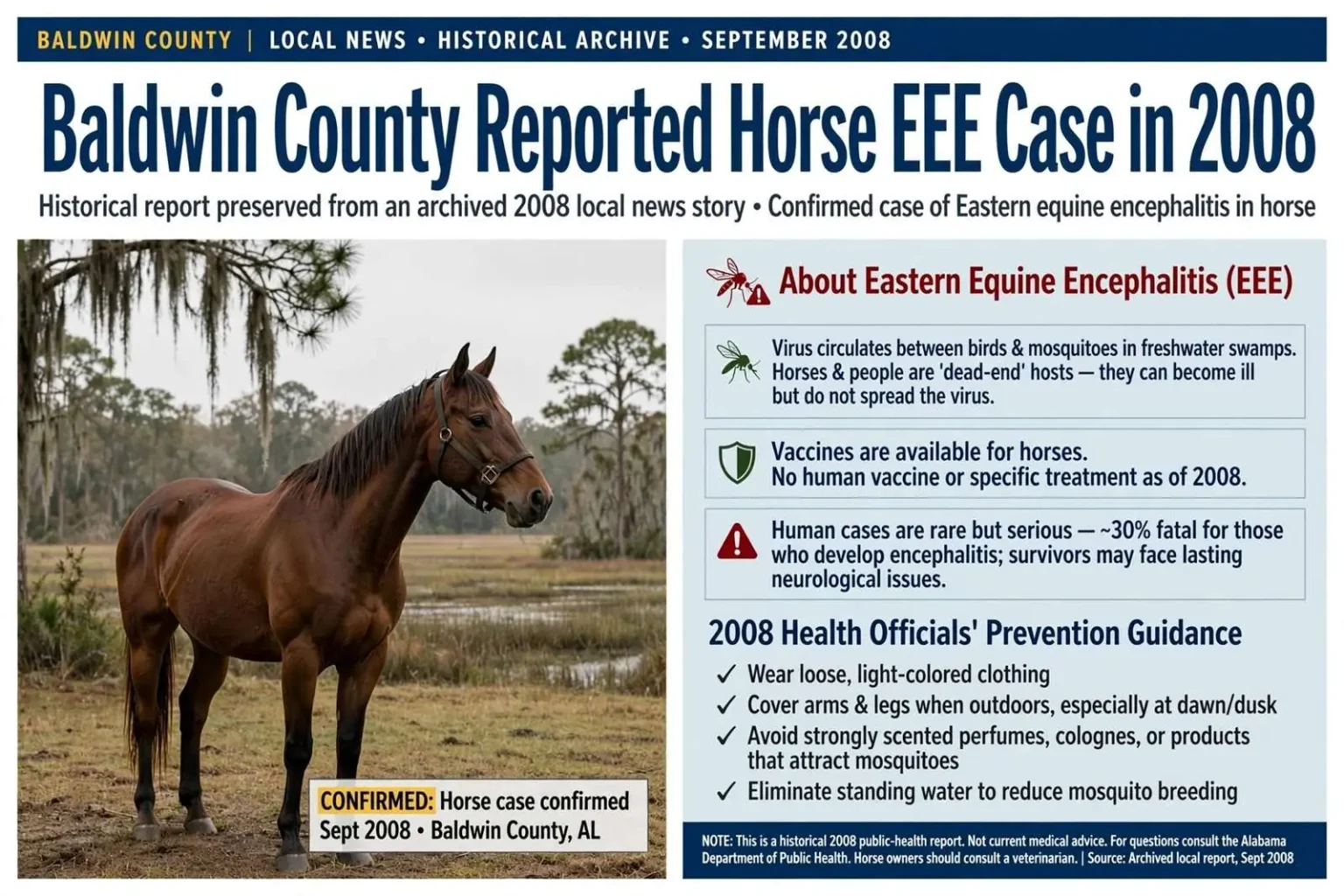
Historical report preserved from an archived 2008 local news story.
A 2008 local news report noted a confirmed case of Eastern equine encephalitis in Baldwin County involving a horse, and it shared mosquito-season prevention information that health officials have long urged Gulf Coast residents to follow. The report explained that mosquito-borne illnesses can move among birds and mosquitoes and sometimes affect mammals, including people and horses. It said vaccines were available for horses but not for people at the time. Health officials advised practical prevention measures such as wearing loose, light-colored clothing, covering arms and legs when possible, and avoiding strongly scented products that could attract mosquitoes.
The confirmation of the disease in a Baldwin County horse fit a pattern that residents of south Alabama know well. Baldwin County, stretching from Mobile Bay east to the Florida line, contains an unusually large share of the habitat mosquitoes prefer: freshwater swamps, pine flatwoods, tidal marshes, and the ponds and ditches that collect rainwater across the county’s rapidly growing subdivisions. Warm Gulf Coast temperatures extend the mosquito season from early spring well into fall, giving viruses that circulate between birds and mosquitoes a long window each year to build up in the environment.
How the Virus Moves
Eastern equine encephalitis, often abbreviated EEE, is a virus that normally lives in a cycle between wild birds and mosquitoes that feed on birds. Under ordinary circumstances the virus stays in that bird-mosquito loop and never comes into contact with people. The danger arises when certain other mosquito species, the ones that readily bite both birds and mammals, pick up the virus from an infected bird and then carry it to horses or humans. Those animals are considered dead-end hosts, meaning they cannot pass the virus back to mosquitoes in meaningful numbers, but they can become seriously ill when infected.
Horses are among the most visible victims because their infections are hard to miss. The virus causes inflammation of the brain, and affected animals may show unsteadiness, circling, loss of appetite, irritability, or paralysis before declining rapidly. Veterinarians across south Alabama see suspected cases most often in late summer, after months of mosquito breeding have allowed the virus to amplify in the bird population. A single confirmed case in a horse is significant for public health as well as agriculture, because it signals that infected mosquitoes are active in the area and that human exposure is possible.
The report’s note that vaccines were available for horses but not for people at the time reflected the state of medical science in 2008, and it remains broadly true today. An effective equine vaccine is a standard part of veterinary care for horses in the Southeast, typically administered on a schedule set by a veterinarian before mosquito season peaks. No approved human vaccine exists for general use, largely because the disease is rare enough that developing and testing one has not been commercially practical. That asymmetry places nearly all of the prevention burden for people on avoiding mosquito bites.
The Advice Health Officials Gave
The prevention measures described in the 2008 report were the same ones the Alabama Department of Public Health and county health departments have repeated for years during mosquito season. Wearing loose, light-colored clothing reduces bites in two ways at once. Loose garments are harder for a mosquito’s mouthparts to penetrate than fabric held tight against the skin, and light colors are less attractive to the insects than dark shades. Covering arms and legs during the hours when mosquitoes are most active, particularly around dawn and dusk, removes the exposed skin where most bites occur.
Why Baldwin County Pays Attention
Baldwin County’s geography makes it a recurring focus of mosquito-borne illness surveillance. The county’s eastern edge borders Perdido River swampland, its western edge runs along Mobile Bay, and the interior holds the Mobile-Tensaw delta’s southern reaches, all productive mosquito habitat. At the same time, the county’s population was among the fastest growing in Alabama in the 2000s, with new neighborhoods spreading into and alongside the wooded and low-lying land where mosquitoes and the birds that carry the virus live. That combination of expanding suburbs and abundant habitat means human and animal exposure is a yearly concern rather than a rare event.
Horse owners in the county have particular reasons to stay vigilant. Baldwin County has long been home to a substantial equine community, from working ranch properties in the northern part of the county to pleasure horses and boarding stables across the central corridor. For these owners, an EEE report is a reminder to check vaccination records with their veterinarians, to keep horses stabled during peak mosquito hours when possible, and to drain or treat water sources where larvae develop. Livestock owners across south Alabama learned over the years that the modest cost of annual vaccination is small compared with the loss of an animal to a preventable disease.
For the general public, the appearance of EEE in a local horse prompts health departments to step up testing and messaging. Mosquito control programs respond by increasing surveillance, trapping insects to test for virus, and in some areas spraying to reduce adult mosquito populations. Residents are encouraged to report standing water and dead birds, which can serve as early indicators of viral activity in a neighborhood. The system depends on reports like the one issued in 2008, because a confirmed animal case is often the first hard evidence that the virus has reached a particular area.
A Recurring Gulf Coast Concern
Eastern equine encephalitis is not the only mosquito-borne illness tracked along the Gulf Coast. West Nile virus arrived in Alabama in the early 2000s and became an annual presence, and health officials monitor both diseases through the same networks of bird testing, mosquito trapping, and reports of animal and human cases. The two viruses share the same prevention advice, which is one reason health departments fold their guidance into a single mosquito-season message each year rather than treating each illness separately.
The 2008 Baldwin County report belongs to that longer story. Every few years, conditions align to produce more viral activity, and each confirmed animal case renews the same cycle of public warnings, veterinary reminders, and personal precautions. The fundamentals have not changed: wear protective clothing, use approved insect repellents, avoid the outdoors at peak mosquito hours when practical, remove standing water from property, and keep horses vaccinated.
Understanding the Mosquito Lifecycle
Much of the prevention advice that officials offered in 2008 rests on how mosquitoes reproduce. The insects pass through egg, larva, pupa, and adult stages, and the first three all require water. Some species lay eggs on the surface of permanent ponds and swamps, while others deposit them in containers, tree holes, and flood-prone ground where they sit dormant until rain covers them. This is why homeowners are urged to empty flower pots, buckets, gutters, bird baths, and old tires on a weekly basis. A mosquito can complete its early development in less than an inch of standing water, and on the Gulf Coast a summer shower followed by several days of heat is enough to produce a new generation of adults.
The species that transmit EEE behave differently from one another, which shapes when and where risk appears. The birds-and-swamp mosquitoes that maintain the virus deep in wetland habitat tend to stay there, biting birds and rarely encountering people. The bridge mosquitoes, the ones that carry the virus from the bird population to mammals, include species that flourish in residential areas and are active at dawn and dusk. That split explains the standard guidance about limiting outdoor activity during those hours and about being especially careful near swampy ground, wooded lots, and the edges of new development where yards meet natural habitat.
Surveillance is the other half of the response. Health departments and mosquito control staff trap adult mosquitoes throughout the warm months, sort them by species, and test pools of insects for virus. They also test sentinel chickens, collect dead birds reported by the public, and investigate reports of sick horses and other animals. Each piece of that network existed in 2008 and continues today, and each confirmed case of EEE in a horse feeds the same purpose: giving the community early warning so that vaccination, spraying, and personal protection can begin before human cases occur.
This article records historical public-health reporting from 2008. It is not current medical advice, and the specific details of the Baldwin County case have long since passed into the record. Readers with questions about mosquito-borne disease today should use current guidance from public-health authorities, including the Alabama Department of Public Health and the Baldwin County Health Department, and consult a veterinarian about protecting horses and other animals. What the 2008 report preserved is the enduring logic of Gulf Coast mosquito season: the virus cycles quietly between birds and insects, a single confirmed case tells the community it is present, and the best protection available to people remains the simple habit of not getting bitten.