After Grisly Killing, Baldwin County Neighborhood Forms Watch Group
Neighbors near a Foley-area home where an elderly man was killed met with Baldwin County deputies to organize a neighborhood watch and ease safety worries.
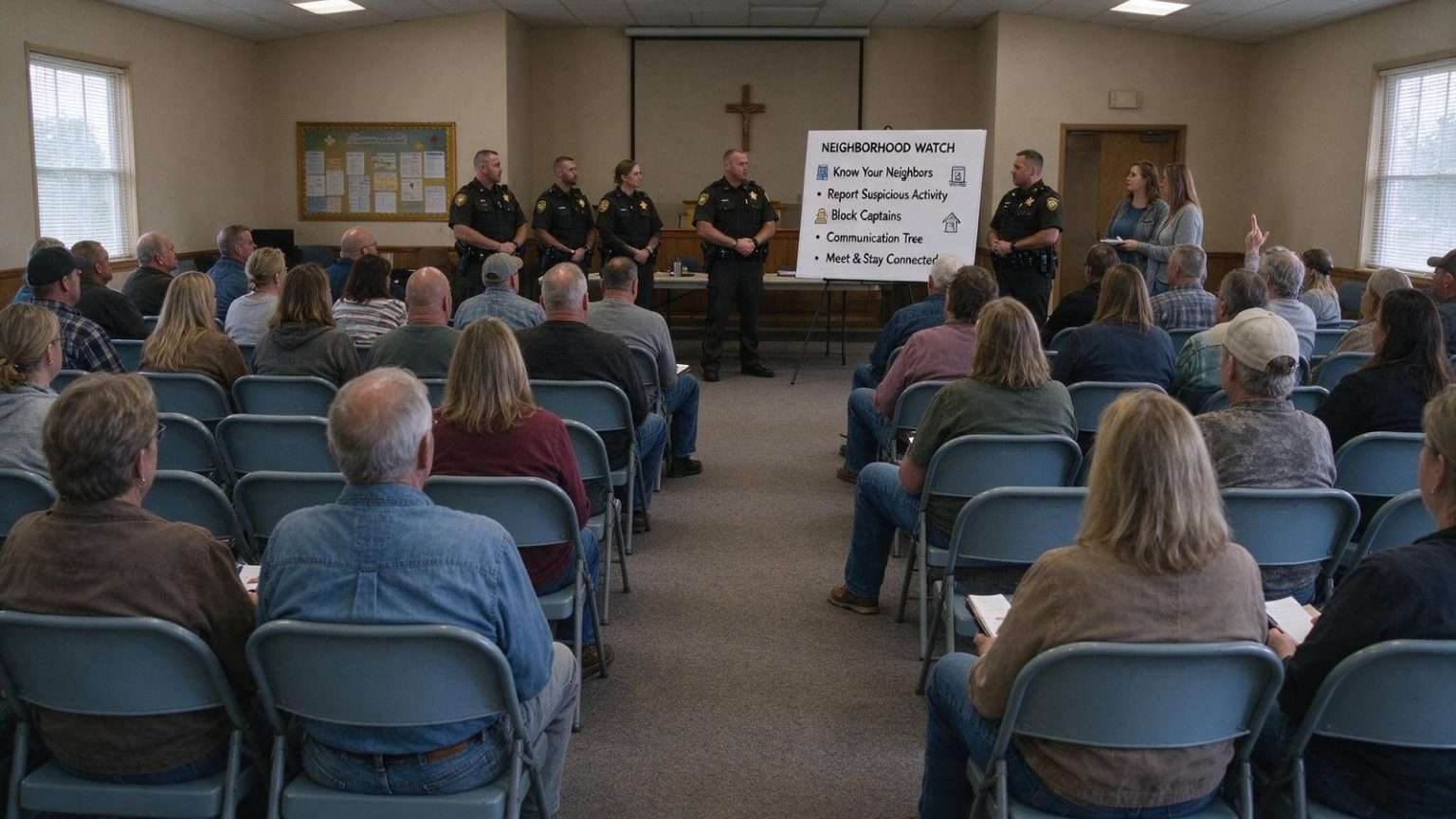
Residents of a Baldwin County neighborhood near Foley gathered with sheriff’s officials in December to talk through safety concerns and lay the groundwork for a neighborhood watch program, months after an elderly neighbor was killed in his own home.
About 25 people attended the hour-long meeting at a Summerdale church, according to a Baldwin County Sheriff’s Office major who helped organize the session. The gathering focused on general crime trends and residents’ responsibilities in reporting suspicious activity, rather than specifics of the ongoing case, which remained under investigation at the time.
The meeting came after an 87-year-old man was killed at his home in the Copperwood subdivision, a development less than three years old at the time. A Millbrook-area man was later arrested and jailed on a $1 million bond in connection with the case. Investigators said the killing did not appear to be a random act — a detail that did little to soften the shock in a neighborhood where many families had moved in within months of each other.
A neighborhood shaken
Sheriff’s officials said the neighborhood gathering was organized by residents themselves, who wanted a chance to meet face to face after the violence of having a homicide occur so close to home. In a subdivision built within the previous three years, the crime had interrupted the ordinary process by which new neighborhoods get acquainted — the wave-from-the-driveway stage in which neighbors are still learning one another’s names, cars and routines.
Some residents voiced worries about declining property values following the incident, concerns the sheriff’s major said tend to fade as time passes and memories of a single event soften. Real estate in Baldwin County had been on a strong run through the period, with new subdivisions rising across the Foley and Summerdale corridors as the county’s population climbed, and officials noted that a neighborhood’s long-term values depend more on cohesion and upkeep than on a single incident, however grim.
Deputies said the case was one of the more difficult ones the department had worked in recent memory, given how close it hit to a quiet, newer subdivision where many residents had only recently gotten to know each other.
The message from the sheriff’s office
Rather than dwelling on the crime itself, sheriff’s officials used the meeting to encourage residents to build relationships with neighbors and consider forming a formal community watch group. “Having a nosy neighbor can be a beneficial thing,” the sheriff’s major told residents, encouraging the kind of familiarity that can help identify unusual activity before it becomes a problem.
The advice reflects the core principle behind neighborhood watch programs nationwide: deputies cannot be on every street at once, and the people best positioned to notice that something is wrong — a strange vehicle parked too long, a visitor at a house whose residents are away, a door left open at an elderly neighbor’s home — are the people who live there.
Officials described the Copperwood residents as engaged and eager to organize, a disposition that made the meeting unusually productive compared to sessions convened in neighborhoods where apathy has taken root after years without serious crime.
How a neighborhood watch works
A formal watch program is more than a promise to be alert. Organized groups register with the sheriff’s office, designate block captains, maintain phone or email trees for spreading warnings quickly and hold periodic meetings where deputies brief residents on crime trends in the area. Members are trained to observe and report — description, direction of travel, vehicle details — rather than to confront, leaving intervention to law enforcement.
Sheriff’s offices across Baldwin County have long promoted the model, particularly in unincorporated areas where houses sit on scattered lots and the natural surveillance of a denser town street does not exist. The effectiveness of a watch group rests on participation: a program with a sign in the yard but no active members deters no one, while a group that actually knows its neighbors’ schedules can spot an anomaly within minutes.
The Copperwood meeting followed that template — a first session to organize interest, with follow-up meetings expected to formalize the structure, elect coordinators and set up communication channels with the sheriff’s office district deputies who patrol the area.
The setting: the Foley-Summerdale corridor
The Copperwood subdivision lies in the unincorporated area near Foley, one of the fastest-growing sections of Baldwin County. The city of Foley anchors the region’s commercial life with its schools, hospital and retail corridor, while Summerdale and the surrounding communities supply the subdivisions that have spread across former farmland in recent decades.
Baldwin County as a whole has ranked among Alabama’s fastest-growing counties for years, its population drawn by the Gulf Coast economy, lower housing costs than neighboring Mobile and a quality of life that markets itself on quiet neighborhoods and good schools. New developments like Copperwood — less than three years old when the killing occurred — are the physical expression of that growth, streets of new construction filled with families who often arrive from out of state.
Sheriff’s deputies cover that unincorporated territory with patrol districts radiating from substations across the county, and response times in rural-flavored areas make resident vigilance all the more valuable to the department’s work.
The case that prompted it
The killing that brought the neighborhood together remained under investigation as the group organized, with the 87-year-old victim found dead in his own home and a Millbrook-area man held in the Baldwin County jail on a $1 million bond in connection with the case. Investigators’ early conclusion that the crime was not random offered some reassurance — suggesting the victim was targeted rather than chosen by chance — but offered little comfort to a community confronting the fact that violence had reached one of its own homes.
The victim’s age added to the concern. Elderly residents living alone are a focus of the sheriff’s office’s community outreach in general, with deputies encouraging regular check-ins, documented visitor expectations and the kind of neighborly attention that can flag trouble early — precisely the habits a watch program formalizes.
Millbrook sits across Mobile Bay in Elmore County, north of Montgomery, and the arrest of a suspect from so far away illustrated how such cases draw investigative resources across jurisdictional lines, with deputies from Baldwin County coordinating with agencies elsewhere in the state as the case developed.
What residents can do
The sheriff’s office’s advice at the meeting distilled to practical habits. Know your neighbors’ vehicles and schedules. Take note of unfamiliar cars that linger. Report suspicious activity when it happens rather than recalling it days later, providing descriptions rather than conclusions. Look in on elderly neighbors, especially during hot summers and cold snaps when isolated residents are most at risk.
Deputies stress that reports cost nothing and that dispatchers would rather screen a false alarm than arrive late to a real one. In a newer subdivision, where landscaping crews, delivery trucks and contractors come and go constantly, the distinction between ordinary traffic and something worth reporting is exactly what a watch group learns to make.
Rebuilding a sense of safety
For the roughly 25 residents who filled the church meeting room that December evening, the session served two purposes at once: practical organizing and collective recovery. Communities that experience a violent crime often go through a period in which ordinary routines — evening walks, unlocked doors, children playing outside — feel changed, and sheriffs’ offices have found that organized response shortens that period.
The Copperwood group’s decision to meet rather than retreat, officials suggested, was itself the best sign for the neighborhood’s future: a development less than three years old, shaken by the worst kind of news, choosing to get to know itself better rather than to withdraw behind closed doors.
The sheriff’s office role in new subdivisions
The Baldwin County Sheriff’s Office, which polices all of the county’s unincorporated territory, has worked for years to build relationships with the subdivisions that appear along its growth corridors. Deputies attend civic association meetings, host seasonal safety briefings and assign district deputies who are expected to become familiar faces in the neighborhoods they cover — an approach the department credits with generating the tips that solve cases in areas where few cameras and fewer witnesses exist.
In a county that has added tens of thousands of residents over two decades, those relationships are also a practical necessity. New streets often appear faster than patrol familiarity can follow, and a deputy responding to a theft call benefits enormously from a resident who can say which vehicles belong on the street and which do not. Watch programs, the department argues, are the organized version of that knowledge.
December meetings carry their own dynamic. Year-end gatherings coincide with a seasonal rise in package thefts and burglaries targeting homes left dark during holiday travel, and deputies typically pair the organizing message with concrete warnings about lighting, hold-mail services and asking a trusted neighbor to check on a house while its owners are away.
A model other neighborhoods follow
Communities across Baldwin County have organized watch groups after crimes large and small, and the department treats each new group as a node in a wider network that passes warnings between subdivisions. When a string of vehicle breakouts hits one area, an active watch group can spread the description to neighboring developments the same evening, multiplying the eyes available to deputies.
For Copperwood, the immediate agenda was structural: choosing coordinators, collecting contact information, deciding how often to meet and establishing the direct line to the district deputy who covers the area. The sheriff’s office provides training materials and guidance, but the groups run on residents’ time — the block captains who maintain the lists and the neighbors who agree to be called at odd hours.
The major who addressed the December session left the group with the same counsel he gives every new watch organization: the program’s value is measured in the ordinary familiarity it builds, street by street, long before anyone needs it — because the night something happens is the wrong time to be learning a neighbor’s name.