Baldwin County Deputies Seek Suspect in Credit Card Theft Spree Near Bay Minette, Atmore
Baldwin County deputies are asking for help identifying a man suspected of using a stolen credit card at businesses near Bay Minette and Atmore.
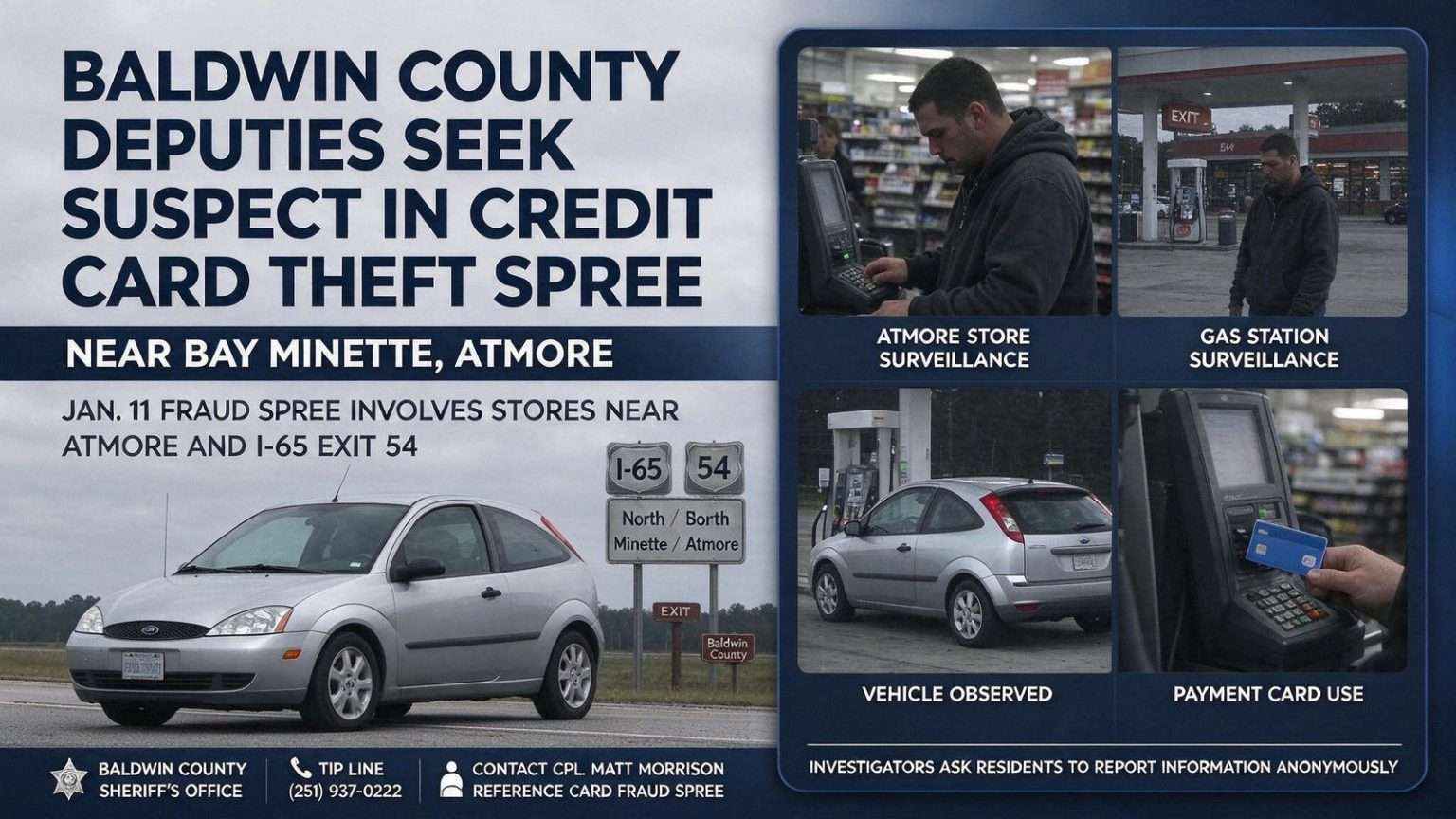
The Baldwin County Sheriff’s Office is asking for the public’s help identifying a man suspected of using a stolen credit card at several locations around Bay Minette and Atmore earlier this month. According to investigators, the string of fraudulent purchases took place on Jan. 11, with the suspect using the card at multiple businesses in a short span of time, including a stop at a Walmart in Atmore along Alabama 21 and a gas station near Interstate 65 at Exit 54.
The rapid-fire pattern of the transactions is typical of stolen-card fraud, in which a thief moves quickly from store to store before the cardholder notices the charges and the account is shut down. Each stop adds to both the total loss and the pool of surveillance footage, and investigators in cases like this one routinely reconstruct the suspect’s route from the camera systems of every business the card touched.
Surveillance images captured at both locations show a man believed to be behind the transactions, along with the vehicle he was driving. Deputies described the getaway car as a silver, mid-2000s Ford Focus, a two-door hatchback — a specific enough description that investigators hope someone in the community recognizes the car even if they cannot place the face.
Who Investigators Are Looking For
Investigators believe the suspect may have ties to the Bay Minette or Atmore area, or possibly to communities just across the state line in north Escambia County, Florida. The geography of the transactions — Bay Minette, the Baldwin County seat, and Atmore, just across the county line in Escambia County — suggests someone familiar with the corridor connecting the two, where U.S. 31, Alabama 21 and Interstate 65 give a driver multiple quick routes between towns.
The Sheriff’s Office released the images in hopes that someone in the community can help identify the man before he strikes again. Detectives stress that stolen-card cases are rarely isolated: a card that works once tends to be used repeatedly until it is declined, and offenders who succeed in one spree frequently repeat the pattern with another card within weeks.
How Card Fraud Investigations Unfold
Credit and debit card fraud cases like this one often hinge on tips from residents who recognize a face or a vehicle from surveillance photos, and investigators say even small details can help move a case forward — a partial license plate, a direction of travel, a workplace logo on clothing, or the timing of a regular stop at one of the businesses involved. Once a suspect is identified, detectives can match the transactions to receipts, compare signatures, and build the paper trail that turns recognition into charges.
Anyone with information about the identity of the suspect or the whereabouts of the vehicle is asked to contact Cpl. Matt Morrison with the Baldwin County Sheriff’s Office. Callers can remain anonymous if they choose, and the department’s tip channels are staffed to take information around the clock for cases like this one.
A Persistent Problem Along the Corridor
Card-skimming and stolen-card fraud have been a persistent headache for small businesses and shoppers across Baldwin and Escambia counties, with law enforcement agencies frequently reminding residents to monitor their bank statements closely after visiting gas stations and big-box retailers along well-traveled corridors like U.S. 31 and Interstate 65. The routes that make the Bay Minette–Atmore corridor convenient for commerce also make it attractive for fraud, since a thief can hit multiple merchants across two counties and a state line in a single afternoon before any single agency has assembled the full picture.
Skimming devices — secretly installed card readers that capture account data at gas pumps and ATMs — remain a recurring problem along highway corridors everywhere, and deputies advise drivers to use pumps closest to the store, check readers for loose or damaged panels, and pay inside when something looks off. Stolen physical cards, like the one used in the Jan. 11 spree, are the other half of the problem, usually taken from unlocked cars, purses left unattended or mailboxes, and often used within hours of the theft.
Local banks and credit unions in the Bay Minette area have also urged customers to report any suspicious charges immediately so that cards can be canceled before additional damage is done. Fraud losses are typically reversible when reported quickly, but the window matters: the faster a card is shut down, the less a thief can extract, and the cleaner the transaction record investigators inherit when they begin their work.
The Sheriff’s Office and Its Coverage
The Baldwin County Sheriff’s Office is the primary law enforcement agency for most of Baldwin County outside its incorporated cities, patrolling a county that is geographically the largest in Alabama and one of its fastest-growing. Its investigators work cases that cross municipal boundaries daily — as this one does, reaching from Bay Minette to Atmore — and the department regularly uses surveillance-image releases to harness the public’s eye in exactly this fashion. Deputies note that identifications from published photos remain one of the most productive investigative tools in property and fraud cases, precisely because the same offenders pass through the same stores, gas stations and neighborhoods as everyone else.
What Residents Can Do
Sheriff’s officials and banking professionals across the area repeat a short list of prevention measures: check bank and card statements daily rather than monthly, set up transaction alerts through your bank’s app, keep cards secured rather than in vehicles, and report a lost or stolen card within minutes of noticing it is gone. Merchants, for their part, are encouraged to maintain camera systems that capture faces at the register — the footage from the Atmore Walmart and the Exit 54 gas station is what makes this case solvable at all.
For anyone who recognizes the man in the released images or the silver mid-2000s Ford Focus two-door hatchback, the department asks that you contact Cpl. Matt Morrison directly. Information about where the vehicle is regularly parked, where the driver works, or any other detail — however minor it seems — can be the piece that completes the case, and anonymity is available to callers who prefer it.
What Happens Next
Once the suspect is identified, the case would move through the standard channels: charges presented to the Baldwin County District Attorney’s Office, warrants issued, and prosecution in the county’s courts — with the possibility of additional charges if investigators tie the man to other fraud sprees in the region. Fraud convictions can carry serious penalties under Alabama law, particularly when multiple transactions and repeat offenses are involved, and prosecutors treat the theft and fraudulent use of credit cards as part of the same continuum of financial crimes that prey on the area’s businesses.
Until then, the Sheriff’s Office is counting on the same thing that breaks most cases of this kind: a resident, a coworker or an acquaintance who recognizes the face or the car and makes the call. Investigators released the surveillance images precisely because they believe someone along the Bay Minette–Atmore corridor — or across the line in north Escambia County, Florida — knows exactly who is behind the Jan. 11 spending spree, and one anonymous tip could end it before the next card is stolen.
The Geography of the Case
The locations tied to the Jan. 11 transactions sketch the suspect’s likely orbit. Bay Minette, the county seat of Baldwin County, sits near the center of the county along U.S. 31, while Atmore lies to the north in neighboring Escambia County along Alabama 21, with Interstate 65 connecting the two communities in a short drive. The Walmart in Atmore and the gas station near Exit 54 both sit along heavily traveled routes where cameras run continuously and traffic mixes local drivers with interstate travelers, giving investigators two solid video records and any number of potential witnesses.
The likelihood that the suspect has ties to Bay Minette, Atmore or communities across the line in north Escambia County, Florida, shapes where deputies are concentrating their canvass: convenience stores, workplaces, and social circles where a silver, mid-2000s two-door Ford Focus would be recognized. Familiarity with back roads between the two towns is itself a clue, and investigators note that offenders in card-fraud cases usually spend the money close to home, where the stolen card’s owner and the merchants are least likely to cross paths with them again.
How Stolen Cards Spread So Fast
The pattern behind a spree like the Jan. 11 one is well documented. A stolen card is typically used within hours of the theft, in small transactions designed to test whether it works, followed by rapid purchases of goods that can be resold — electronics, gift cards, fuel, prepaid phones. Thieves space stops across multiple merchants and jurisdictions to keep any single business from noticing the pattern, and they stop once a card is declined. That behavior explains why the transactions in this case spanned Bay Minette and Atmore in a short span of time, and why deputies are asking businesses along the corridor to review their own footage for similar activity before or after that date.
For the cardholder whose account was drained, the spree is more than an inconvenience: transactions must be disputed, a new card issued, and any automatic payments tied to the account repaired. Banks and credit unions in the Bay Minette area process these claims routinely, and they echo the Sheriff’s Office in emphasizing that early reporting is what limits the damage — and what gives investigators the cleanest possible transaction log to work from when they begin tracing the suspect’s route.
Identifying the Suspect
The surveillance images released by the department show a man believed to be responsible for the transactions, captured at both the Atmore Walmart and the Exit 54 gas station, along with the vehicle he was driving. Detectives ask anyone who recognizes either to resist sharing guesses publicly and instead contact Cpl. Matt Morrison directly, since misidentification can complicate a case and unfounded accusations can harm uninvolved people. Verified tips, by contrast, move quickly: once a name is attached to the footage, detectives can pull records, locate the vehicle and bring the case to charges within days.