
ADEM issues air quality alert for Mobile, Baldwin Counties
ADEM issued a Code Orange air quality alert for Mobile and Baldwin Counties, warning sensitive groups as Canadian wildfire smoke affected U.S. air.
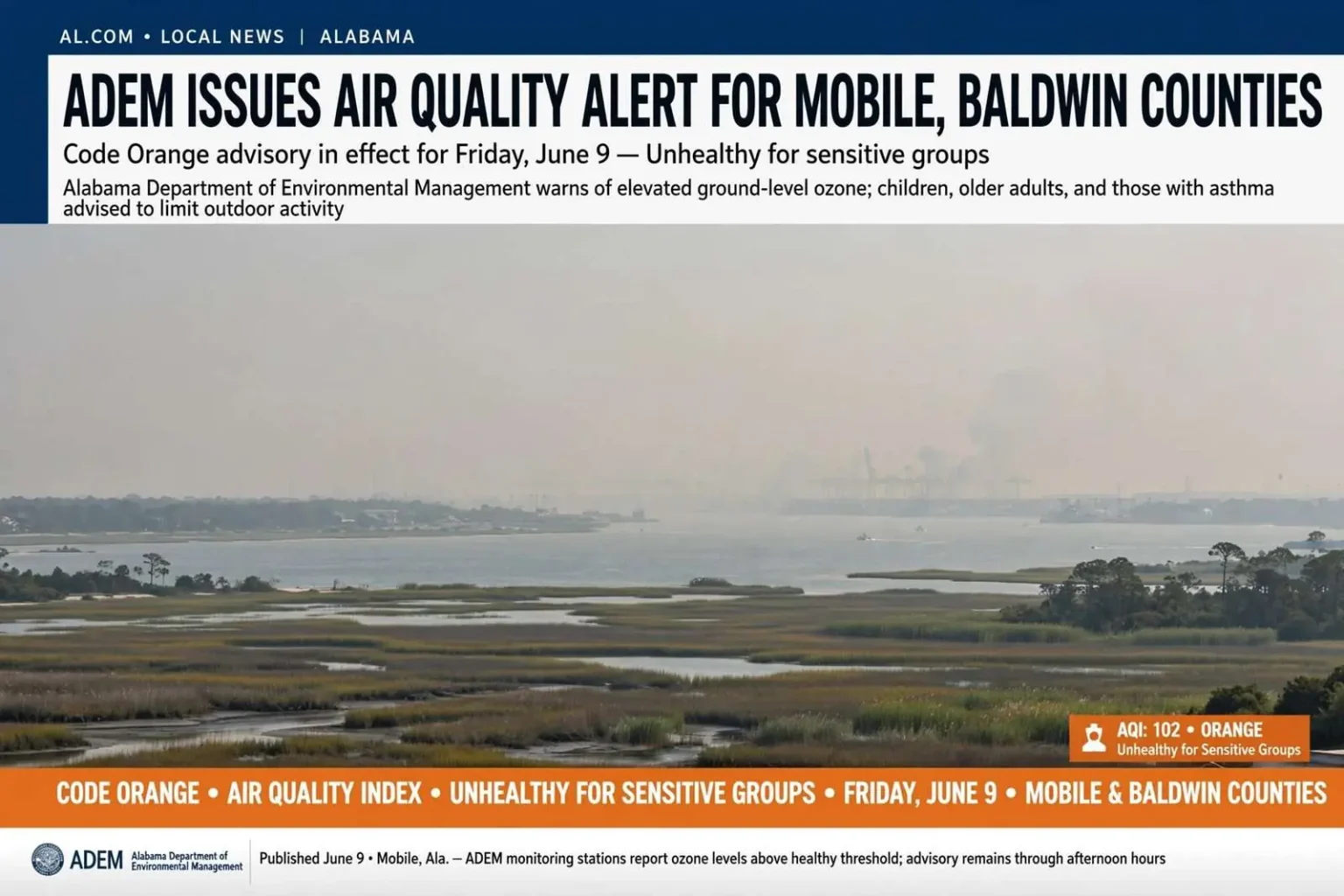
MOBILE, Ala. — The Alabama Department of Environmental Management has issued an air quality alert for Mobile and Baldwin Counties for Friday, June 9, warning residents that ground-level ozone concentrations are expected to reach levels unhealthy for sensitive groups. The alert designates a Code Orange day under the federal air quality index, the level at which people with certain health conditions are advised to limit prolonged outdoor exertion.
Under Code Orange conditions, according to ADEM, ground-level ozone is expected to build to concentrations that are unhealthy for sensitive groups. Children and people with asthma are among those most at risk under the expected conditions, along with older adults and anyone with respiratory disease. The advisory does not ask the general public to change its activities, but it does recommend that people in sensitive groups reduce time spent outdoors and avoid strenuous exercise during the hours when ozone peaks.
The alert follows severe air quality problems across much of the northeastern United States, driven by smoke from wildfires in Canada. Smoke from those fires drifted across vast stretches of the country, pushing air quality indexes into the hazardous range in cities hundreds of miles from the fire lines. Along the Gulf Coast, the connection is indirect — the same regional weather pattern and air mass conditions associated with the widespread smoke event can affect how ozone forms and accumulates over the Southeast.
Ozone at ground level is a pollutant, not a protective layer. While ozone high in the atmosphere shields the earth from ultraviolet radiation, ozone near the ground forms when emissions from vehicles, industry, and other sources react in heat and sunlight. Hot, sunny days with light winds — exactly the kind of early June weather common on the Gulf Coast — are the conditions under which ozone builds to its highest concentrations, which is why air quality alerts for Mobile and Baldwin Counties typically arrive during the summer months.
What Code Orange means for residents
The Air Quality Index is the color-coded scale used nationwide to communicate daily air quality, running from green for good air through yellow, orange, red, purple, and maroon as pollution levels rise. Code Orange — the “unhealthy for sensitive groups” band — means the general population is unlikely to be affected, but people with lung disease such as asthma, children and teenagers, older adults, and people who are active outdoors are advised to take precautions.
For children, the guidance matters because their lungs are still developing and they breathe more air relative to their body size than adults do. Schools and youth sports programs in Mobile and Baldwin Counties routinely check air quality during the summer, and on Code Orange days coaches are advised to shorten or move practices and to watch for symptoms among athletes. Parents of children with asthma are encouraged to keep rescue inhalers accessible and to watch for coughing, wheezing, or shortness of breath during outdoor activity.
People with asthma face the most direct risk from elevated ozone. Ozone inflames the airways, and exposure at alert-level concentrations can trigger attacks in people whose asthma is otherwise controlled. ADEM’s advisory aligns with the guidance respiratory health organizations issue on ozone days: stay indoors during peak afternoon hours, keep air conditioning running rather than open windows, and follow the asthma action plan prescribed by a physician.
Older adults and people with chronic obstructive pulmonary disease, heart disease, or other respiratory conditions fall into the same sensitive-group category. For them, the recommendation is similar — reduce prolonged outdoor exertion, particularly in the afternoon when ozone concentrations peak, and seek medical attention if breathing becomes difficult.
ADEM issues air quality alerts for Mobile County and the rest of the state’s metropolitan areas as part of its mandate to monitor and protect Alabama’s environment. The department operates air monitoring stations that measure ozone and particulate pollution continuously, and when forecast conditions and monitored trends point to a day above the healthy-for-all threshold, the department issues the advisory through its alert system and the news media. Mobile and Baldwin Counties — the state’s coastal, fast-growing corner — are among the areas most likely to see summer ozone advisories because of their climate and traffic volumes.
The June 9 alert’s connection to the Canadian wildfire smoke event highlights how air quality has become a national issue. Wildfire smoke carries fine particulate matter — soot particles small enough to lodge deep in the lungs — and smoke plumes from large fires can travel thousands of miles. During major smoke events, the northeastern United States has seen some of its worst air quality on record, and the meteorological patterns that move that smoke around the country can influence air conditions well beyond the affected regions. For Gulf Coast residents, the practical takeaway is that air quality responds to conditions far beyond their own counties.
Ground-level ozone and wildfire smoke are different pollutants with overlapping health effects. Ozone is invisible and forms in heat and sunlight; smoke is visible haze made of particulates and gases. Both irritate the respiratory system, and both are tracked on the Air Quality Index. An ozone alert for Mobile and Baldwin Counties means the forecast points to the region’s own summertime pollution chemistry, amplified by the kind of stagnant, hot conditions that also allowed the Canadian smoke to dominate air quality discussions nationally.
How residents can respond
The actions ADEM recommends on Code Orange days are modest, and they add up. Residents can reduce their contribution to ozone formation by limiting vehicle idling, combining trips, and refueling vehicles in the evening when temperatures are lower — gasoline vapors released during refueling contribute to ozone formation in heat. Lawn equipment, boats, and other gasoline engines are also ozone contributors, and postponing their use until evening helps on alert days.
For sensitive individuals, the response is about protecting health rather than reducing pollution. Checking the daily air quality forecast, scheduling outdoor activity for the morning when ozone is lower, taking breaks indoors, and following a doctor’s guidance for asthma or COPD are the standard recommendations. Parents signing children up for summer sports can ask whether coaches check air quality and how they adjust activities on alert days.
The alert for Friday, June 9 is one advisory in the annual rhythm of Gulf Coast summers. Mobile and Baldwin County residents can expect ozone advisories whenever heat and sunshine combine with light winds during June, July, and August, and ADEM’s alert system exists precisely so that residents know which days carry higher risk. The department’s monitoring network will continue reporting conditions through the summer, and alerts will be issued on the days when the forecast and the monitors agree that ozone — or smoke — has pushed air quality into the range where some residents should take care.
For now, the guidance for Friday is clear: a Code Orange day for Mobile and Baldwin Counties, unhealthy for sensitive groups, with children and people with asthma among those most at risk. The general public can carry on with normal plans, but anyone with respiratory conditions — and anyone responsible for children, older relatives, or outdoor workers — should keep the advisory in mind as the day heats up and ozone builds through the afternoon hours.
The science behind ozone alerts is worth understanding, because it explains why the advisories follow a seasonal rhythm. Ground-level ozone is not emitted directly by any source; it is created through a chemical reaction that requires nitrogen oxides and volatile organic compounds, both common in vehicle exhaust and industrial emissions, to cook together in heat and sunlight. That is why ozone is a summer problem in the Gulf South: long daylight hours, high temperatures, and the intense sun of June through August accelerate the chemistry, while calm days allow the ozone to accumulate rather than disperse. Morning ozone is usually the day’s lowest, rising through the afternoon and peaking in the hours after midday before falling back overnight.
Mobile and Baldwin Counties also carry a geography that shapes their air quality. The coastal location brings sea breezes that usually help disperse pollutants, but it also puts the region’s roads, port activity, and growing commuter traffic into the ozone-formation equation. Baldwin County’s rapid growth has added vehicle miles across the bay and along the Eastern Shore corridors, and Mobile’s industrial and port operations contribute their own emissions profile. Air quality in the two counties is thus the product of climate, geography, and growth together, and ADEM’s monitoring network tracks the result continuously.
The monitoring stations themselves are spread across Alabama’s metropolitan areas, measuring ozone and fine particulate matter with instruments calibrated to federal standards. The data feeds the real-time Air Quality Index that residents can check online, and it builds the long-term record used to assess whether an area meets federal air quality standards. Coastal Alabama has generally stayed in attainment for ozone, but days like June 9 test the margin, which is why ADEM asks residents to take voluntary steps on alert days — keeping ozone down on marginal days protects the region’s standing and its residents’ health alike.
The Canadian wildfire smoke that set the backdrop for this alert is part of a pattern that has grown more frequent in recent years, with large boreal fires sending plumes across North America. For Gulf Coast residents, those events serve as a reminder that air quality is connected across the continent — smoke that darkens skies in New York can influence weather and air patterns that reach the Southeast. ADEM’s alert for Mobile and Baldwin Counties is grounded in local ozone forecasting, but it arrives in a national context of heightened attention to the air everyone breathes.
Residents who want to stay ahead of future advisories can sign up for air quality notifications and check the daily AQI forecast, which is updated each afternoon for the following day. The June 9 Code Orange advisory for Mobile and Baldwin Counties will not be the last of the summer; the heat, sun, and light winds that create ozone days will return through August, and ADEM will issue alerts on the days when conditions warrant. Knowing what Code Orange means — and who should adjust their plans — is the practical takeaway for the two counties’ residents as summer proceeds.


