Baldwin County Approves New Rental Fees for Historic Park Facilities
Baldwin County commissioners approved new rental fees for a historic church and pavilions at Bicentennial Park and Live Oak Landing park sites.
Anyone hoping to rent a historic North Baldwin County church or park pavilion for a wedding or gathering will now pay a fee, after county commissioners voted Tuesday to approve new rental charges at two popular sites. The decision ended a long-standing practice that allowed private events at the county’s historic facilities at no charge, shifting part of the cost of upkeep onto the people who use them. County officials cast the change as a housekeeping measure aimed at a small corner of county operations, but it drew a genuine debate on the commission floor about who should pay for public amenities and why.
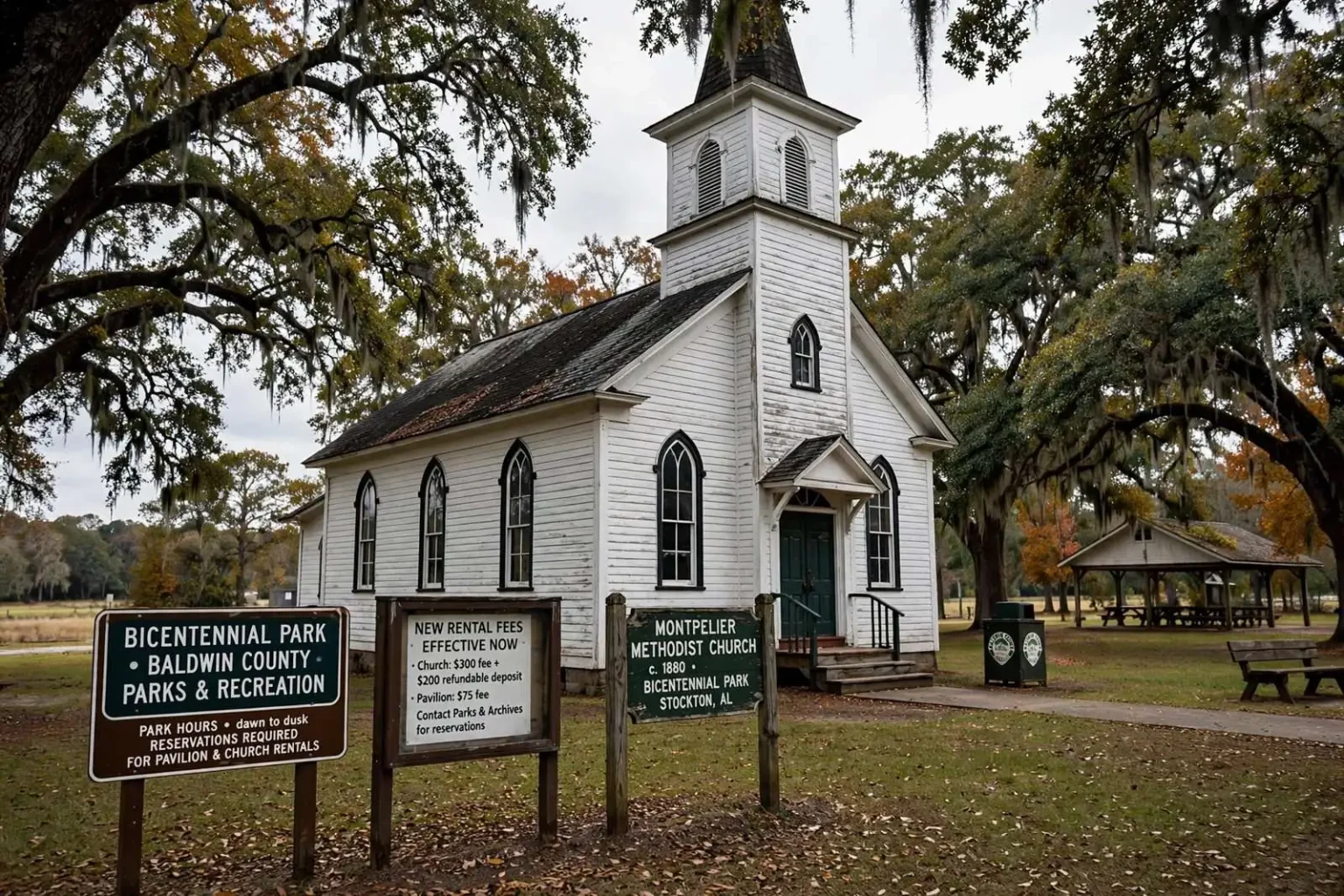
In a 3-1 vote, the Baldwin County Commission approved a $300 usage fee plus a $200 refundable security deposit to reserve the historic Montpelier Methodist Church inside Bicentennial Park. The deposit is returned to renters once the county inspects the facility following an event. The two-tier structure separates the cost of using the building from the cost of any damage or cleaning it requires, an arrangement counties commonly use for historic venues where ordinary wear and tear can be costly to repair.
Commissioners also approved a separate $75 rental fee for pavilions at both Bicentennial Park and Live Oak Landing. The pavilion fee reaches a far wider set of users, since covered pavilions at both parks host family reunions, birthday parties, church gatherings and reunions of every description through the warm months. Live Oak Landing, the county’s riverside park on the Tensaw River above Stockton, and Bicentennial Park in Stockton anchor the county’s park system in its rural northern end, where options for large-group gathering spaces are limited compared with the municipal facilities of the county’s fast-growing southern cities.
Why the County Says It Needed the Fees
County officials said the fees were designed to offset costs that had previously fallen entirely on taxpayers. An analysis from the county’s Archives Director found that electricity alone costs roughly $2,445 per year to keep the historic church running for occasional private events. That figure covers climate control and lighting for a building that sits empty most days but must be kept maintained and event-ready whenever a reservation comes in — a recurring cost that continues whether the church hosts one event a year or fifty.
Commissioner Chris Elliott framed the change as a matter of fairness across the county’s diverse communities. “The people in Fairhope and Gulf Shores shouldn’t be subsidizing a private wedding in North Baldwin,” he said. Elliott’s argument rests on the county’s unusual geography: Baldwin County stretches from the beaches and resort economies of its southern end to the farm communities of its northern half, and its general fund draws on property and sales tax revenue generated across that entire span. A free rental, in his view, asks taxpayers countywide — including residents of cities with their own civic venues — to cover a private family’s celebration.
Archives Director Felisha Anderson said the fee wasn’t intended to generate significant revenue, describing the charges instead as a way to recover real costs and discourage casual booking of a facility the county maintains as a historical asset. Anderson’s department cares for the county’s historic properties and records, and the church — relocated and preserved inside Bicentennial Park as a piece of North Baldwin’s history — falls under that stewardship. Revenue from the rental fee will offset the direct expenses of keeping the doors open for events, not fund new programs.
A Dissent on the Commission
Not every commissioner agreed with the approach. Commissioner Frank Burt cast the lone dissenting vote, arguing the fees weren’t necessary given how infrequently the facilities are booked. He noted the church was reserved only five times during the current fiscal year and questioned why the county needed to impose new charges for such limited use.
“Wherever you turn, government is asking people for more and more money whether it’s in the form of taxes or fees,” Burt said. His objection captured a familiar tension in county government: fees are politically easier to enact than taxes because they attach to a specific service, but their cumulative effect on residents who already feel squeezed can be substantial. For Burt, a $300 charge to use a building the county already owns and maintains amounted to a new cost for families celebrating weddings, memorials and reunions in a part of the county with few affordable alternatives.
County staff pushed back on the idea that usage was too rare to matter. Officials said the county has repeatedly paid attendants overtime to clean up after weddings at Bicentennial Park, and noted instances where people broke into the park and left messes for county employees to address. Overtime cleanup and vandalism response are exactly the unpredictable costs that never appear in a facility’s budget line until they arrive, and staff argued that a refundable deposit gives the county a straightforward way to recover them when they do.
The debate also turned on the difference between the two facilities. The church is a preserved historic building booked a handful of times a year for weddings and special events, while the pavilions at Bicentennial Park and Live Oak Landing see steady, high-volume use through spring, summer and fall. A $75 pavilion fee applies to hundreds of reservations a year; a $300 church fee applies to a relative few. Commissioners weighing the vote were effectively deciding two different questions — whether to charge for a premium historic venue, and whether to start charging families for the ordinary pavilion gatherings that many residents have treated as free for years.
The Parks and the People They Serve
Bicentennial Park in Stockton commemorates Alabama’s 200th anniversary of statehood and serves as North Baldwin’s primary public gathering ground, home to the historic Montpelier Methodist Church building and event grounds used for festivals, school events and community celebrations. Live Oak Landing gives the county its principal public access point to the Tensaw River, with boat ramps, camping and the pavilions now subject to the rental fee. Both parks sit in a rural stretch of the county where local governments are small and public venues are scarce, which is why the commission’s decision resonated beyond the modest dollar amounts involved.
North Baldwin communities — Stockton, Bay Minette, Perdido, Little River and Whitehouse Fork — have long relied on church grounds, school facilities and county parks for large gatherings. A $75 pavilion fee is unlikely to price out a family reunion, but the change does mark a philosophical shift: county facilities in the region now operate on the same fee-for-use basis as the civic centers, beaches and event venues of the southern county, where user fees have long been the norm.
What Renters Should Know
Under the new schedule, renters reserving the Montpelier church pay the $300 usage fee up front plus the $200 security deposit, which is refunded after a post-event inspection confirms the building was left in acceptable condition. Pavilion reservations at either park carry the $75 fee. Residents planning events will need to book through the county’s parks and archives staff, and the inspection step means renters should factor cleanup time into their event planning if they expect their deposit returned in full.
The vote reflects a broader pattern among Alabama county commissions as maintenance costs rise: user fees on parks, boat ramps, fairgrounds and historic sites are replacing free access across the state. Counties justify the shift by pointing to budgets stretched between road departments, sheriffs’ offices and infrastructure demands, all of which must be funded before parks. In Baldwin County — one of the fastest-growing counties in Alabama — the pressure is especially acute, since growth drives up service demands faster than it drives up revenue in any given year.
For taxpayers who never rent the facilities, the fees offer a modest measure of relief from a hidden subsidy they had been paying unknowingly. The $2,445 annual electric bill for the church, the overtime for event cleanup and the costs of addressing break-ins had all been absorbed into general county operations, invisible in any single tax bill but real across the budget. Charging users converts diffuse costs into a direct charge tied to the benefit received — the basic logic of a user fee, applied to a church, some pavilions and the families of North Baldwin.
Whether the fees dampen reservations at the two parks remains to be seen. Supporters expect demand at the historic church to continue among brides drawn to a preserved country sanctuary, and pavilion use at the river landing is likely to remain steady given the lack of comparable venues nearby. Burt’s dissent, meanwhile, will keep the question on record: the next time a Baldwin County board weighs a new fee on something that used to be free, the debate over the Montpelier church and the Live Oak pavilions will be the precedent both sides reach for.
The commission’s decision takes effect with the county’s standard reservation process, and residents with questions about booking either facility can contact county parks staff. What began as a routine item on a Tuesday agenda ended as a small but clear statement about how Baldwin County intends to care for its historic and recreational assets as it grows: those who use them will help pay for them, and the taxpayers of Fairhope, Gulf Shores and every other corner of the county will no longer carry the whole load alone.