
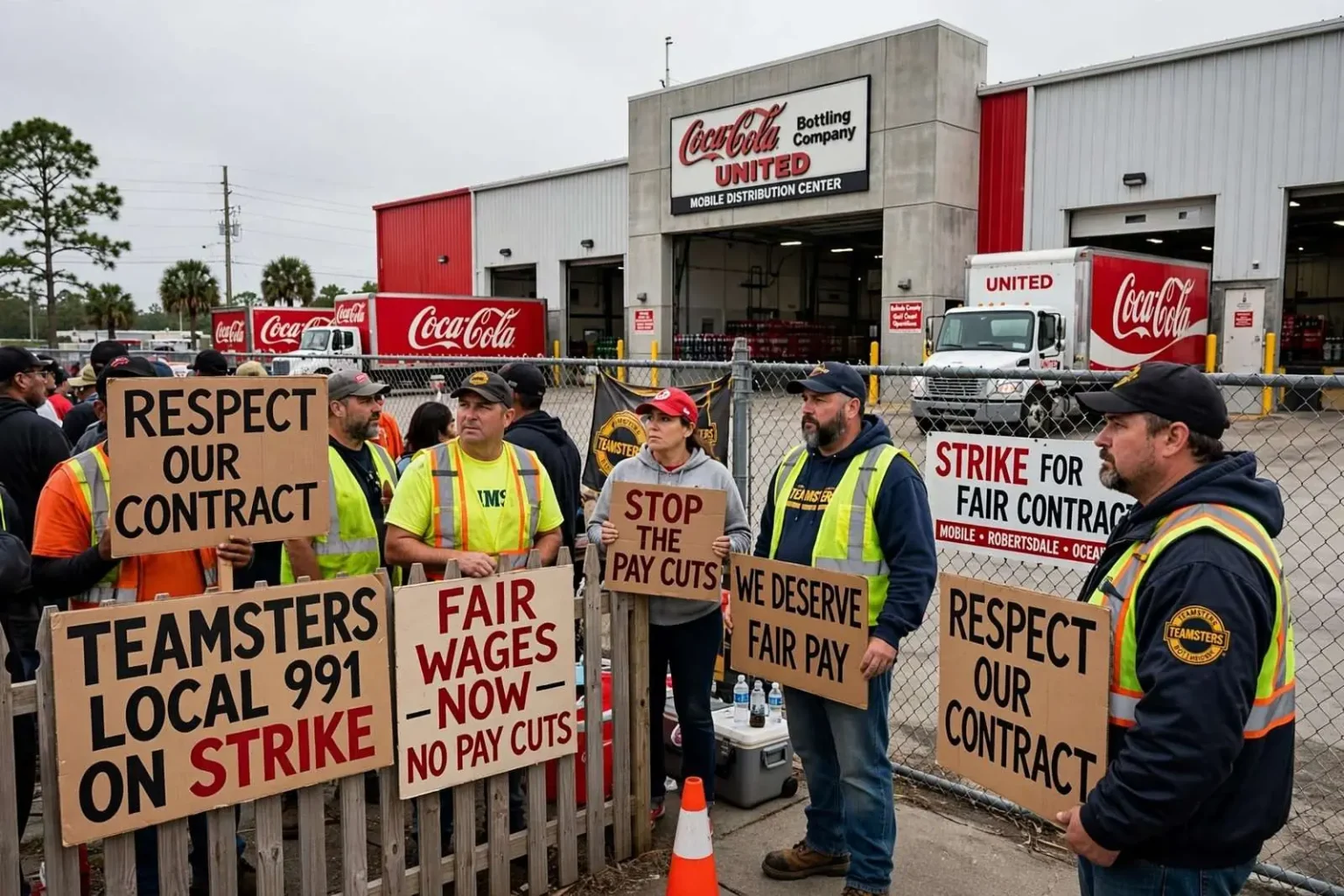
Coca-Cola Bottling Company UNITED says a strike called by Teamsters Local 991 is underway at its facilities, but that operations in Mobile, Leroy, Robertsdale, Alabama, and Ocean Springs, Mississippi, continue. The work stoppage, which followed weeks of contract negotiations, affects one of the Southeast’s major beverage bottlers — and it puts the daily delivery of Coca-Cola products across the Gulf Coast at the center of a labor dispute both sides say they would rather settle at the table.
The company’s position
In a statement, the company said that despite its good-faith effort to negotiate a new labor contract, union leaders unwilling to reach an agreement called a strike as of Aug. 9. Coca-Cola UNITED said it has activated a business continuity plan to ensure customers keep receiving product delivery and service. Continuity plans of that kind typically rely on management personnel, non-striking employees and redistributed routes to keep distribution running during a stoppage, and the company’s message to customers was designed to head off the disruption that a strike at a bottler can cause across stores, restaurants and vending operations throughout its territory.
Coca-Cola Bottling Company UNITED, headquartered in Birmingham, is one of the largest independently owned Coca-Cola bottlers in the United States, with operations across Alabama, the Florida Panhandle and the Mississippi Gulf Coast. Its Gulf Coast facilities — the Mobile plant, the Leroy operation in Washington County, the Robertsdale site in Baldwin County and the Ocean Springs facility across the state line — together cover the territory where the strike is underway, making the region the dispute’s focal point.
How the dispute developed
According to Jim Gookins, principal officer with Teamsters Local 991, an agreement with Coca-Cola expired on July 15 and the company presented a new proposal to the union. The timeline that followed compressed the dispute’s escalation into a few weeks: the union rejected the company’s opening offer, authorized a strike, accepted an extension to keep talking, and finally walked out when a second proposal also failed to win ratification.
The first offer was rejected by members on Saturday, July 14, with an authorization to strike. A strike authorization vote does not itself start a strike — it licenses union leadership to call one if negotiations fail — but it signals a membership prepared to withhold labor, and it changes the atmosphere at the bargaining table immediately.
The parties agreed to an extension through Aug. 5 and resumed negotiations through July 31, when the company presented another proposal. Extensions are common in contract disputes, buying time for further bargaining while keeping both sides bound to the existing terms and holding any work action in reserve. The talks that ran through the end of July produced the company’s second offer, which became the immediate trigger for the strike that followed.
On Saturday, Aug. 4, that proposal was also rejected, with another strike authorization. Five days later, on Aug. 9, the union’s leadership made good on the authorization and called members out — putting picket lines at the facilities whose operations the company insists are continuing.
What workers are striking over
The union president said earlier that employees are striking over wages, after a plant was bought out by another company that asked workers to take a pay cut. The wage issue sits at the center of the dispute: workers facing a request to accept lower pay from a new owner responded with the strongest tool the contract process gives them — the refusal to work until terms they can ratify are put on the table. Buyouts in the beverage industry have consolidated distribution territories across the South in recent years, and the transition periods that follow are exactly where wage disputes of this kind tend to erupt, as new owners seek cost savings and incumbent workers seek to protect compensation built over years of service.
Gookins confirmed the company and union will meet with a federal mediator Monday in an effort to reach an agreement. Federal mediation brings a neutral third party from the Federal Mediation and Conciliation Service into the bargaining process — a standard step in sustained labor disputes that neither side wants to abandon. A mediator has no power to impose terms; the role is to structure the conversation, translate positions, and search for the compromises neither side will propose directly to the other. The decision of both sides to accept mediation was the clearest sign yet that neither the company nor the union views the strike as a permanent state of affairs.
What a bottling strike means for the Gulf Coast
The strike’s geography matters to how it is felt. The affected facilities serve distinct pieces of the company’s Gulf Coast territory: Mobile, the largest, covers the central Gulf Coast market; Leroy serves the western stretches of the territory; Robertsdale handles Baldwin County and the communities along the bay; Ocean Springs extends coverage into coastal Mississippi. A stoppage that touches all four at once means the dispute’s effects — whatever they prove to be — are distributed across the whole region rather than concentrated in one city.
For the company’s customers — the grocery stores, convenience stores, restaurants and vending operators that depend on daily or weekly deliveries — a strike raises the practical question of continuity. The company’s business continuity plan is its public answer to that question, and the early days of a strike are typically when both sides test their leverage: the company against the cost of running routes with substitute labor, the union against the company’s ability to sustain service without its regular workforce.
For the workers, a strike is a calculated risk. Teamsters members at a bottler earn wages built over successive contracts, and a strike puts that income on hold while committing the membership to a dispute whose outcome no one controls. The two rejected offers — and the two strike authorizations that accompanied them — show a membership that judged the company’s terms not worth accepting even at the cost of a walkout, which is the position union negotiators carry into Monday’s mediation session: a ratified contract is the only way back to work, and the membership has twice said the terms offered do not qualify.
The Teamsters’ stake in the region
Teamsters Local 991 represents workers across the Gulf Coast’s transportation and logistics economy, and bottling employees are among the union’s traditional strongholds. Beverage delivery is physically demanding work — drivers and warehouse workers move heavy product on tight schedules, six days a week in many operations — and the contracts that govern it reflect decades of organization. A wage cut request, in that context, is not read by members as a routine bargaining position but as a reversal of what previous generations of the same workforce negotiated, which is why the response to the company’s proposals was rejection rather than grudging acceptance.
The union’s timeline of the dispute also tells the story of a membership moving deliberately. The first rejection came with a strike authorization, but the local agreed to extend negotiations through Aug. 5 and bargained through the end of July before rejecting the second offer — a sequence that shows leadership testing every avenue short of a walkout before making the call on Aug. 9. Strikes are never the first choice of a local union; they are the last tool left when the proposals on the table cannot be sold to the people who would have to work under them.
Mediation and the road to settlement
Monday’s mediation session is the dispute’s next milestone, and both sides framed it as genuine rather than ceremonial. The company says operations continue and customers will keep receiving product; the union says its members struck over wages they consider non-negotiable. What a settlement looks like between those positions — whether the company moves on pay, whether the union accepts a phased approach, or whether the mediator finds a structure neither side has proposed — is precisely what the session exists to discover.
Labor disputes at regional bottlers tend to resolve through exactly this kind of process. Neither a bottler nor its union benefits from a prolonged stoppage: the company risks customers and market share, the workers risk income and, ultimately, the confidence of the members who must ratify whatever agreement is reached. The two failed proposals already on the record give the mediator a concrete starting point — two sets of terms the membership has judged insufficient — and the Monday session will test whether a third version can bridge the gap the first two could not.
Until then, the picket lines stand at facilities in Mobile, Leroy, Robertsdale and Ocean Springs, the company runs its continuity plan, and Gulf Coast customers watch the deliveries arrive on schedule or not. The dispute’s dates — an agreement that expired July 15, rejections on July 14 and Aug. 4, an extension that lapsed Aug. 5, and a strike called Aug. 9 — mark the stages of a negotiation that has so far produced more documentation than agreement. Whether the federal mediator’s session on Monday changes that record is the question both sides, and the region’s stores and restaurants, are now waiting to have answered.