Baldwin County Sheriff’s Office to Run Safety Checkpoints Across the County This Month
The Baldwin County Sheriff's Office says deputies will run safety checkpoints countywide this month to promote safe roads and deter impaired driving.
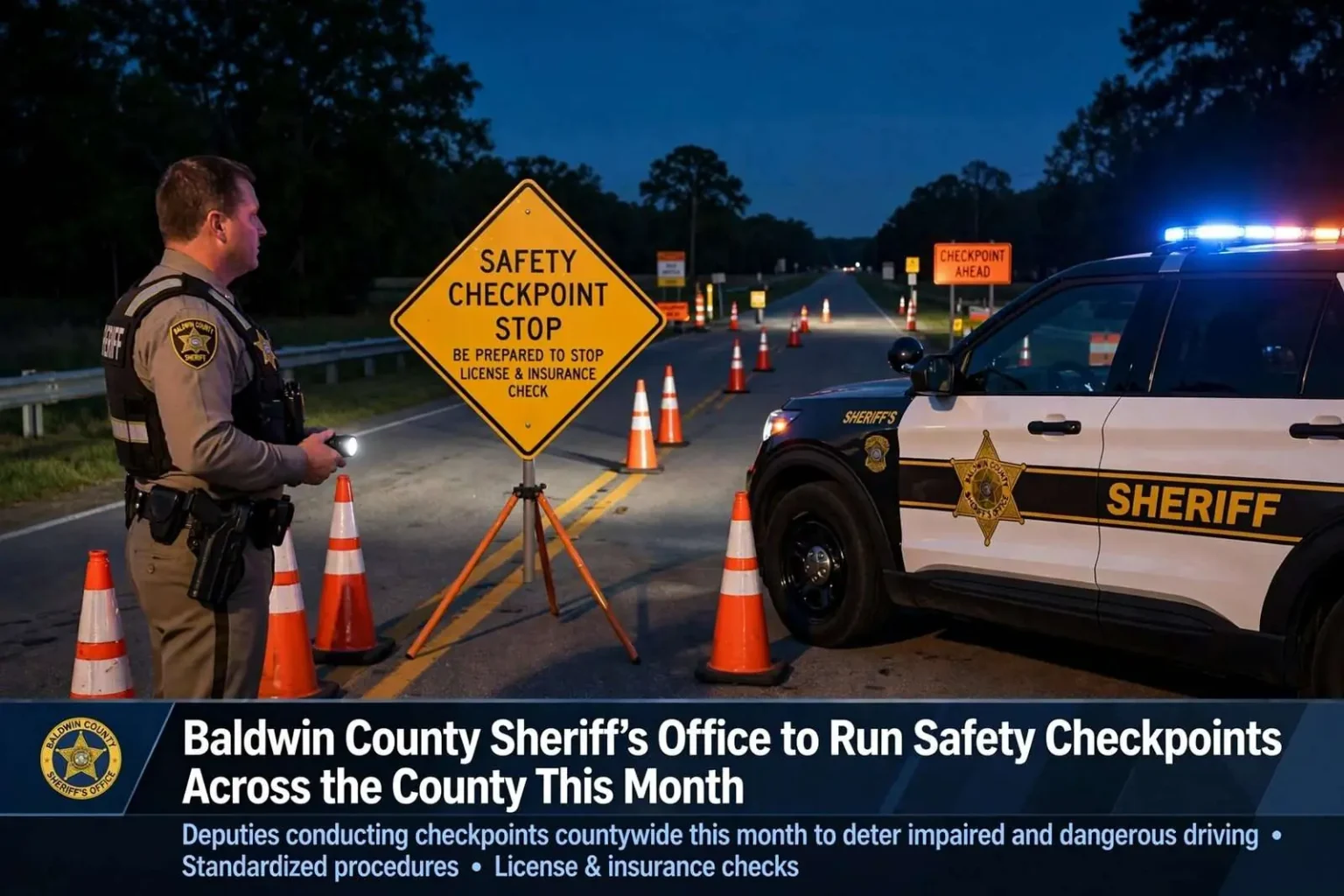
The Baldwin County Sheriff’s Office says deputies will be conducting safety checkpoints at various locations across the county throughout the month, a familiar presence on Baldwin’s roads as the agency works to deter impaired and dangerous driving. In a post on its Facebook page, the sheriff’s office said the checkpoints will follow standardized procedures under applicable law to ensure consistency and fairness for every driver who passes through them.
“The goal is simple: promote safe roads, deter impaired driving, and help keep our community safe,” the office said in announcing the effort. Deputies are asking residents for their cooperation and patience if they encounter a checkpoint while driving through the county this month, noting that brief stops are the price of a program aimed at keeping impaired drivers off the road.
How Safety Checkpoints Work
A safety checkpoint is a predetermined stop location where deputies briefly evaluate every vehicle, or vehicles selected by a neutral formula, for signs of impairment and violations such as expired licenses, suspended registrations, or missing insurance. Because the selection of the site and the procedures are set in advance — and applied uniformly — checkpoints are treated differently under the law from random stops, which are not permitted. Courts have upheld properly conducted checkpoints as constitutional, while requiring that agencies minimize the intrusion on drivers and follow their announced plan exactly.
That legal framework is what the sheriff’s office was pointing to when it emphasized standardized procedures under applicable law. Deputies working a checkpoint typically operate under a written operational plan approved in advance, with supervisory oversight, clearly marked signs and cones, and a process for moving vehicles through quickly. Most stops last a matter of seconds: a deputy checks a driver’s license and insurance, looks for obvious signs of intoxication, and waves the vehicle onward. Drivers who show indicators of impairment, or whose documents raise issues, are moved to a secondary area for a closer look.
Why Baldwin County Runs Them
Baldwin County’s geography makes checkpoint enforcement a practical tool. The county is the largest in Alabama by land area, stretching from the Mobile Bay shore to the Florida line, and its roads carry a mix of commuter traffic, agricultural vehicles, and heavy tourist volume — particularly along the Highway 98, Highway 181, and Interstate 10 corridors that link the Eastern Shore, Fairhope, Daphne, Foley, and the beach communities. Weekend nights during tourist season and holiday periods are peak times for impaired driving, and visible enforcement on those corridors is intended to change behavior before crashes occur.
Law enforcement agencies across the country credit saturation patrols and checkpoints with measurable reductions in alcohol-related fatalities, and Alabama has participated in national mobilizations such as “Drive Sober or Get Pulled Over” for years. The deterrent effect is the point: a driver who knows checkpoints are running this month thinks twice before getting behind the wheel after drinking, whether or not they ever actually pass through one.
What Deputies Look For
At a checkpoint, deputies are trained to spot a specific set of indicators: the smell of alcohol, slurred speech, bloodshot eyes, open containers in the vehicle, and fumbled document exchanges. They also verify licenses and insurance, which means checkpoints routinely catch other violations — suspended licenses, uninsured vehicles, outstanding warrants — that surface when drivers otherwise might not have been stopped at all. Deputies can also share boating safety materials and answer questions, since Baldwin County’s waterways and its roads alike see heavy recreational traffic.
For drivers, the encounter is straightforward if you know what to expect. Have your driver’s license, proof of insurance, and registration accessible before you reach the checkpoint. Roll down your window, answer questions briefly and politely, and follow the directions of the deputies directing traffic. If you have consumed alcohol, the safest course is not to drive at all — a checkpoint is only ever a problem for the driver who is impaired or unlicensed.
Impaired Driving in Alabama
Alabama’s driving-under-the-influence law applies to drivers with a blood alcohol concentration of 0.08 percent or higher, and to drivers under 21 at 0.02 percent, reflecting zero-tolerance principles for young drivers. A first DUI conviction carries fines, possible jail time, license suspension, and mandatory substance abuse evaluation and treatment, with penalties escalating sharply for repeat offenses. Refusing a chemical test triggers license consequences of its own under the state’s implied consent law.
The human stakes are what agencies emphasize when they announce enforcement campaigns. Impaired driving crashes remain a persistent cause of deaths on Alabama roads, and rural and suburban counties like Baldwin see their share of the tragedies — head-on collisions on two-lane highways, run-off-road crashes at night, and motorcycle and pedestrian fatalities concentrated in evening hours. Every impaired driver diverted by deterrence, or arrested at a checkpoint, is a potential crash prevented.
The Sheriff’s Office and the Community It Serves
The Baldwin County Sheriff’s Office is one of the larger county law enforcement agencies in Alabama, providing patrol, investigations, corrections, and school resource services across a county that has been among the fastest-growing in the state for two decades. That growth — from the Eastern Shore suburbs to the resort communities along the coast — has multiplied traffic volumes on roads built for a much smaller population, and the agency’s enforcement posture has evolved with it. Safety checkpoints, publicized on the office’s Facebook page, have become a regular feature of its public communication, alongside notices about scams, storm preparedness, and missing persons.
The office’s emphasis on fairness and standardized procedures also reflects how checkpoints are perceived. Some drivers find them an inconvenience or an intrusion, and courts have required agencies to walk a careful line. By announcing the checkpoints in advance, stating their purpose plainly, and committing to uniform procedures, the sheriff’s office is following the practices that both the law and public expectations demand of a program that touches hundreds of law-abiding drivers to reach the few who are impaired.
A Month of Safer Roads
For residents, the practical message for the month is simple: expect to see deputies at checkpoint locations at various times and places around the county, plan a few extra minutes if your route takes you through one, and make arrangements — a designated driver, a rideshare, or simply staying put — if alcohol is part of your evening. The sheriff’s office asked for cooperation and patience, and the brief delay at each stop is the mechanism by which the program does its work.
Checkpoints also serve as reminders of what local agencies can and cannot do. They cannot stop and search drivers without legal cause, and they do not replace the ordinary patrols, traffic stops, and crash investigations that fill deputies’ shifts the rest of the month. What they add is a visible, predictable demonstration that Baldwin County takes impaired driving seriously — a message aimed at every driver who considers getting behind the door after drinking, on every road in the county, throughout the month the checkpoints run. Deputies said the office will continue to share information about the program through its Facebook page, where residents can follow updates as the month progresses.
Planning Your Route Around Checkpoints
Residents who commute through Baldwin County during the checkpoint month can take a few steps to make any encounter uneventful. Keeping current registration, insurance, and a valid license in the vehicle removes the most common secondary complications. Drivers should also be mindful that checkpoints tend to appear on known impaired-driving corridors during evening and overnight hours, so the drivers most likely to encounter them are those out late — exactly the population the program is trying to reach.
Motorists who witness dangerous driving in Baldwin County can report it to the sheriff’s office, and deputies encourage the public to treat an impaired driver on the road as an emergency worth a phone call. A vehicle weaving across lanes, braking erratically, or running signals is a hazard that dispatchers can relay to patrol units immediately, and such citizen reports have preceded many impaired-driving arrests across the county over the years.
The checkpoint program, like the office’s other public safety campaigns, depends on that partnership between deputies and residents. The agency announced the effort through the same Facebook page where it shares county-wide safety information, and the response from residents in past campaigns has included both thanks for the deterrence and questions about locations and timing. For its part, the office has kept its message consistent: follow the law, buckle up, slow down, and don’t drive impaired — and if you come upon a checkpoint this month, roll down your window, have your documents ready, and know that the deputy at your window is there for the same reason you are on the road: to get everyone home safely.