Newly Appointed Baldwin County Judge to Seek Election in 2016
Newly appointed Baldwin County District Judge J. Clark Stankoski announced he will run for election to the seat in the March 2016 primary vote.
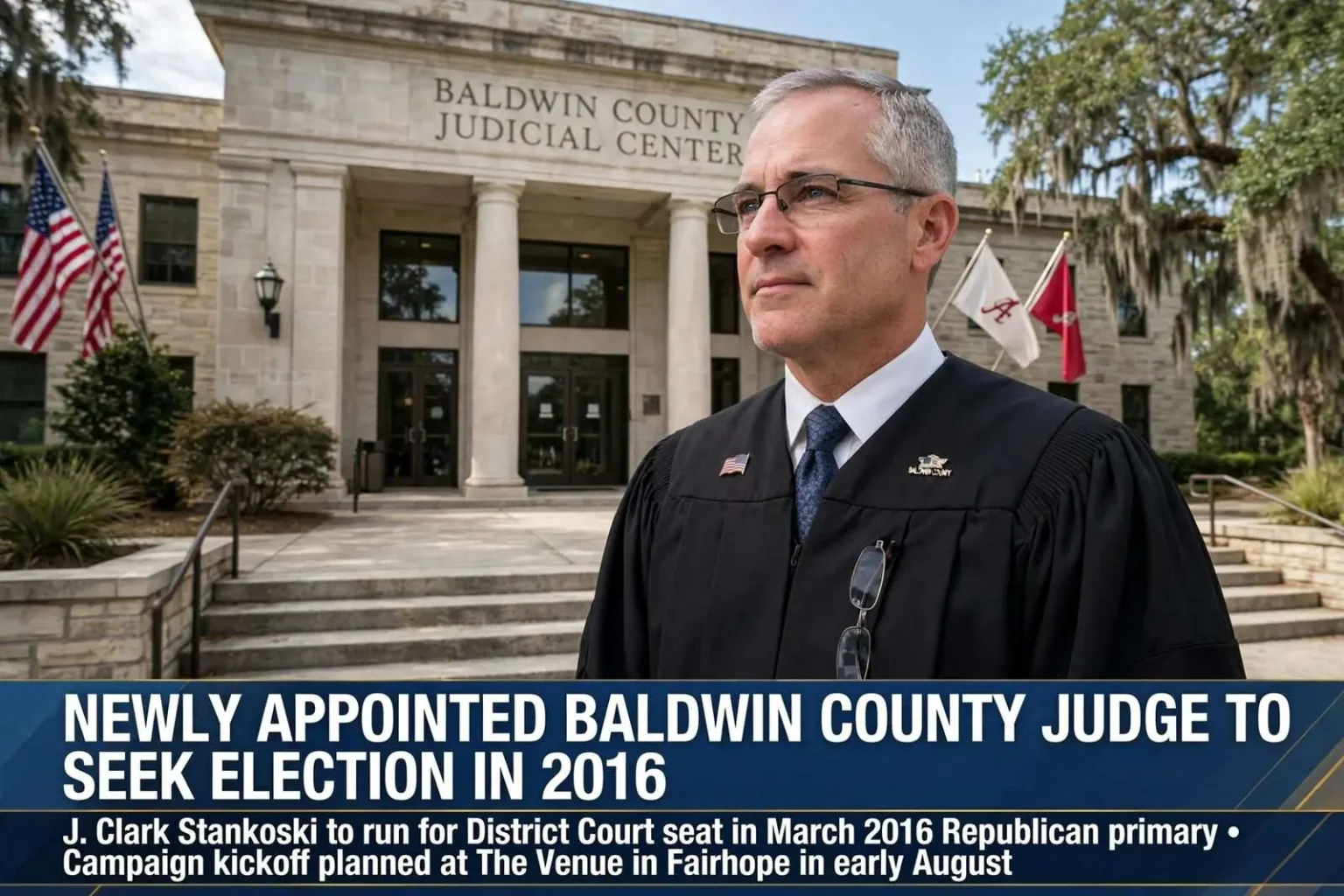
A newly appointed Baldwin County District Court judge is already looking ahead to next year’s ballot, announcing plans to seek election to the seat he was recently appointed to fill. J. Clark Stankoski, appointed to the District Court judgeship on July 10, said he will seek the Republican Party nomination during the March 2016 primary. The announcement signals that the judicial reshuffling that has reshaped Baldwin County’s courts this year will now continue at the ballot box, where voters will have the final say on who holds the county-level judgeship going forward.
Stankoski plans to formally kick off his campaign with a public appearance at The Venue in Fairhope in early August. The venue, a popular gathering spot in the heart of one of Baldwin County’s most engaged communities, gives the newly minted judge a chance to meet supporters face to face in the same eastern shore city where he built much of his legal career. “Spending my professional legal career here, I am excited about the opportunity to seek election for the county seat,” Stankoski said in announcing his candidacy. “My legal background has given me the experience needed to handle the diverse issues that fall within the jurisdiction of this court and as your next District Judge.”
A Seat in Motion: Baldwin County’s Judicial Reshuffling
Stankoski replaced Scott Taylor, who moved up to a Circuit Court appointment, continuing a pattern of judicial reshuffling that has played out across Baldwin County’s court system throughout the year. In Alabama, when a judgeship becomes vacant between elections, the governor appoints a replacement to serve until the next scheduled election. That appointed judge must then decide whether to stand for the seat in the following election cycle, a step that Stankoski has now made clear he intends to take. The chain of moves began when a Circuit Court seat opened and Taylor, then serving on the district bench, was elevated, creating the District Court vacancy that Stankoski filled in July.
The District Court that Stankoski now serves is one of the busiest trial courts on the Alabama Gulf Coast. Headquartered at the Baldwin County Judicial Center in Bay Minette, the county’s district bench handles misdemeanor criminal prosecutions, traffic cases, small claims disputes, preliminary hearings in felony matters, and a steady docket of civil cases from communities stretching from Daphne and Fairhope to Foley, Gulf Shores, and Bay Minette itself. Because Baldwin County is among the fastest-growing counties in the state, the court’s caseload has expanded alongside the population, making the qualifications of the person on the bench a matter of practical concern for residents across the county.
A Career Rooted in Baldwin County
Before his appointment, Stankoski was a senior partner at a Fairhope law firm and previously served as a Baldwin County Assistant District Attorney. His years in private practice on the eastern shore placed him inside the same communities his courtroom now serves, while his time as a prosecutor gave him firsthand experience with the criminal side of the district court’s docket. That combination of civil and criminal work is unusual in its breadth, and it formed the core of the case county officials cited when they selected him for the appointment over the summer.
During his time with the District Attorney’s office, he specialized in criminal defense and civil litigation, prosecuting hundreds of misdemeanor cases ranging from theft to domestic violence. Misdemeanor prosecution is the daily bread of the District Court, covering offenses that carry sentences of a year or less and touching nearly every corner of county life, from shoplifting and property crimes to domestic disputes that require judges to balance safety, accountability, and due process. Stankoski’s hundreds of prosecuted cases gave him a working familiarity with the deputies, officers, defense attorneys, and victims’ advocates who move through the Baldwin County justice system each week.
Notably, while serving as an Assistant District Attorney, Stankoski helped start Baldwin County’s first White Collar Prosecution Unit, a specialized effort focused on financial crimes that had not previously been handled by a dedicated unit in the county. Financial crimes such as forgery, fraud, embezzlement, and identity theft often require prosecutors to trace documents, financial records, and electronic evidence in ways that ordinary street-crime cases do not, and the creation of a dedicated unit reflected a growing recognition that Baldwin County’s expanding population and business community needed that capability. Stankoski’s role in standing up the unit gave him experience with some of the most complex criminal matters that reach the county’s courts.
His broader legal background spans juvenile law, domestic relations, real estate, tort law, adoption cases, municipal planning and zoning, and contract law. That range matters in a District Court setting, where judges routinely encounter families in crisis, disputes over property and contracts, and matters involving children. Juvenile and domestic relations dockets in particular require a judicial temperament that differs from the detached efficiency expected in a traffic docket, and attorneys who have practiced in those areas bring an understanding of the human stakes involved. In a county where land development, coastal real estate, and municipal growth issues surface constantly, a judge with zoning and real estate experience has seen the kinds of disputes that often land in Baldwin County courtrooms.
Service Beyond the District Bench
Stankoski has also held several local judicial and legal roles beyond the district bench, including serving as attorney for the town of Silverhill and as municipal judge in Summerdale. Both are small south Baldwin County communities, and the work involved in each role is a reminder of how interlocking local government is across the county. A municipal judge presides over traffic citations, ordinance violations, and minor offenses within city limits, while a town attorney advises council members on the open meetings law, contracting, zoning questions, and the day-to-day legal questions that arise in small-town administration. Holding both positions means Stankoski has sat on the judicial side of the bench and counseled elected officials from the other side of it.
He is also a licensed mediator and arbitrator, credentials that county officials say made him a strong fit for the District Court appointment. Mediation and arbitration experience tends to matter in small claims and civil dockets, where a judge who understands settlement dynamics can help parties resolve disputes without the cost of a full trial. In a fast-growing county like Baldwin, where docket pressure is a persistent concern, that skill set translates into practical benefits for the litigants, attorneys, and deputies whose time is consumed by crowded court calendars.
The Road to the 2016 Ballot
By seeking the Republican nomination in the March 2016 primary, Stankoski is following the path every appointed Alabama judge must travel to keep a seat long term. In a county where Republican primaries effectively decide most countywide offices, the March contest is the decisive hurdle, and qualifying through the county party is the first formal step of a campaign that will stretch through the winter. The nominee would then advance to the November general election, where the seat would appear before the county’s full electorate.
The early August campaign kickoff at The Venue in Fairhope is designed to build momentum among the eastern shore’s politically active residents before the summer ends. Fairhope, with its engaged civic culture and its history of spirited local politics, is a natural stage for a candidate whose career is anchored there, and the event gives Stankoski an opportunity to introduce himself to voters who may know his name from the appointment but not the story behind it.
For Stankoski, the argument he will carry through the campaign is essentially the one he made at the announcement: that a legal career spent in Baldwin County, across prosecution, private practice, municipal service, and mediation, has prepared him for the diverse mix of cases that flow through the District Court. “My legal background has given me the experience needed to handle the diverse issues that fall within the jurisdiction of this court,” he said, framing his record as the central qualification for a bench that touches more daily lives than almost any other county office.
The timing of his appointment also matters. Taking the bench in July gave him several months on the job before qualifying and the primary season begin in earnest, a period during which he has been able to move from arguing cases to presiding over them. Judges appointed to fill vacancies often describe that stretch as a steep learning curve, and voters in Baldwin County will be watching how the newest member of the district bench handles the transition from advocate to arbiter.
Baldwin County’s growth ensures that the District Court will not lack for work regardless of who holds the seat. New subdivisions along the U.S. 98 and Alabama 181 corridors, expanding municipalities, and a steady influx of new residents all feed the misdemeanor, traffic, small claims, and domestic dockets that define the court’s calendar. County leaders have repeatedly pointed to judicial capacity as a pressure point that comes with growth, which is one reason the selection of judges tends to draw close attention from bar members and civic groups alike.
Stankoski’s path from the District Attorney’s office to a Fairhope law partnership to the district bench traces the kind of local legal career that Baldwin County’s courts were built on. Whether that record persuades Republican primary voters in March 2016 will determine whether his appointment becomes a long tenure. For now, the newly appointed judge has made his intentions plain: he wants the seat he holds, and he plans to spend the months between now and the primary asking the voters of Baldwin County to keep him in it.