Investigation Continues After Officer-Involved Shooting on Fisher Street
A man remained hospitalized after Mobile officers shot him during a confrontation on Fisher Street, the department's third such shooting since January.
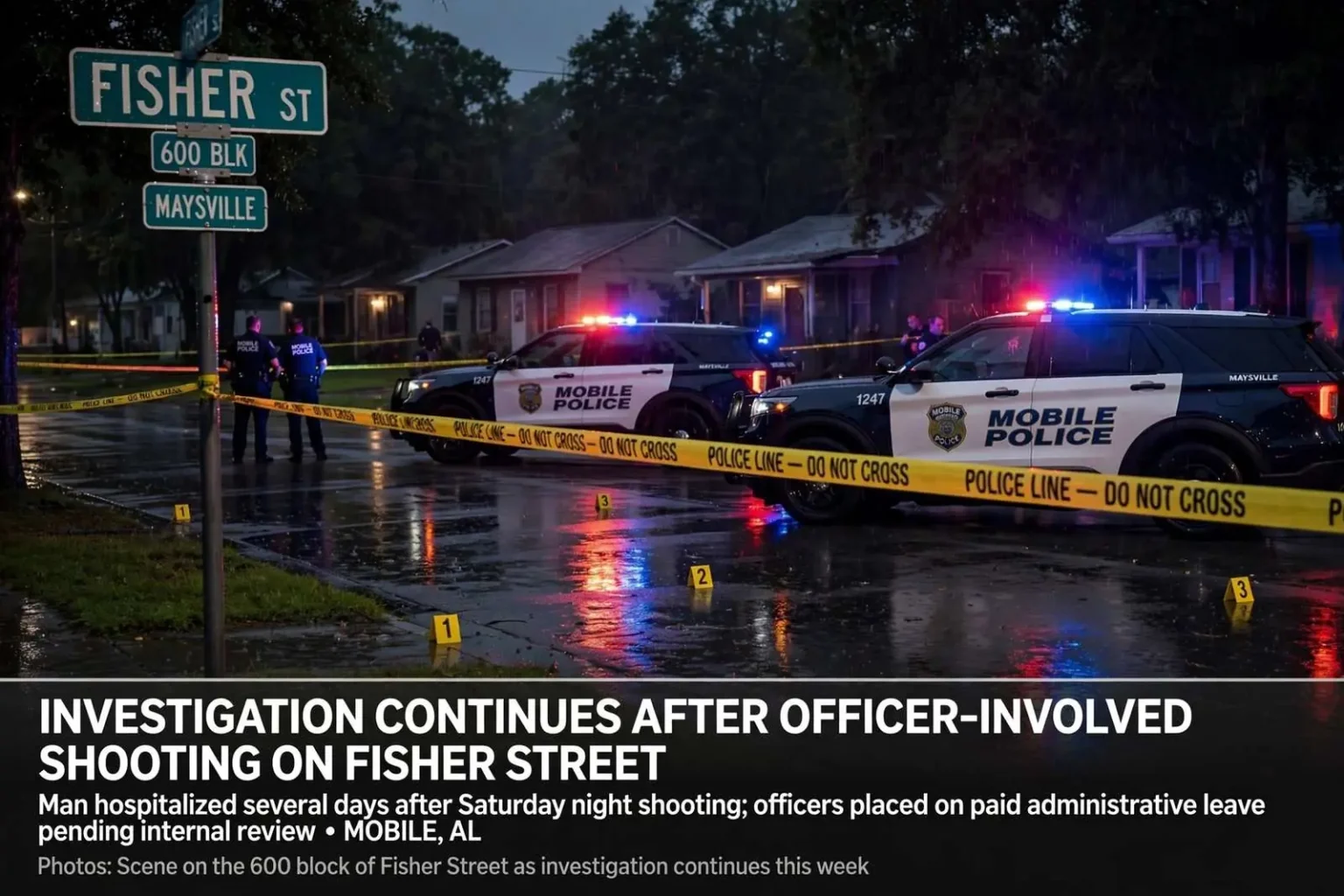
A man injured during an officer-involved shooting in Mobile remained hospitalized several days after the incident, as police continue an internal review of the officers’ actions. The shooting happened late on a Saturday night on the 600 block of Fisher Street, in the city’s Maysville area east of Government Street, when two Mobile police officers on an unrelated call encountered a man holding a gun.
According to the Mobile Police Department, the two officers were responding to an unrelated call when they came across the man, who authorities say turned toward them while holding a gun in his hand. Officers opened fire, striking him in the arm. He was taken to a hospital, where he remained days later, according to police. Investigators have not said whether the man was armed with anything beyond the handgun he was seen holding, nor have they released his name or condition beyond confirming he survived.
Officers placed on leave
A department spokesman said the two responding officers were not publicly identified and declined to say how long either had served with the department. Consistent with standard department procedure following any officer-involved shooting, both officers were placed on paid administrative leave pending the outcome of an internal investigation.
Paid leave after a shooting is not a disciplinary measure, police officials have explained in past cases, but a standard cooling-off and safety period that allows investigators to interview the officers, collect evidence and reconstruct the scene without the pressure of an active patrol schedule. The officers remain employees of the department throughout the process, and their status can change depending on what the review finds.
The internal review
An internal review board was expected to convene within 72 hours of the shooting to examine the evidence gathered and determine whether the officers’ use of force was within department policy. The board typically hears from investigators who worked the scene, reviews body camera and surveillance footage when available, and considers whether the encounter followed the department’s use-of-force continuum.
If investigators find no wrongdoing, the officers would be cleared to return to regular duty. If the board finds policy violations, the matter can move into the department’s disciplinary process, and in cases where criminal questions arise, findings can be referred to the Mobile County District Attorney’s Office for an independent review of whether the shooting was legally justified.
Third shooting this year
The Fisher Street incident marked at least the third officer-involved shooting for the Mobile Police Department since the start of the year. In April, an internal investigation was opened after an off-duty officer shot her estranged ex-boyfriend during an alleged home invasion attempt. In May, officers opened fire on a man accused of breaking into a stranger’s home and firing at them with a stolen weapon.
Police have not said whether either of those earlier cases has been formally resolved. The pattern reflects a reality that departments across the Gulf Coast have grappled with in recent years: each shooting triggers scrutiny not just of the officers involved but of the training, supervision and circumstances that put them in that position.
How Alabama departments handle officer-involved shootings
Officer-involved shootings routinely trigger internal reviews across Alabama law enforcement agencies, a process intended to determine both whether officers followed department policy and whether any additional training or protocol changes may be warranted. In larger departments like Mobile’s, the review typically runs on two parallel tracks: an administrative investigation focused on policy and an evidence review that feeds the district attorney’s justification determination.
The Alabama State Bureau of Investigation has historically been available to assist local agencies with shooting scene work, and some departments invite outside agencies to handle the criminal-side investigation entirely to avoid the appearance of bias. Mobile police have generally conducted their own internal reviews while the district attorney’s office independently examines whether the use of deadly force was lawful under state standards.
The Fisher Street neighborhood
The 600 block of Fisher Street sits in a residential section of Mobile where Saturday-night calls for service are common, ranging from noise complaints to welfare checks. Officers responding to one call frequently encounter separate situations along the way, and those unplanned encounters — like the one described in this case — can escalate in seconds when a weapon is visible.
Residents of the area reported a heavy police presence in the hours after the shooting, with investigators canvassing for witnesses and marking evidence near the scene. Police did not say whether any residents were inside nearby homes when the gunfire occurred, and no injuries to bystanders were reported.
What happens next
For the wounded man, the hospital stay that stretched past several days suggests his injuries required more than emergency treatment, though police have not detailed his prognosis. Once he is able, investigators will interview him about where he obtained the gun, why he was on Fisher Street and what he was doing in the moments before the shooting. Any charges stemming from the encounter — such as weapons offenses — would be separate from the review of the officers’ conduct.
The internal review board’s findings are typically announced internally rather than in a public report, though the department has faced steady calls in recent years to share more detail with the community after shootings. Mobile police did not release additional details about the case as the investigation continued, and no timeline has been given for when the review board’s determination might be complete.
The legal standard for deadly force
The review board’s task will center on a standard familiar to departments nationwide: officers may use deadly force when they reasonably believe they face an imminent threat of death or serious physical injury. The moment described by police — a man turning toward officers while holding a gun — is the kind of split-second decision the standard is built to evaluate, weighing what the officers knew at the time rather than what investigators learned afterward.
Body camera footage has become central to these reviews in Mobile, as it has in departments across Alabama, and the presence or absence of a recording often shapes how quickly a case moves. The department has expanded its camera inventory in recent years, and footage from the responding officers’ units would be among the first pieces of evidence the board examines.
Community context in Mobile
Mobile’s police department has worked in recent years to balance enforcement demands with community trust efforts, and each officer-involved shooting tests that balance. Community groups have periodically called for faster public disclosure of basic facts — how many rounds were fired, whether a weapon was recovered, whether cameras captured the encounter — while police counter that releasing details mid-investigation can compromise interviews and evidence.
The three shootings since January also land in a period when the department has emphasized recruiting and retention, both of which affect how much training time officers receive before facing the streets. Nationally, research on officer-involved shootings has found that the circumstances of an encounter — darkness, the presence of a firearm, calls involving weapons reports — drive outcomes far more than department-to-department differences in policy.
Waiting on answers
For now, the facts established publicly are limited: two officers on an unrelated call, a man with a gun who turned toward them, a gunshot wound to his arm and a hospitalization that has continued for days. The review board’s 72-hour convening deadline means an initial look at the evidence will come quickly, even if the full investigation stretches longer.
The wounded man’s identity has not been released, and it remains unclear whether he will face charges connected to the encounter. What is clear is that the Fisher Street shooting will be added to the record of a department that has now responded to at least three officer-involved shootings this year, each following the same established path: scene investigation, administrative leave, review board and a determination that decides whether the officers return to duty or face discipline.
After the review ends
Once the review board reaches its determination, several paths open. A full clearance returns both officers to their regular assignments, often after a brief re-familiarization period at the range and with patrol procedures. A finding of policy violations can bring consequences ranging from retraining and written reprimands to suspension or termination, depending on severity. And if any evidence suggests criminal conduct by the officers, the matter leaves the department’s hands entirely and goes to prosecutors for a charging decision.
In the months after any shooting, the department also reviews the tactical details for lessons: whether the call the officers were responding to was dispatched properly, whether backup was positioned as trained, and whether the encounter suggests changes to how similar calls are handled in the future. Those operational conclusions rarely become public, but they shape patrol procedures across the city’s precincts.
For residents of the Fisher Street neighborhood, the investigation’s most visible markers — the tape, the evidence markers, the unmarked cars — will be gone within days. What remains is a department process that will take weeks or months to answer the questions the shooting raised, in a city that has been through this sequence several times already this year.