Baldwin Commission Candidate Convicted of Domestic Violence, Appeals Verdict
Daniel Dyas, a candidate for the Baldwin County Commission, was convicted in Fairhope Municipal Court and sentenced to 15 days in jail. He appealed to circuit court days before the primary.
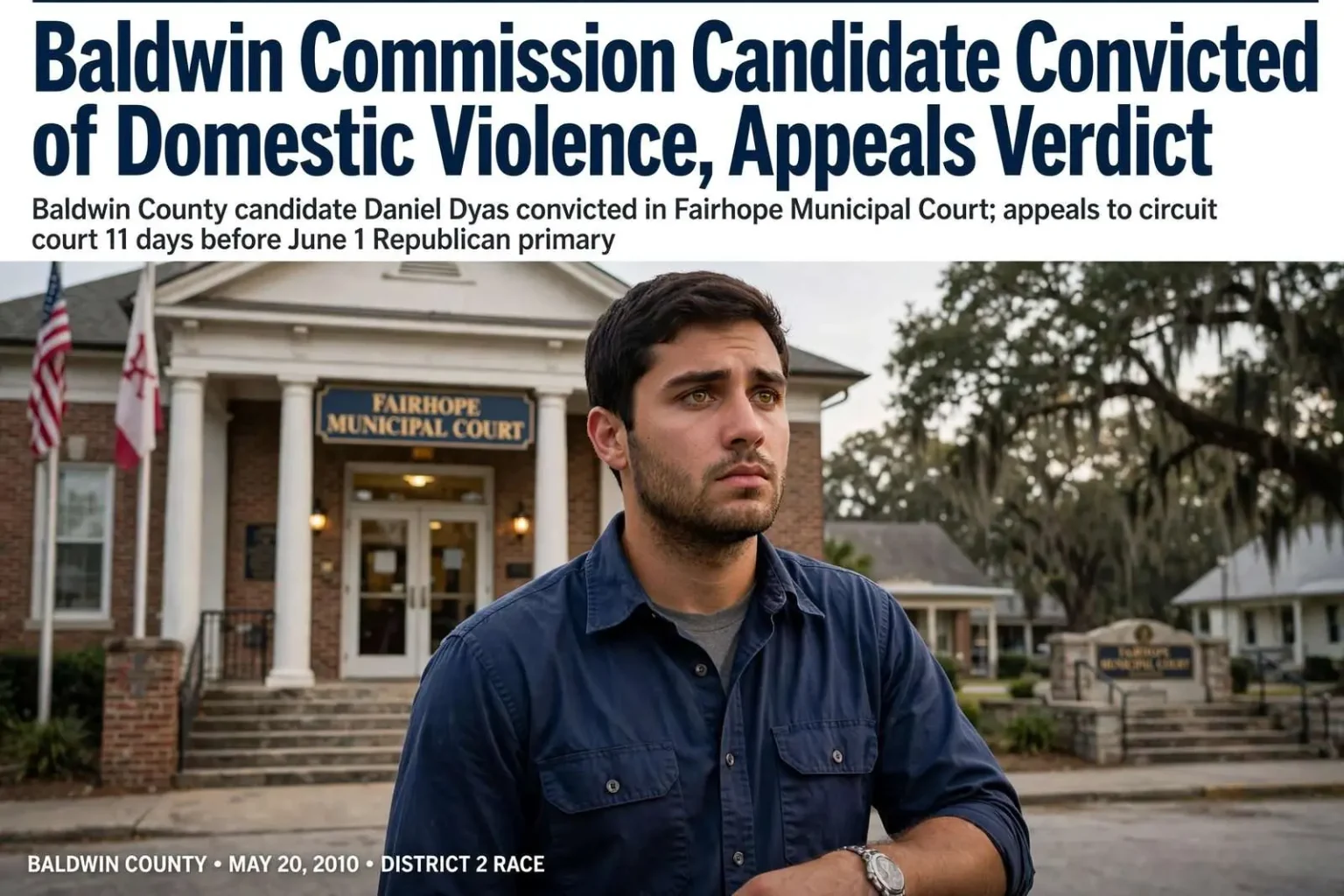
Baldwin County Commission candidate Daniel Dyas was convicted of domestic violence in Fairhope Municipal Court on Wednesday night and sentenced to 15 days in jail. He immediately appealed the case to Baldwin County Circuit Court, a procedural step that left his political standing formally unresolved with the primary election barely a week and a half away.
The conviction landed 11 days before the June 1 Republican primary in which Dyas was seeking the District 2 seat on the Baldwin County Commission, throwing a fresh controversy into the closing stretch of a campaign that had already drawn crowded fields and unusually active candidate forums across the Eastern Shore.
The case
Dyas, a 28-year-old general contractor, was charged with third-degree domestic violence, a misdemeanor, on a complaint brought by his wife three months earlier. Third-degree domestic violence under Alabama law covers a range of alleged assaults or threats against a person with whom the defendant has or had a household or family relationship, and it is the most frequently charged tier of the state’s domestic violence statutes.
He was represented by defense attorney Richard Horne. After local court officials recused themselves, special Judge John Gamble presided over the matter, which was prosecuted by Parker Sweet. The recusals — a not-uncommon step in a small municipal court when the defendant is a familiar local figure — brought in an outside judge to hear the case and underscored the delicacy of proceeding with a sitting candidate as the accused.
Horne said he expected a different outcome on appeal. “I promise you if we try it to a jury we will get a not guilty verdict,” he said after the municipal court verdict, signaling that his client’s defense strategy would center on putting the case before a Baldwin County jury rather than leaving the bench verdict in place.
How an appeal works
In Alabama, a defendant convicted in a municipal court may appeal to circuit court for a trial de novo, meaning the case is heard again from the beginning, this time with the right to a jury. The municipal conviction does not become final while such an appeal is pending. In practical terms, the circuit court treats the earlier trial as if it had never happened, and the prosecution must prove its case again from scratch.
That procedural posture left Dyas convicted but not finally adjudicated as voters prepared to go to the polls. A trial de novo can take months to reach a circuit court docket, meaning the primary — and possibly the general election — could pass before the appeal is resolved, with the candidate’s legal status frozen in the meantime.
The timing also shapes the political calculus. A pending appeal gives the campaign its preferred framing — a conviction under review, with a jury trial to come — while opponents can point to the 15-day sentence and the municipal judge’s finding. Voters, in the end, will weigh both arguments without the benefit of the final legal answer.
The race
Dyas was running in the Republican primary against incumbent Commissioner David Ed Bishop and challenger Bob James for the District 2 seat. The Baldwin County Commission oversees roads, drainage, planning and the county budget in one of the fastest-growing counties in Alabama, and the 2010 cycle had drawn unusually crowded fields for county office.
The growth pressures that define Baldwin County politics were central to the District 2 contest. The Eastern Shore communities the district covers have absorbed years of rapid residential development, and the commission’s decisions about road capacity, drainage and subdivision planning carry direct consequences for property owners across the district. Campaigns for the seat have traditionally turned on candidates’ handling of growth — who builds, where, and who pays for the infrastructure that follows.
In the weeks before the conviction, Dyas had appeared alongside his opponents at candidate forums across the Eastern Shore, including a Baldwin County Young Republicans rally at the Fairhope Pier and a scheduled Eastern Shore Republican Women luncheon at the Fairhope Yacht Club. Those venues trace the geography of Eastern Shore Republican politics, from the waterfront crowds at Fairhope’s signature park to the party’s organizational backbone in the women’s clubs that anchor candidate season.
Forums of that kind give challengers the visibility that fundraising alone cannot buy, and Dyas had been using them to build name recognition against an incumbent. Bishop, as the sitting commissioner, entered the race with a record to defend; James and Dyas were competing to position themselves as alternatives. The verdict, arriving in the final days, upended the dynamics that the forums had been building.
An unusual campaign season
The Dyas verdict added to a spring in which Baldwin County races had already produced more than the usual share of drama. Crowded primary fields mean crowded candidate forums, and crowded forums mean more opportunities for sharp exchanges — a dynamic that has made Baldwin County’s local races a draw for political watchers well beyond the county line.
Local party organizations found themselves managing the optics as much as the schedule. Republican groups that host candidate events must balance their role as forums for every qualifying candidate against the discomfort that follows when one of those candidates makes headlines for the wrong reason, and the events scheduled in the verdict’s aftermath put that balance to an immediate test. Organizers of the Eastern Shore Republican Women’s luncheon, among others, faced the question of how — and whether — to proceed with a candidate whose legal situation had changed overnight.
The episode also renewed attention on how domestic violence cases move through Alabama’s courts generally. Misdemeanor domestic violence charges begin in the municipal or district court where the alleged conduct occurred, and outcomes vary widely with the evidence, the relationship between the parties and the choices the complaining witness makes about proceeding. Advocates for domestic violence victims note that the criminal process is only one layer; protective orders, custody matters and family-court proceedings often continue in parallel, as they can here, regardless of how the criminal appeal is resolved.
What happens next
For Dyas, the immediate question was whether his 15-day sentence would be served or suspended pending appeal. Alabama’s appellate procedure allows defendants in municipal convictions to seek bond and hold off on executing a sentence while the circuit court case is arranged, and his campaign’s ability to continue appearing at forums and events through the primary’s final stretch would depend on how that was resolved.
For the District 2 race, the conviction reorders the closing argument. Bishop and James gained a ready-made contrast in the race’s final days, while Dyas’s campaign must decide whether to address the verdict directly or try to keep the focus on growth, roads and county services. In a three-way primary, even a modest shift in vote splits can decide the outcome, and an 11-day news cycle is a long time for a story of this kind to sit at the top of local coverage.
The county’s voters, meanwhile, have seen the commission’s importance grow with the population. Roads that were rural two decades ago now carry commuter traffic; drainage systems designed for a smaller Baldwin County face storm after Gulf storm; and the budget that funds it all has expanded with the tax base. The District 2 seat, like its counterparts on the commission, is a job with daily consequences for residents — which is why the contest drew multiple serious candidates in the first place, and why the race’s turbulent close drew so much attention.
The broader picture
The 2010 election cycle in Baldwin County had already been marked by crowded fields for county offices, as growth reshaped the electorate and ambitious candidates sensed opportunity in open seats and contested incumbencies. The Dyas case added a legal dimension to a political season that had been defined by crowds and competition, and it served as a reminder that local campaigns can turn on events no strategist plans for.
Municipal court proceedings in Baldwin County’s Eastern Shore cities rarely intersect with countywide campaigns, but Fairhope — with its active civic culture and its role as a venue for candidate events — sits at the center of both worlds. The same city that hosted Republican rallies at its pier and luncheons at its yacht club now supplied the courtroom, the judge and the verdict that became the District 2 race’s final storyline.
Whether the circuit court appeal is resolved before or after the June 1 primary, the case will follow the campaign wherever it goes. A jury trial de novo offers Dyas the fresh start his attorney promised, and Baldwin County juries are drawn from the same growing, changing electorate that will decide the commission race. Between now and then, the voters of District 2 will sort through what they know, what remains unproven and what they expect of the person who would represent them on the county commission.