University of South Alabama Mobile
South Alabama Hits Record Enrollment, Strains Campus Parking
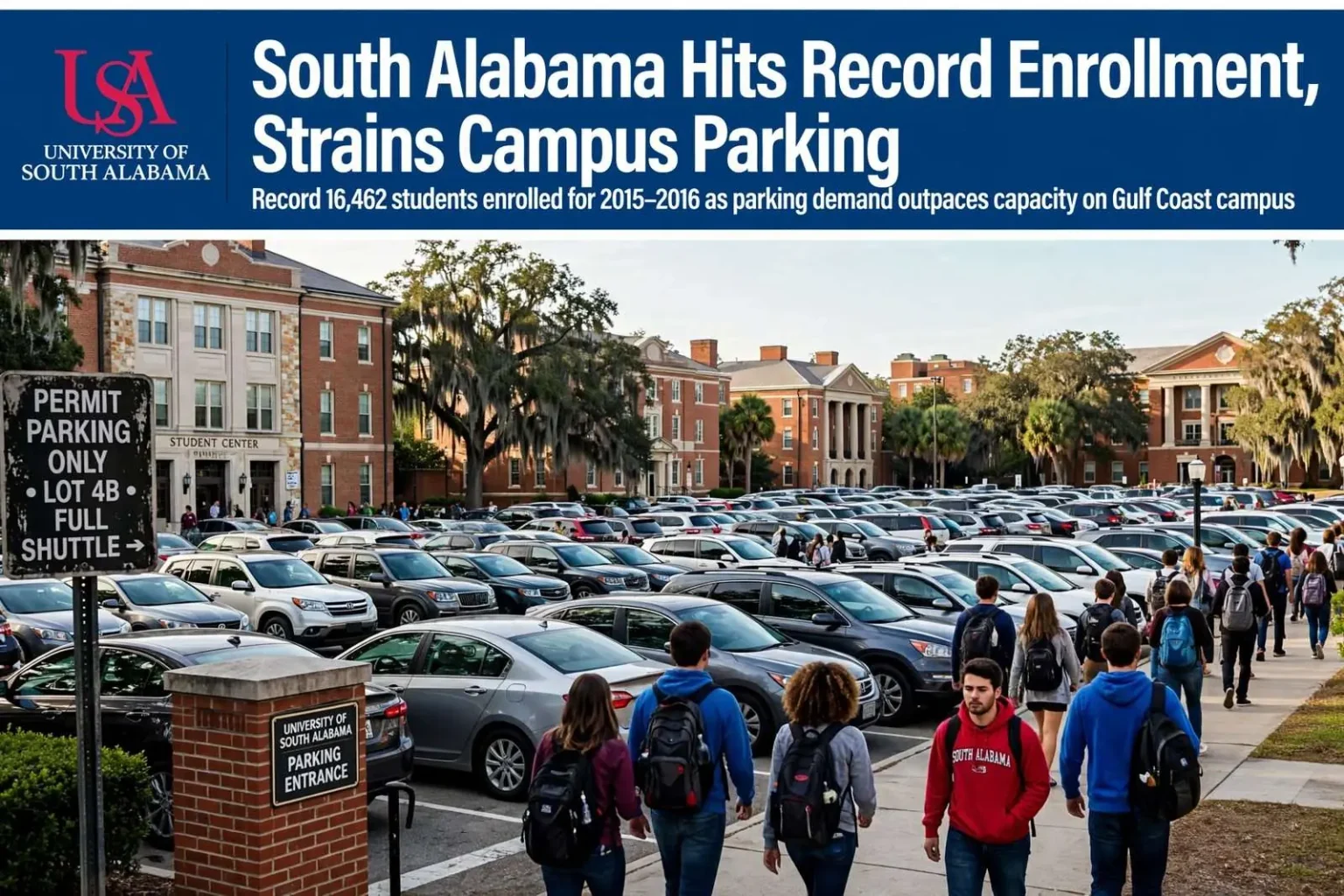
The University of South Alabama enrolled a record 16,462 students this fall, its largest freshman class ever, adding pressure to campus parking.
The University of South Alabama enrolled a record number of students for the 2015-2016 academic year, setting several new institutional marks even after officials had braced for a possible dip due to tougher admission standards. Total enrollment reached 16,462 students, according to a university spokesman, marking the largest overall student body in the school’s history. The incoming class also set records as the largest freshman class ever, the largest African-American student population on record, and the largest graduate enrollment the university has seen.
The growth comes just months after South raised its minimum admission requirements, increasing the required ACT score to 19 and the minimum GPA to 2.5. When those changes were announced in June, early projections suggested the tighter standards could shrink the incoming freshman class by roughly 300 students. Instead, enrollment climbed to new highs despite the higher bar for admission, a result that surprised even administrators who had spent the summer preparing for the opposite outcome.
University officials also reported an improvement in student retention, with 73 percent of the previous year’s freshman class returning for a second year. That figure represents an eight-point increase in retention over the past four years, a trend administrators have pointed to as evidence that recruitment and support efforts are paying off even as the university tightens who it admits.
Raising the Bar and Still Growing
The combination of record enrollment and tougher admissions is an unusual one in higher education, where raising standards typically costs a public university a slice of its applicant pool. South Alabama’s experience suggests the university’s popularity in the region had headroom to spare: enough qualified applicants existed along the Gulf Coast and beyond to fill a larger class even with the ACT and GPA floors moved upward. Administrators have framed the dual achievement as evidence that the institution is growing in quality and quantity at the same time, rather than trading one for the other.
The rising retention figure carries its own significance. A class that returns for its sophomore year at a 73 percent rate is a class that found its footing academically and socially, and every retained student represents tuition revenue that did not have to be replaced by new recruitment. The eight-point climb over four years is the kind of slow, compounding improvement that university presidents point to when defending investments in advising, tutoring and first-year programs.
The record African-American enrollment also reflects the university’s place in a majority-minority region. South Alabama draws heavily from Mobile, Baldwin and the surrounding counties, and a student body that mirrors its region is both a demographic reality and an institutional asset for a university whose graduates largely stay to staff the hospitals, schools and businesses of the Gulf Coast.
The Side Effect: Nowhere to Park
The surge in students has brought a familiar side effect for anyone who drives to campus: parking has become noticeably harder to find. Students and staff have voiced frustration over crowded lots and longer walks to class as the university works to keep pace with its growing population. The complaint is practically a rite of passage at growing American universities, but at South Alabama the growth has been fast enough that the strain is felt semester by semester rather than year by year.
Campus parking dynamics are unforgiving arithmetic. Every additional student who brings a car to campus competes for a fixed number of spaces, and commuter-heavy institutions like South, where a large share of students live off-campus, feel the squeeze most acutely during the morning class blocks. Lot assignments, permit pricing and shuttle routes are the usual levers, and each carries its own constituency of complaining students.
Housing pressure runs parallel to the parking problem. As more students choose to live on campus, residence halls fill earlier in the enrollment cycle, and the university’s ability to recruit from further away depends on having beds to offer.
To help address the university’s growing housing needs, the university’s board was expected to approve construction of a new residence hall at a meeting the same week enrollment figures were announced. The new hall is planned for the site of the former Delta 2 dormitories and is expected to follow a similar design to two of the university’s more recent residence halls, continuing the campus’s move toward newer, apartment-style student housing.
A University Built for Growth
South Alabama’s trajectory has been one of steady expansion since its founding in the 1960s, when the institution opened its doors to a small first class and grew into the comprehensive university that now anchors higher education in the Mobile area. Its academic medical enterprise, anchored by the USA Health System and the College of Medicine, gives the university an economic footprint in Mobile that reaches well beyond its student count, and its programs in engineering, nursing, education and business supply the region’s employers with a steady pipeline of graduates.
Record enrollment therefore matters to Mobile well beyond campus boundaries. Sixteen thousand students rent apartments, eat in restaurants, work part-time jobs and fill the city’s churches and volunteer organizations, and the university’s growth compounds the economic role it already plays as one of the area’s largest employers. City planners, landlords and business owners all feel a record class in their own spreadsheets.
The graduate enrollment record is a quieter but strategically important marker. Graduate students bring research funding, professional training partnerships and advanced degree programs that raise a university’s profile, and South’s health sciences programs in particular draw graduate enrollment tied to the region’s hospitals and clinics. Growth at that level signals a maturing institution rather than simply a bigger one.
What the New Residence Hall Means
The planned hall on the former Delta 2 site continues a building cycle that has reshaped student housing at South over recent years. Older dormitory designs, with long corridors and shared baths, have given way to newer residence halls built along suite and apartment lines that recruiting surveys show students and parents prefer. Reusing the Delta 2 site keeps the new construction inside the campus core, where residents can walk to class, dining and the student recreation facilities that factor heavily in housing choices.
New beds also feed the enrollment machine. Universities that cannot house their students watch commuter attrition eat into retention, and South’s rising retention numbers depend in part on students who live close enough to campus to be pulled into its academic and social life. The board’s expected approval, coming the same week as the enrollment announcement, paired the two stories deliberately: growth on one side of the ledger, capacity to handle it on the other.
Parking remains the harder problem to build out of. Residence halls add beds without adding road capacity, and the university’s options — new lots on the campus edge, expanded shuttle service, incentives to leave cars at home — each take time and money that compete with academic priorities. Administrators will be watching the lots as closely as the classrooms through the fall semester.
The Admissions Calculation Behind the Records
The decision to raise minimum admissions standards is one that public universities weigh carefully, knowing that access missions and enrollment revenue both pull against selectivity. South’s move to an ACT minimum of 19 and a GPA minimum of 2.5 was framed by administrators as a quality step: students admitted closer to a higher floor, the reasoning goes, are more likely to persist to graduation, which feeds the retention gains the university has been recording. The projections that suggested a 300-student freshman decline were the anticipated price of that policy.
That the price never came due says something about the university’s recruiting reach. South Alabama draws from a broad Gulf Coast footprint — Mobile and Baldwin counties, the Florida Panhandle, Mississippi and Louisiana — and its out-of-state recruiting has pushed into markets where the university’s scholarship packages and health sciences programs carry real drawing power. Applicants who in earlier years might have been borderline admits were evidently replaced by qualified applicants who chose South over competitors.
The record freshman class arrived into a campus that has visibly reinvested in itself over recent years, from housing and recreation facilities to the athletics momentum that followed the university’s move into top-level football competition. Prospective students tour campuses and make decisions based on what they see, and South’s facilities story has been part of the pitch for the better part of a decade.
The Retention Story Behind the Headlines
The 73 percent retention figure deserves as much attention as the enrollment records, because retention is where universities quietly win or lose. A student who returns for a second year is a student who passed the gateway courses, found an advisor who knew their name and decided the investment was worth continuing. The eight-point gain over four years represents hundreds of additional students each cycle who stayed rather than stopped out, and each of those students compounds through the graduation statistics that follow.
Universities drive retention through unglamorous machinery: early-alert systems that flag struggling students in the first weeks, supplemental instruction in the courses that fail the most students, structured advising and first-year seminars. South’s improvement suggests those systems have matured during the same window in which admissions standards rose, a combination that reinforces itself — better-prepared admits are easier to retain, and better retention programs rescue the marginal ones.
Looking Ahead From a Record Year
The challenge ahead for South Alabama is the pleasant kind: managing success. A 16,462-student university strains every service it provides, from parking lots to advising appointments to seats in high-demand courses. The new residence hall will relieve housing pressure when it opens, but the university’s planning cycle — capital projects take years from approval to occupancy — means administrators are already planning for enrollment numbers that have not yet materialized.
For Mobile, the record year reinforces the university’s role as one of the city’s essential institutions. A bigger student body means a bigger talent pipeline into the local workforce, more activity around the campus and medical center, and a stronger case for the public and private investment that follows growing institutions. The parking frustration students felt in the first weeks of the fall semester is, in that light, a byproduct of the best problem a university can have.