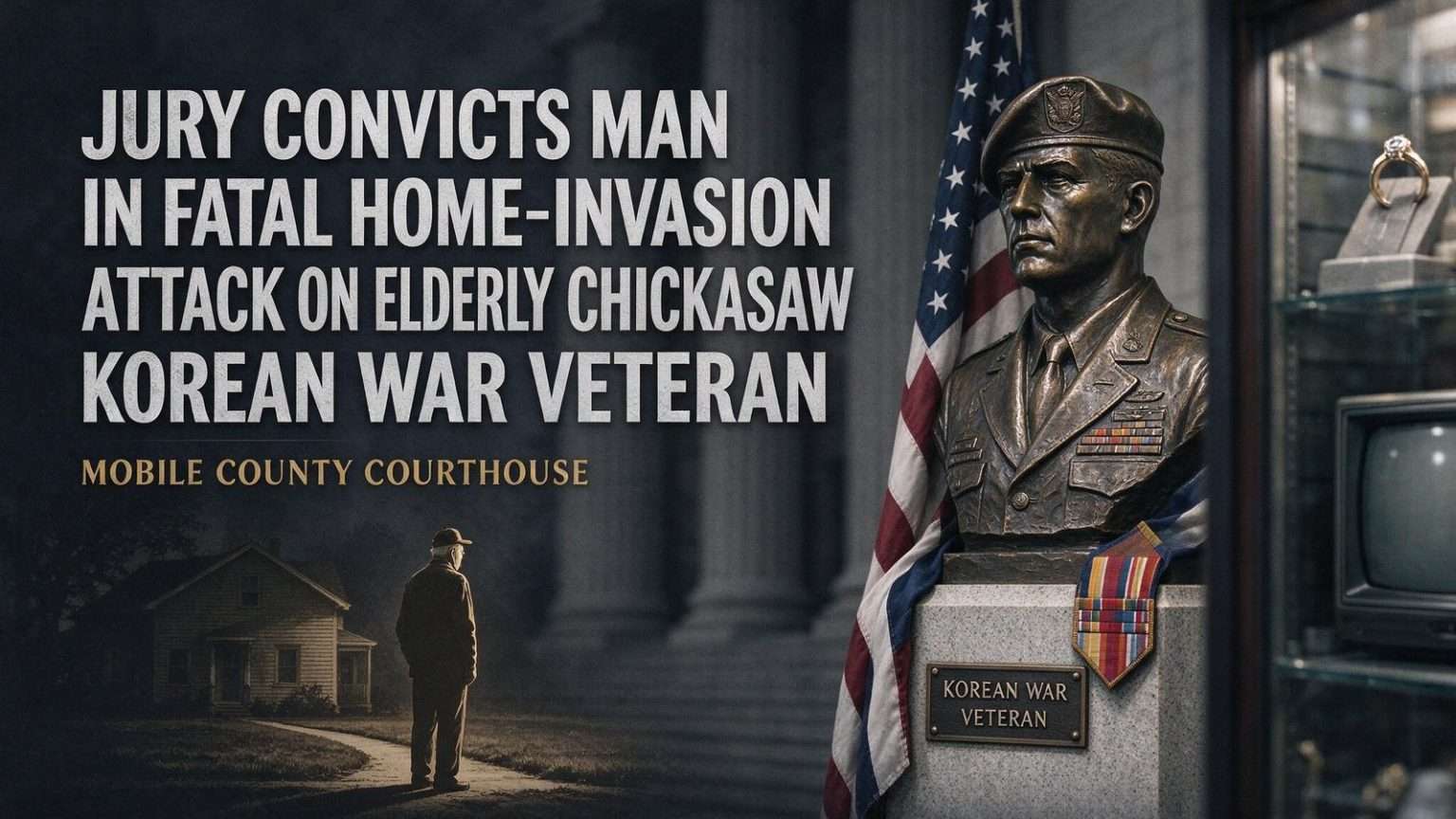
Jury Convicts Man in Fatal Home-Invasion Attack on Elderly Chickasaw Korean War Veteran
A Mobile County jury convicted a man in the fatal home-invasion attack on an elderly Chickasaw Korean War veteran in a case that drew wide local attention.
A Mobile County Circuit Court jury has convicted one of three defendants charged in connection with the death of an 86-year-old Chickasaw man who was attacked in his own home during a burglary that authorities say began as a search for cash and valuables to fund a drug habit. The victim, a Korean War veteran, was assaulted in January 2014 when intruders forced their way into his residence. According to prosecutors, he was beaten, choked and stabbed multiple times during the attack. He survived for nearly two weeks before dying at a Mobile hospital while undergoing surgery related to complications from the assault.
Court records show the attackers made off with the victim’s wedding ring, which they later pawned for a small sum of cash. Prosecutors said the group also attempted to steal a flat-screen television from the home but abandoned it in the backyard as they fled. The stolen ring money, according to testimony, was used to buy food and drugs. The smallness of the take — a pawnshop payout on a wedding ring — against the scale of the violence has been the detail prosecutors and investigators alike have returned to throughout the case: an elderly man’s life traded for an amount of money that would not cover a week’s groceries.
One Conviction, Two Cases Still Pending
Of the three people charged in the case, one has now been found guilty by a jury on burglary and attempted murder charges. A second defendant is scheduled to stand trial later this spring, while the third defendant previously pleaded guilty and was sentenced to two concurrent life terms in prison. The prosecution has therefore moved along three separate tracks — a plea, a conviction at trial, and a pending case — each requiring the same witnesses and the same painful evidence to be presented to a different set of jurors.
Because the victim survived for nearly two weeks after the attack before dying, the legal architecture of the case was shaped from the start by questions of causation and timing — which is how a case that ended in a death produced an attempted murder conviction at trial. Prosecutors tied the fatal surgery directly to the injuries inflicted during the January assault, and the jury’s verdict reflects that chain: the home invasion, the beating, the choking and the stabbing that followed were, in the state’s theory and evidently the jury’s view, the cause of everything that came after.
The Victim the Community Remembered
Mobile County District Attorney Ashley Rich, who prosecuted the case, described the victim as a gentle, well-liked figure in his community who had spent his later years quietly helping neighbors. She said the brutality of the attack against a defenseless elderly man made the case especially difficult for investigators and prosecutors to process. Prosecutors’ offices handle difficult cases routinely, but the ones that stay with staff — as veteran prosecutors often note — are the ones where the victim’s vulnerability and the meagerness of the motive sit in such stark contrast.
The case drew significant attention in the Chickasaw community, where neighbors described the victim as a longtime fixture known for his kindness. His military service during the Korean War was frequently cited by those who knew him as a source of pride, and community members expressed shock that a home invasion targeting an elderly veteran could happen in their neighborhood. Chickasaw — a small city in northern Mobile County that incorporated in 2008 and has worked hard to build its own identity, police force and civic institutions since — treated the January attack as a violation of exactly the small-town closeness the community prizes.
The loss of the wedding ring carried its own weight in a close-knit community. Neighbors spoke of a man whose decades of marriage were part of the story of his life in Chickasaw, and the image of that ring sitting in a pawnshop while he fought for his life in a Mobile hospital became, for many residents, the shorthand for everything wrong about the crime. That pawnshop record also became evidence, connecting the defendants to the scene and giving investigators a documented trail from the home invasion to the getaway.
Inside the Prosecution
For the trial team, the evidence carried the weight of the attack itself. Medical testimony traced the progression from the January assault — blunt force, strangulation and multiple stab wounds — through the complications that led to surgery and death, establishing for jurors the full medical chain between the intruders’ entry and the victim’s death. Testimony about the pawned ring, the abandoned television in the backyard and the use of the proceeds filled in the picture of a crime committed for trivial gain and executed with staggering carelessness for human life.
Rich’s office has made crimes against the elderly a visible priority in recent years, and prosecutors frequently note that elderly victims are targeted precisely because attackers assume they cannot resist, cannot identify their assailants and may not survive to testify. In this case the victim survived long enough for investigators to work the scene, trace the pawned ring and develop the case against all three defendants, and the evidence assembled in those two weeks carried the jury that has now convicted the first defendant and will carry another this spring.
Sentencing and What Comes Next
Sentencing for the defendant convicted at trial is expected to be scheduled in the coming weeks. Prosecutors have indicated they intend to seek significant prison time given the severity of the injuries inflicted and the vulnerability of the victim. Under Alabama law, the felony convictions carry sentencing ranges that give the judge substantial discretion, and the state’s filing will press for a term that reflects both the severity of the attack and the vulnerability of an 86-year-old victim living alone.
The pending trial of the second defendant will bring the community back through the same evidence, and the already-sentenced codefendant’s two concurrent life terms establish the practical ceiling the state will be pointing toward. Families of the victim will attend all of it, as they have since January 2014, watching the system assign responsibility piece by piece for a death that began with intruders forcing their way into an old man’s house.
The case serves as a reminder of the risks facing elderly residents living alone, and Mobile County law enforcement officials have periodically urged neighbors and family members to check in regularly on older residents, particularly those who live independently in their own homes. For Chickasaw, the conviction is a measure of justice — with more to come this spring — but the neighborhood’s own answer to the crime has been the kind community prosecutors always describe: watching out for the veterans and widows on their streets, and refusing to let an 86-year-old neighbor’s death be the last word about who they are.
How the Case Unfolded
The home invasion itself began, according to the state’s account, as a burglary driven by a drug habit — intruders looking for cash and valuables in the home of an elderly man they apparently believed would be an easy mark. When the attack ended, the intruders left through the same door they forced, pausing only to drop a flat-screen television in the backyard as they fled. What they took was a wedding ring from the finger of a veteran of the Korean War, and what they left behind was a crime scene that Mobile County investigators would spend the following weeks turning into a three-defendant prosecution.
The investigation moved quickly enough that three people were charged, one pleaded guilty early enough to receive a life sentence before the trial docket moved, and the two remaining cases were separated for trial. That sequencing — plea first, then trials — is the standard path for multi-defendant violent cases, and it gave the first trial jury a record already shaped by a codefendant’s conviction. The life terms handed down in the plea are the benchmark against which the sentencing judge, and the public, will measure the outcome of the trial that just concluded.
What It Means for Chickasaw
For the city of Chickasaw, the verdict closes one chapter of a case that has hung over the community since the January morning when police and medics first responded to the victim’s home. The city, which operates its own police department and has invested heavily in its civic life since incorporating, saw the attack as an assault on a neighbor who had spent his later years doing what the city values most — looking after the people around him. Residents filled the roles that small communities fill in such cases: providing information, supporting the family, and following the court proceedings from arraignment through verdict.
The coming spring trial will bring the case back into public view, and the sentencing of the first convicted defendant will give the community its first formal accounting of punishment in the death. Whatever sentences emerge, the arc of the case has already established its own lesson for the region: that an attack on an elderly resident in his own home will be investigated, prosecuted and tried to conclusion, and that the pawnshop transaction that seemed like easy money to the attackers became the thread that unraveled all three of them.